Beställningsvara. Skickas inom 7-10 vardagar. Fri frakt för medlemmar vid köp för minst 249 kr.
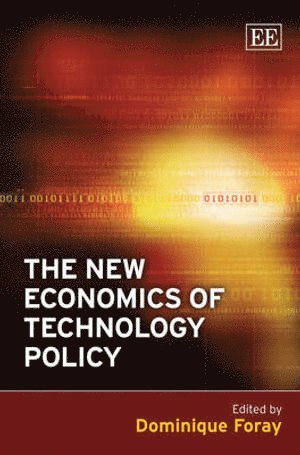
This innovative book comprehensively sheds light on the theory and practice of technological policies by employing modern analytical tools and economic techniques. The New Economics of Technology Policy focuses on all public interventions intended to influence the intensity, composition and direction of technological innovations within a given entity such as a region, country or group of countries. Dominique Foray has gathered together many of the leading scholars in the field to comprehensively explore numerous avenues and pathways of research.Bringing together a collection of policy-oriented papers, this book will strongly appeal to policy-makers, academic researchers and graduate students with an interest in economics, public policy, science, technology and society.
Edited by Dominique Foray, Professor of Innovation Economics, College of Management, Ecole Polytechnique Fédérale de Lausanne, Switzerland
Contents:1. General IntroductionDominique ForayPART I: FRAMEWORKS AND RATIONALES FOR TECHNOLOGY POLICY2. Building Effective ‘Innovation Systems’ versus Dealing with ‘Market Failures’ as Ways of Thinking About Technology PolicyRichard R. Nelson 3. Technology Policy: The Roles of Industrial Analysis and Innovation StudiesW. Edward Steinmueller 4. Increase Learning, Break Knowledge Lock-ins and Foster Dynamic Complementarities: Evolutionary and System Perspectives on Technology Policy in Industrial DynamicsFranco Malerba 5. Can we Link Policy Practice with Research on ‘STIG Systems’? Toward Connecting the Analysis of Science, Technology and Innovation Policy with Realistic Programs for Economic Development and GrowthPhilippe Aghion, Paul A. David and Dominique Foray6. CommentsDietmar Harhoff PART II: HOW MUCH AND WHERE?7. Critical Episodes in the Progress of Medical InnovationNathan Rosenberg8. A Policy-shaped Research Agenda on the Economics of Science and TechnologyIrwin Feller9. Basic Research and Growth PolicyHans Gersbach 10. CommentsMark Schankerman 11. Comments on Nathan Rosenberg’s ‘Critical Episodes in the Progress of Medical Innovation’ Iain M. Cockburn PART III: RATIONALES FOR AND MODES OF MISSION-ORIENTED POLICIES12. What Does Economic Theory Tell us About Mission-oriented R&D?David C. Mowery 13. The Dismal Science, the Crown Jewel and the Endless FrontierBhaven N. Sampat 14. CommentsW. Edward Steinmueller PART IV: THE USE OF MODELS AND SURVEYS FOR TECHNOLOGY POLICY15. The ‘Funding Gap’: Financial Markets and Investment in Innovation Bronwyn H. Hall 16. R&D Investment Under Uncertainty: The Role of R&D Subsidies and Patent PolicyDirk Czarnitzki and Andrew A. Toole 17. Innovation Surveys and Innovation PolicyJacques Mairesse and Pierre Mohnen PART V: TECHNOLOGY POLICY IN SWITZERLAND18. How Effective are the R&D-Promoting Activities of the Swiss Innovation Agency CTI? An Evaluation Based on Matched-pairs AnalysisSpyros Arvanitis and Nora Sydow 19. Characteristics of Foreign R&D Strategies of Swiss Firms: Implications for PolicyHeinz Hollenstein 20. Small and Medium-sized Enterprises: The Promotion of R&D and Innovation Behaviour in SwitzerlandBeat Hotz-Hart PART VI: TECHNOLOGY POLICY IN THE EUROPEAN UNION21. Nature of the European Technology Gap: Creative Destruction or Industrial Policy?David Encaoua 22. Innovation, Growth and Structural Reforms: What Role for EU Policy?Reinhilde Veugelers PART VII: TECHNOLOGY POLICY AND NEW MODELS OF INNOVATION23. Adapting Policy to User-centered Innovation Eric von Hippel 24. Technology Policy, Cooperation and Human Systems DesignYochai Benkler 25. CommentsDavid Encaoua PART VIII: TECHNOLOGY POLICY FOR DEVELOPMENT26. Innovation Policy for Development: An OverviewManuel Trajtenberg 27. Discussion of Manuel Trajtenberg’s ‘Innovation Policy for Development: An Overview’Richard R. Nelson PART IX: CONCLUSIONS28. Research Without FrontiersLuc Soete 29. The Rumblings of a Paradigm Shift: Concluding CommentsManuel TrajtenbergIndex