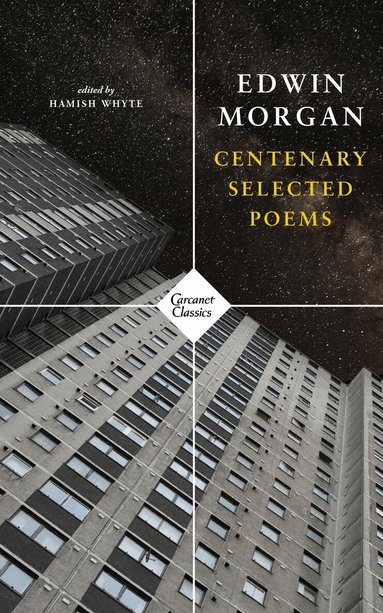
Home in Space
- Nyhet
Selected Concrete, Visual and Sound Poetry
Inbunden, Engelska, 2026
849 kr
Kommande
Produktinformation
- Utgivningsdatum2026-06-01
- Mått156 x 234 x undefined mm
- Vikt454 g
- FormatInbunden
- SpråkEngelska
- Antal sidor336
- FörlagReaktion Books
- ISBN9781836391968
Tillhör följande kategorier
Greg Thomas (Anthology Editor) Greg Thomas is a writer, critic, poet and artist based in Glasgow, Scotland. He is the author of Border Blurs: Concrete Poetry in England and Scotland (2019) and has written extensively on visual and concrete poetries, text art and multimedia art.Julie Johnstone (Anthology Editor) Julie Johnstone is an artist, curator, editor and publisher based in Edinburgh, Scotland. She was previously the Head Librarian of the Scottish Poetry Library and established and curated the Edwin Morgan Archive at the Library.
"Edwin Morgan’s is the kind of poetry I want. A Home in Space is a multiverse chock full of concrete word-patterning, sound-ups and cut-ups, galaxies and constellations, collages, overlays, typographic arrays, acoustic riffs, lettrist elations and noncesensical confabulations, graphic designs, ur-computer inventions, and iconoclastic ads and icons. Greg Thomas and Julie Johnstone’s detailed, historically informative, and discerning introduction sets the stage for Morgan’s verbo-visual-vocal – patalexical! polychromatic! – lollapalooza of a book." - Charles Bernstein, Donald T. Regan Professor Emeritus of English and Comparative Literature, University of Pennsylvania"A perfect introduction to this transformative painter . . . this book has no rivals." - Larry Silver, Sixteenth Century Journal"A superb new book on medieval food . . . lavishly illustrated." - Sunday Telegraph"No one can say anything sensible about undocumented artworks without connoisseurship. This practice relies exclusively on judgments based on comparisons informed by feats of visual memory. But those judgments follow rules that do not necessarily capture actuality. It has taken an historian of Peter Burke’s acuity to analyze the development of a form of attention–connoisseurship that relies on questionable rules unacknowledged by those who follow them. Burke’s tour d’horizon is a tour de force." - Ivan Gaskell, Bard Graduate Center"This bold and ambitious book brings to life the horse-riding peoples of the Eurasian steppe while also exploring the political conditions that have shaped their discovery and study from Imperial Russia to the present. It offers a nuanced account of Western, Russian, and Ukrainian scholarship, presenting major anthropological theories accessibly and vividly illustrating how textual sources and archaeology together illuminate the past." - Karen S. Rubinson, Research Associate, Institute for the Study of the Ancient World, New York University"What a wonderful book this is, chock-full of mystery and magic. Promising to take the reader “on a seafaring voyage”, it delivers on all fronts. Beautifully written, engaging throughout and wonderfully illustrated, we encounter the “merfolk, ghosts, phantom ships and sea monsters” that have populated folklore tales, myths, legends and dreams for centuries. Take a dive into The Perilous Deep with Karl Bell, who brings exemplary scholarship as well as storytelling flair to the lightless depths of the “supernatural and monstrous Atlantic”." - Ruth Heholt, Professor of Literature and Culture, Falmouth University"Not only does Karl Bell’s new book provide a colourful compendium of the “merfolk, ghosts, phantom ships and sea monsters” that have populated the seafaring folklore of the Atlantic nations for centuries, he also looks at how and why these tales came into being, and how they evolved and mutated as they were transmitted from place to place over time." - Roger Cox, The Scotsman"Brahms’s later life is well known, but we hear less about the young dynamo whom Joseph Joachim described in 1853 as “this green-gold baby tiger”. In this sympathetic and level-headed biography, John Worthen traces Brahms’s early influences, delves into the complexities of his long relationship with Clara Schumann and explores the cast of mind which led him to remain “free but lonely”." - Susan Tomes, pianist and writer"More than a compendium of maritime folklore, The Perilous Deep explores how mariners and landlubbers alike have used storytelling to make sense of their relationship to the sea. Engaging with the godlings, leviathans, ghost ships, serpents, selkies and mermaids that haunt the Atlantic, Karl Bell shows that while the ocean can be a place of terror, it is also a place of possibility." - David Hopkin, Professor of European Social History, Hertford College, University of Oxford, and President of the Folklore Society". . . presenting meticulous research into the folklore that has bound maritime and coastal communities on both sides of the Atlantic . . . Bell’s research is presented with all the scholarly hallmarks one would expect, including caveats about the reliability of sources and references to other academics . . . For Bell, ancient mariners’ tales and practices can ‘teach us how to confront our own environmental fears as we attempt to navigate the turbulent currents of an uncertain future’." - Mark Nayler, Times Literary Supplement"Peter Burke sheds light on one of the most enigmatic and captivating aspects of the history of art." - Paolo Coen, University of Teramo"Oh no! Not whole-roasted ox again! Even for the aristocracy, medieval fare must have been boring, it's been assumed. The reality was quite otherwise, Hannele Klemettilä reveals. This social history with recipes is as delicious in its details as it is mouthwatering in its presentation . . . More enterprising readers may want to take a stab at some of the 60-odd recipes in which Klemettilä serves up a splendid banquet of forgotten flavours." - The Scotsman"Highly evocative, insightful and utterly compelling, Caspar Meyer’s fascinating reassessment of Scythian civilization reshapes our understanding of how Scythian nomads experienced their world. A masterful and often intimate portrait of steppe nomad society, Meyer’s book challenges modern preconceptions and assumptions concerning both their way of life and our own. An astonishing tour de force." - Joseph Skinner, Senior Lecturer in Ancient Greek History, Newcastle University"This eagerly awaited study is a veritable triumph. Greg Thomas’s fine introduction ranges seamlessly over the intricate details of Morgan’s multifaceted career as a poet. The decision to reproduce many of the poetic texts in the versions that Morgan himself devised enhances the book’s historical importance." - Stephen Bann, Emeritus Professor of History of Art, University of Bristol, and editor of Concrete Poetry: An International Anthology (1967)"This book is very readable, well balanced and highly focused, leaving the mature master to speak for himself. Essential Brahms reading that will appeal to a wide range of readers, musical or not." - Michael Musgrave, The Juilliard School, author of The Life of Schumann"Acres’s thoroughly enjoyable and readable account of Jan van Eyck and his art is the perfect introduction to this artist for students and aficionados alike. As is the case with all good books, it raises many questions and urges the reader to seek out answers in the still forthcoming scholarly literature on Van Eyck’s production." - Maryan Ainsworth, Historians of Netherlandish Art Reviews"Klemettilä, who skates across the whole of continental Europe in The Medieval Kitchen . . . reveals the delicacy, craft and complexity that underpinned medieval food . . . the book puts us in touch with an essential element of medieval culture and shows how it shaped that world. In helping to restore its reputation [she] also helps to further repair the standing of an age whose rich sophistication is too often unfairly sneared." - TLS"This is a history of margins and fringes – not only of the Atlantic Ocean itself, but also of the imaginations of those who worked on its surface and lived at its edges. In his new book, Karl Bell draws on everything from street ballads to scientific treatises, mariners' memoirs, newspaper advertisements, paintings and literature . . . this is an uncanny cornucopia of folklore, hovering on the borderlands between fact and fiction . . . This is a tale that grows stronger in the telling, and it is perhaps in the later chapters that Bell's writing is at its most sparkling ." - Eleanor Barraclough, BBC History Magazine"This magisterial history of social connoisseurship by a leading cultural historian covers the field in the last 500 years. Following the codification of the methodology in the 17th and then in the 18th century Peter Burke presents a rich insight and critical assessment of the achievement, as well as the limitations, of the methodology in the development of modern art history over the last 200 years." - Jean Michel Massing, King's College, Cambridge"In this absorbing and entertaining survey, Karl Bell explores how the fear of and fascination with the vastness and unknowable depths of the North Atlantic Ocean were expressed through beliefs and stories of the supernatural. The meaning of spectral ships, omens, talismans, taboos, mermaids, sea monsters and Atlantis are explored using a rich range of sources from journalism, folklore and fiction." - Owen Davies, Professor of Social History, University of Hertfordshire"By showing his works as a series of encounters, Acres demonstrates how Van Eyck crafted his paintings to actively engage with the audience, a novel concept in European art, where physical and psychological boundaries were beginning to dissolve via a pervasive realism that could only be fully accomplished by the most skilled artists." - Choice"By way of clever observations and pictorial analysis, this eloquently written monograph is highly commendable. It offers a concise introduction to the work of one of the most influential Renaissance artists of his time and addresses in eight chapters the career and clusters of Van Eyck's paintings. Alfred Acres presents impressively erudite perspectives and refreshingly balanced views on even some of the most persistent problems in art history like the authorship of the Ghent Altarpiece. It will be welcomed by the general reader and will inspire specialists to think anew." - Till-Holger Borchert, Director of Suermondt-Ludwig-Museum, Aachen"What a wonderful book this is, chock-full of mystery and magic. Promising to take the reader “on a seafaring voyage”, it delivers on all fronts. Beautifully written, engaging throughout and wonderfully illustrated, we encounter the “merfolk, ghosts, phantom ships and sea monsters” that have populated folklore tales, myths, legends and dreams for centuries. Take a dive into The Perilous Deep with Karl Bell, who brings exemplary scholarship as well as storytelling flair to the lightless depths of the “supernatural and monstrous Atlantic”." - Ruth Heholt, Professor of Literature and Culture, Falmouth University"Not only does Karl Bell’s new book provide a colourful compendium of the “merfolk, ghosts, phantom ships and sea monsters” that have populated the seafaring folklore of the Atlantic nations for centuries, he also looks at how and why these tales came into being, and how they evolved and mutated as they were transmitted from place to place over time." - Roger Cox, The Scotsman"[Klemettilä] presents a fascinating picture of a very different mindset when it comes to food and inspired me to get a taste of those forgotten flavors . . . While my palate may not be able to take on an all-medieval diet, it was still a fun, experiential way to encounter another age. The recipes will be worth returning to occasionally, a little pinch of history to season my 21st-century table." - National Catholic Reporter"Peter Burke’s brilliant and entertaining study provides a longue durée history of connoisseurship. From its origins among Renaissance artists judging one another’s work to the era of experts with immense memories, forensic powers of scrutiny, fearless chutzpah and, on occasion, malleable morals, it brings the story right up to date, examining how technical analysis, archival research, and artificial intelligence have joined—but not wholly replaced—the discerning eye. With his usual lucidity and balance, Burke queries the method of connoisseurship but does not deny its successes." - Paul Taylor, Warburg Institute"The Medieval Kitchen is an admirable effort to elucidate how and what European peoples ate during the late Middle Ages. The author's goal is to move medieval food history away from an emphasis on the elaborate feasts of the aristocracy to a discussion inclusive of the food cultures of agricultural and ruling classes . . . The volume is filled with illustrations from medieval books of hours and other manuscripts informative captions accompanying each illustration give historical context. This book is an ideal introduction to the topic for both students and adventurous cooks. Highly recommended" - Choice"More than a compendium of maritime folklore, The Perilous Deep explores how mariners and landlubbers alike have used storytelling to make sense of their relationship to the sea. Engaging with the godlings, leviathans, ghost ships, serpents, selkies and mermaids that haunt the Atlantic, Karl Bell shows that while the ocean can be a place of terror, it is also a place of possibility." - David Hopkin, Professor of European Social History, Hertford College, University of Oxford, and President of the Folklore Society"A wonderful new contribution to the literature on this most extraordinary and engaging of artists. Throughout the pages of this beautifully written book we are offered an excellent synthesis of the long historiography on Van Eyck and a detailed and up-to-date engagement with the most recent research and publications on his work. Alfred Acres invites us to see what this supremely inventive artist was seeking to do with his arresting depictions, and aims to give meaning to the many astounding and delightful details of Van Eyck’s work. This is a study not only of Van Eyck as an individual, but of Van Eyck’s interests, talents, inventiveness and commitment to communication and signification, by looking not just at, but within the art of Van Eyck." - Beth Williamson, Professor of Medieval Culture and Chair in the History of Art, University of Bristol"In this absorbing and entertaining survey, Karl Bell explores how the fear of and fascination with the vastness and unknowable depths of the North Atlantic Ocean were expressed through beliefs and stories of the supernatural. The meaning of spectral ships, omens, talismans, taboos, mermaids, sea monsters and Atlantis are explored using a rich range of sources from journalism, folklore and fiction." - Owen Davies, Professor of Social History, University of Hertfordshire