Beställningsvara. Skickas inom 5-8 vardagar. Fri frakt för medlemmar vid köp för minst 249 kr.
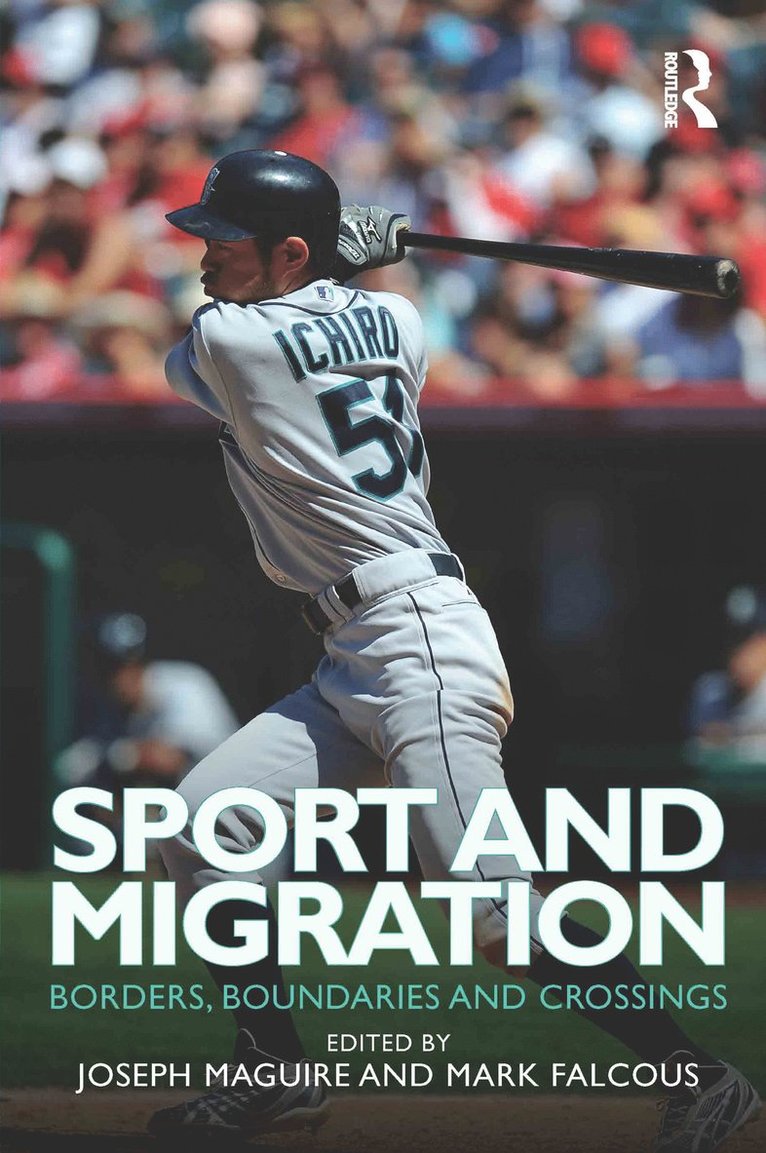
This insightful Handbook explores how sport intersects the experiences of asylum seekers, refugees, workers and migrants. Editors Joseph Maguire, Katie Liston and Mark Falcous bring together esteemed experts to capture the complex dynamics surrounding how sport migrations are embedded in the wider power struggles that characterize global sport.Analysing a range of case studies across the globe, chapter authors examine the control exercised by various stakeholders, both sporting and non-sporting, and how their actions contour migration experiences. They cover matters such as globalization, national identity, and intercultural communication, as well as in-depth issues including talent pipelines, bridgeheads and the stereotyping of athletes from different class, ethnic and gender groups. The dynamics of sports migration are highlighted when revealing the tensions concerning the promotion of commercial spectacle versus the advocacy of national and local identities, and the search for short term viability versus longer term development.The Handbook on Sport and Migration is invaluable for students and scholars of sport law, sociology, migration, policy and globalization. It will also appeal to those working in sport management, sport psychology, exercise sciences, kinesiology, and international migration policy.
Edited by Joseph Maguire, Emeritus Professor of Sociology of Sport, Loughborough University, UK, Katie Liston, School of Sport, Sport and Exercise Sciences Research Institute, Ulster University, Belfast, Northern Ireland and Mark Falcous, School of Physical Education, Sport and Exercise Sciences, University of Otago, New Zealand
ContentsIntroduction: making sense of sport, space, place, identities and migration 1Joseph Maguire, Katie Liston and Mark FalcousPART I SPORTING MOBILITIES: CONTINUITY AND CHANGE1 Geography, migration and sport 11Nicholas Wise2 Football mobilities: a global player transfer market 22Rafaelle Poli, Roger Besson and Loïc Ravenel3 Soccer migration from Trinidad and Tobago: the case of the NASL, 1968–1984 38Roy McCree4 Athletes’ migration in Brazil: social inequality and intersectionality aspossible analytical dimensions 49Renato Francisco Rodrigues Marques and Wanderley Marchi Júnior5 Sport labour migrants out of Africa 62Jepkorir Rose Chepyator-Thomson, Abdulsamad Yusuf, Sean Seiler andChenelle Goyen6 Fijian migrant athletes in the world of professional rugby 73Dominik Schieder7 Exceptionalism and sport migration: the North American perspective 86Alan KleinPART II SPORTING SPACES, PLACES AND IDENTITIES8 Sport, migration and gender 96Sine Agergaard9 ‘A field of broken dreams?’: the precarious social realities of malemigrant footballers from Northern Ireland 104Ryan Adams, Paul Darby and Katie Liston10 “Outsiders within”: sport, naturalisation, and the construction of blackKorean runners 114Yeomi Choi11 International student-athletes and the basketball world system: Africantalent pipelines and Japanese pathways 123Naoki Chiba and Mark Falcous12 Sports migration to Gulf Cooperation Council states: the intersection ofeconomic growth and sport development 140Mahfoud Amara and Gerard Akindes13 Navigators for the new millennium: towards a view of the globalSamoan sports diaspora 150Lisa Uperesa14 Cultural hybridity, simultaneous embeddedness and the complexities ofcapoeira in New Zealand 162Janelle Joseph and Mark FalcousPART III GOVERNANCE, REGULATION AND BOUNDARIES15 Sport, migration, nation-states, and the sports-medical industrial complex 176Joseph Maguire16 From imported athletes to home-grown talents: long-term residents inQatari national sports teams 187Zahra Babar and Danyel Reiche17 Regulation or encouragement? China’s labour migration policies fortable tennis, basketball and football players 197Yu-Wen Chen and Tien-Chin Tan18 African football labour migration: governance, impact, and consequences 207Wycliffe W. Simiyu Njororai19 The diversification of the composition of national football teams 218Gijs Van Campenhout20 Import–export value variance in Czech sport 229William Crossan21 Out of control: professional footballers, migration, and theconsequences for mental health 242Richard ElliottPART IV IMMIGRATIONS, REFUGEES AND CONTROLS22 Informal sport migration as a process of becoming: a digitalethnography of young Gazan parkour athletes 253Holly Thorpe23 Moving through paradox: forced migration, liminality, and sports 265Maikel Waardenburg24 Trying to insert themselves as a square peg into a round hole:experiences of newcomers as coaches in the Canadian amateur sport system 274Lori A. Livingston25 Sport, return visits and transnational identity: South Korean-NewZealanders’ participation in the Korean National Sports Festival 285Ik Young Chang, Kyu Jin Jin and Steven J. Jackson26 Sport, refugees and forced migration: critical dialogues and questionsamid diminishing rights and expanding borders 295Nicola De Martini Ugolotti27 Children’s rights, sport and migration 307Eleanor Drywood, Paul Darby, James Esson, Carolynne Mason and SerhatYilmaz
‘Edited by three of the most influential scholars in the global sociology of sport, the Handbook on Sport and Migration is a definitional text in the sub-field. Taking as the central foci how global sports systems are foundationally based on the flow of athletes between nations, and how such fluidity veritably shapes contemporary constructions of nationhood, space, boundaries, labour, economics, and identity/selfhood, the collection showcases theoretically compelling and substantively rich case studies from around the sporting globe. Handbook on Sport and Migration presents the most nuanced, comprehensive, comparative, and inclusive collection on sport migration from the micro-contextual to the transnational. As such, it is a clarion call for anyone fascinated with global sports studies.’