Beställningsvara. Skickas inom 7-10 vardagar. Fri frakt för medlemmar vid köp för minst 249 kr.
The Handbook on Gender and Security presents a comprehensive overview of the connections between gender and (in)security in international relations. Authors from various disciplines showcase their innovative research, illustrating how past and recent developments have shaped our understandings of this relationship.Contributors adopt novel theoretical approaches and empirical methods to explore the effects and dynamics of security threats. They highlight the significant diversity in definitions of both gender and security, introducing refined ways of understanding the connection between the two, focusing on topics including war, violence, climate change, pandemics, and criminal networks, as well as feminist action. The Handbook identifies fruitful avenues for future research in the field, surveying gender-related security policy at the international, national and regional levels.The Handbook on Gender and Security is an essential resource for students and scholars of International Relations, Security Studies, and Gender Politics. It is also a vital read for policy-makers seeking to understand the significant impact of gender on experiences of and vulnerabilities to security threats.
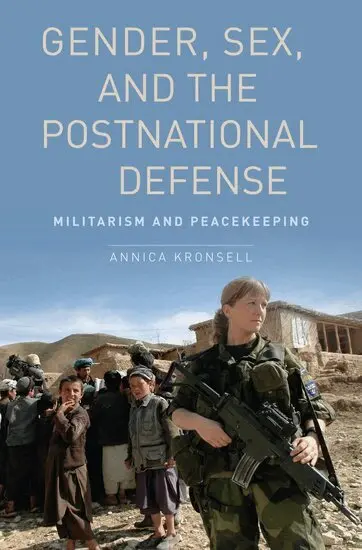
Edited by Jutta Joachim, Associate Professor of Global Security Governance, Department of Political Science, Radboud University, the Netherlands, Annica Kronsell, Professor of Environmental Social Science, School of Global Studies, University of Gothenburg, Sweden and Natalia Dalmer, Post-Doctoral Researcher, Institute of Political Science, Leibniz University Hannover, Germany
Contents1 Introduction: mapping the gendered dimensions of global (in)securities inthe 21st century 1Jutta Joachim, Annica Kronsell and Natalia DalmerSECTION ONE GENDER AND (IN)SECURITY2 Disrupting gender in feminist security narratives 11Leena Vastapuu and Annick T.R. Wibben3 Sex, gender, sexuality and international in/security 23Luise Bendfeldt and Laura Sjoberg4 Ontological insecurity and the gendered postcolonial subject 38Catarina Kinnvall and Christine Agius5 Feminist geopolitics: gender and the everyday production of insecuritythrough public information campaigns 506 The European Union as an intersectionally gendered security actor: towarda feminist postcolonial research agenda 62SECTION TWO FEMINISM, GENDER, AND FOREIGN POLICY7 Interrogating the ‘feminist’ in feminist foreign policy 78Karoline Färber and Jennifer Thomson8 Researching feminist foreign policy in militarising times 88Annika Bergman Rosamond9 The EU’s external LGBT+ rights promotion and the promise of gender(ed)equality 100Markus Thiel10 The transformative potential of feminist foreign policy:is there hope? 112SECTION THREE GENDER(ING) SECURITY ACTORS, WAR AND VIOLENCE11 Gender sidestreaming: why women remain scarce in international peaceand security 127Vanessa Newby and Chiara Ruffa12 “Tanks, tracks, troopers”: military masculinity in digital space 145Natalie Jester13 Women in combat roles in state militaries – what can they teach us? 157Ayelet Harel14 The gendered composition of child soldiers and conflict-related sexualviolence 17015 Between traditional mafias and c-yberorganized crime: the roles of womenin online and offline drug trafficking networks 183Jana Arsovska, Felia Allum and Marie-Helen Maras16 Women’s participation in piracy in Somalia and the Niger Delta 197Brittany VandeBerg, Katja Lindskov Jacobsen and Susan DeweySECTION FOUR GENDER AND CLIMATE CHANGE, NATURALDISASTERS, AND PANDEMICS17 United Nations bureaucracies and knowledge creation on women,peacebuilding, and natural resources 210Natalia Dalmer18 Visualizing the nexus of gender inequality, armed conflict, and climatechange 223Jody M. Prescott19 Climate change and gender-based violence in Colombia: peacebuilding,feminism and the special jurisdiction for peace 235Natalia Urzola and María Paula González Espinel20 Rethinking climate security: understanding climate change through agendered climate security frame 25021 Human security, patriarchy and its manufactured insecurities: addressingcapabilities, inclusivity and intersectionality for gender transformativechange 262Maleeha Aslam22 Conflict and cooperation: understanding the spectrum of coping strategiesamongst pastoralist communities in Northern Kenya 275Nitya Rao, Alena Mizinova, Oliver Wasonga, and Staline KibetSECTION FIVE GENDER AND POST-CONFLICT SETTINGS23 Analyzing cultures of militarized sexual abuse within peacekeeping 288Phoebe Donnelly, Evyn Papworth, and Dyan Mazurana24 Gender as a structuring force in conflict and its aftermath: research oninternational intervention in Afghanistan 299Hannah Partis-Jennings25 What does the ‘post’ in ‘post-conflict’ do? Telling stories about genderbased violence after war 314Harriet Gray26 Women-to-women diplomacy: peacebuilding amidst shifting conditions of(in)security 327Magda Lorena Cárdenas and Elisabeth Olivius27 Preparing for the next window: the endurance of feminist peace activism 339Miriam J. Anderson28 Beyond the presidents and the penniless: women perpetrators of violence 350Izabela StefljaSECTION SIX GENDERING NEW (IN)SECURITIES29 Understanding the anti-gender movement’s securitization of the ‘traditionalfamily’ 363Martijn Mos30 Radical right populism, gender and sexual politics and democratic (in)stability 380Alessia Donà31 Diverse sexual orientations and gender identities in conflict anddisplacement 391Zeynep Pınar Erdem, Onen David Ongwech, Philipp Schulz and HenriMyrttinen32 Redefining (in-)security in cybersecurity: an intersectional lens 404Anwar Mhajne and Crystal Whetstone33 Gender-based violence in WASH: a threat to global health security 417Abraham Marshall Nunbogu and Susan J. ElliotIndex 430
‘This welcome Handbook surveys the breadth of feminist security studies in light of critiques of coloniality, debates on method, questionings of feminist foreign policy, and a context of war, climate change and pandemic. Including leading scholars, it enlarges our field of vision to see emerging and cutting-edge research agendas. An invaluable resource for getting up-to-date quickly!’