
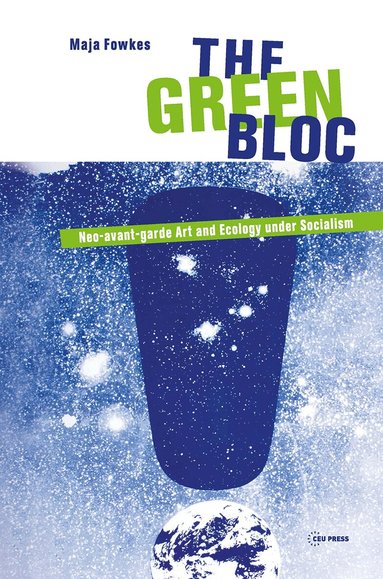
Green Bloc
Neo-avant-garde Art and Ecology under Socialism
Häftad, Engelska, 2015
919 kr
Beställningsvara. Skickas inom 10-15 vardagar. Fri frakt för medlemmar vid köp för minst 249 kr.
Finns i fler format (1)
Expanding the horizon of established accounts of Central European art under socialism, this book uncovers the neglected history of artistic engagement with the natural environment in the Eastern Bloc. The turbulent legacy of 1968, which saw the confluence of political upheaval, spread of counterculture, rise of ecological consciousness, and emergence of global conceptual art, provides the setting for Maja Fowkes’s innovative reassessment of the environmental practice of the Central European neo-avant-garde. Focussing on artists and artist groups whose ecological dimension has rarely been considered, including the Pécs Workshop from Hungary, OHO in Slovenia, TOK in Croatia, Rudolf Sikora in Slovakia, and the Czech artist Petr Štembera, 'The Green Bloc: Neo-avant-garde Art and Ecology under Socialism' brings to light an array of distinctive approaches to nature, from attempts to raise environmental awareness among socialist citizens to the exploration of non-anthropocentric positions and the quest for cosmological existence in the midst of red ideology. Embedding artistic production in social, political, and environmental histories of the region, this book reveals the Central European artists’ sophisticated relationship to nature, at the precise moment when ecological crisis was first apprehended on a planetary scale.
Produktinformation
- Utgivningsdatum2015-07-01
- Mått157 x 226 x 15 mm
- Vikt409 g
- FormatHäftad
- SpråkEngelska
- Antal sidor308
- FörlagCentral European University Press
- ISBN9786155225925
Tillhör följande kategorier
Hoppa över listan
Du kanske också är intresserad av
- Nyhet
- Nyhet
Del 3
- Nyhet
- Nyhet
Del 7
- Nyhet
Del 6
- Nyhet
Del 11