
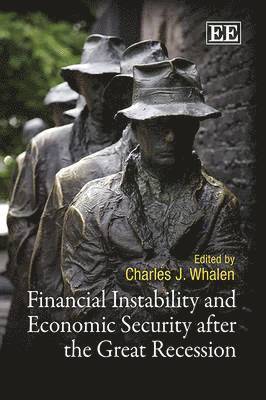
Financial Instability and Economic Security after the Great Recession
Inbunden, Engelska, 2011
2 439 kr
Beställningsvara. Skickas inom 5-8 vardagar. Fri frakt för medlemmar vid köp för minst 249 kr.
This timely book rethinks economic theory and policy by addressing the problem of economic instability and the need to secure broadly shared prosperity. It stresses that advancing economics in the wake of the Great Recession requires an evolutionary standpoint, greater attention to uncertainty and expectations, and the integration of finance into macroeconomics. The result is a broader array of policy options - and challenges - than conventional economics presents. Building on the pioneering work of Thorstein Veblen, John R. Commons and John Maynard Keynes, the authors synthesize key insights from Institutional and Post Keynesian economics into Post-Keynesian Institutionalism. Then they use that framework to explore an array of economic problems confronting the United States and the world. Inspired by the work of Hyman Minsky, the authors place financial relations at the center of their analysis of how economies operate and change over time. Students and scholars of macroeconomics and public policy will find this book of interest, as will a wider audience of financial analysts, policy makers and citizens interested in understanding economic booms and downturns.
Produktinformation
- Utgivningsdatum2011-10-31
- Mått156 x 234 x undefined mm
- FormatInbunden
- SpråkEngelska
- FörlagEdward Elgar Publishing Ltd
- ISBN9780857934833
Tillhör följande kategorier
Hoppa över listan
Du kanske också är intresserad av
Financial Instability and Economic Security after the Great Recession
Charles J. Whalen
Häftad, 2013
709 kr