Beställningsvara. Skickas inom 7-10 vardagar. Fri frakt för medlemmar vid köp för minst 249 kr.
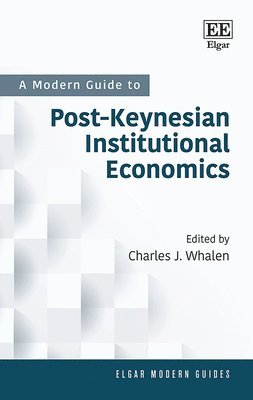
Fashioning Prosperous, Sustainable and Humane Societies examines key challenges confronting humanity in the age of financialization and global warming. A distinguished team of political economists analyzes the social conditions that promote human flourishing and how these can be achieved in the face of growing economic, ecological, and societal precarity.Employing critical perspectives to stress the vital role of governments and civil society, contributors survey past public policies across Asia, Europe, and North and South America. They advance existing literature on Post-Keynesian Institutional economics, exploring the new face of global money-manager capitalism and its consequences for emerging, transitioning, and advanced economies. Ultimately, this timely book outlines a social order free not only from exploitation and authoritarianism, but also from the supremacy of market values.Students and scholars of political economy, Institutional economics and public policy will find this book to be an essential resource. Policymakers will additionally find its insights both bold and practical.
Edited by Charles J. Whalen, Research Fellow, The Baldy Center for Law and Social Policy, University at Buffalo, Buffalo, NY, USA
ContentsPART IIntroduction1 Introduction: precarity and beyond 2Charles J. WhalenPART IIEconomic precarity: analyses and policy alternatives2 The effect of precarious work on wealth inequality in theUnited States: analysis and policy implications 17Emek Karakilic3 Wage stagnation and inequality in the United States: howpublic policy often made things worse and what can be doneto pursue more broadly shared prosperity 36Oren M. Levin-Waldman4 Financialized US labor and the COVID-19 pandemic: lessonslearned and lingering questions 57Avraham I. Baranes5 Precarious employment, precarious lives, and frameworks forchange 77Janice PetersonPART IIIEcological precarity: pathways to sustainability6 The environment and care work: similar problems, similarsolutions? 97Anna Zachorowska-Mazurkiewicz and Mateusz Racławski7 Post-Keynesian Institutionalism and the transition toecological sustainability 117Samba Diop8 Financing the future: sustainable economic andenvironmental transition through sustainable regulation 136Faruk Ülgen9 Financing energy transition: managed money versus publicmoney 154Yan LiangPART IVCivic precarity: societal revitalization through participation10 Power to the people? Historical and theoretical perspectiveson energy, nutrition insecurity, and environmental disruption 173David A. Zalewski11 Large Chinese corporations in Latin America: moreextraction or a just transition to an environmentallysustainable economy? 191Alicia Girón12 How to rebuild the economy of post-war Ukraine: a PostKeynesian Institutionalist perspective 224Anna Klimina13 Values and institutions of participatory and deliberativedemocracy: contribution and functioning in the economy andpublic policy 245Asimina Christoforou and Fikret AdamanPART VConclusion14 Corporate financialization and socioeconomic precarity:processes, consequences, and remedies 268William Lazonick
‘The essays in this volume elaborate the many ways in which families and individuals globally are burdened by exposure to conditions that endanger their existence and emotional wellbeing. Financial vulnerabilities, especially, can be a major source of deep trauma. Admirably the authors in Beyond Precarity seek to chart a better world where people can experience security, fulfillment and joy, rather than live under the persistent threat of pain and injury.’