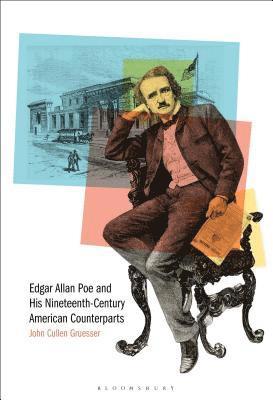
Winner of the 2019 Patrick F. Quinn Award for the best book on Poe (awarded by the Poe Studies Association) Edgar Allan Poe and His Nineteenth-Century American Counterparts addresses Poe’s connections with, critical assessments of, borrowings from, and effect on his literary peers. It situates Poe within his own time and place, paying particular attention to his interactions with, and impact on, figures such as Nathaniel Hawthorne, Walt Whitman, Herman Melville, Mark Twain, Harriet Jacobs, and Pauline Hopkins. John Cullen Gruesser rebuts myths that continue to cling to Poe, demonstrates Poe’s ability to transform themes he encountered in the works of his literary contemporaries into great literature, and establishes the profound influence of Poe’s invention of detective fiction on nineteenth-century American writers.
John Cullen Gruesser is Senior Research Scholar of Literary Studies at Sam Houston State University, USA. He is the author or editor of ten books and a past President of the Poe Studies Association.
Introduction: Dreams and Mystifications of PoePart I: The Quixotic Quest for Literary Fame, Financial Stability, and a Republic of Letters in Antebellum America1: Poor Edgar's Almanac: E. A. Poe's Money Woes 2: Outside Looking In: Poe and New York City3: Eddy P., the Scrivener: Biography and Autobiography in Herman Melville's "Story of Wall-Street"Part II: The Competition in Cunning: Ramifications of and Responses to Poe's Ratiocinative Tales4: Character Rivalry, Authorial Sleight-of-Hand, and Generic Fluidity in the Dupin Trilogy 5: Varieties of Detection in Nathaniel Hawthorne's The Scarlet Letter, Walt Whitman's Life and Adventures of Jack Engle, Herman Melville's Benito Cereno, and Mark Twain's "The Stolen White Elephant"6: Madness, Mystification, and "Average Racism" in "The Gold-Bug," E. D. E. N. Southworth's The Hidden Hand, Harriet Jacobs's Incidents in the Life of a Slave Girl, and Pauline Hopkins's Hagar's DaughterCoda: "A Crime of Dark Dye": Misreading Poe's CriticismNotesIndex
A smart, crisply written, and engaging study … The book will be useful not just for students of Poe and nineteenth-century publishing but also for teachers looking to weave Poe into their US literature offerings in news ways … Gruesser shows how central he was to a striking variety of writers publishing in the decades after his death.
Susan F. Beegel, John Bird, Deborah Clarke, Robert Donahoo, William Engel, Barbara Heavilin, Stacey Peebles, Philip Edward Phillips, Anthony Reynolds, Cherene Sherrard-Johnson, Susan Elizabeth Sweeney, Brian Yothers, William I. Lutterschmidt, John Gruesser, John Cullen Gruesser