
Computer-Assisted Analysis System for Mathematical Programming Models and Solutions
A User’s Guide for ANALYZE©
Inbunden, Engelska, 1993
2 159 kr
Beställningsvara. Skickas inom 10-15 vardagar. Fri frakt för medlemmar vid köp för minst 249 kr.
Finns i fler format (1)
Welcome to ANALYZE, designed to provide computer assistance for analyzing linear programs and their solutions. Chapter 1 gives an overview of ANALYZE and how to install it. It also describes how to get started and how to obtain further documentation and help on-line. Chapter 2 reviews the forms of linear programming models and describes the syntax of a model. One of the routine, but important, functions of ANALYZE is to enable convenient access to rows and columns in the matrix by conditional delineation. Chapter 3 illustrates simple queries, like DISPLAY, LIST, and PICTURE. This chapter also introduces the SUBMAT command level to define any submatrix by an arbitrary sequence of additions, deletions and reversals. Syntactic explanations and a schema view are also illustrated. Chapter 4 goes through some elementary exercises to demonstrate computer assisted analysis and introduce additional conventions of the ANALYZE language. Besides simple queries, it demonstrates the INTERPRT command, which automates the analysis process and gives English explanations of results. The last 2 exercises are diagnoses of elementary infeasible instances of a particular model. Chapter 5 progresses to some advanced uses of ANALYZE. The first is blocking to obtain macro views of the model and for finding embedded substructures, like a netform. The second is showing rates of substitution described by the basic equations. Then, the use of the REDUCE and BASIS commands are illustrated for a variety of applications, including solution analysis, infeasibility diagnosis, and redundancy detection.
Produktinformation
- Utgivningsdatum1993-03-31
- Mått155 x 235 x 18 mm
- Vikt581 g
- FormatInbunden
- SpråkEngelska
- SerieOperations Research/Computer Science Interfaces Series
- Antal sidor270
- Upplaga1993
- FörlagKluwer Academic Publishers
- ISBN9780792393221
Tillhör följande kategorier
Hoppa över listan
Mer från samma författare
Del 6
Advances in Sensitivity Analysis and Parametric Programming
Tomas Gal, H.J. Greenberg
Inbunden, 1997
3 689 kr
Del 2
Advances in Sensitivity Analysis and Parametric Programming
Tomas Gal, H.J. Greenberg
Häftad, 2012
3 589 kr
Hoppa över listan



Mer från samma serie
Reactive Search and Intelligent Optimization
Roberto Battiti, Mauro Brunato, Franco Mascia
Inbunden, 2008
1 439 kr
Del 29
Next Wave in Computing, Optimization, and Decision Technologies
Bruce L. Golden, S. Raghavan, Edward A. Wasil
Inbunden, 2004
2 959 kr
Simulation Approaches in Transportation Analysis
Ryuichi Kitamura, Masao Kuwahara
Inbunden, 2005
1 479 kr
Metaheuristic Procedures for Training Neural Networks
Enrique Alba, Rafael Martí
Inbunden, 2006
1 479 kr
Perspectives in Operations Research
Frank B. Alt, Michael C. Fu, Bruce L. Golden
Inbunden, 2006
1 479 kr
Del 37
Extending the Horizons: Advances in Computing, Optimization, and Decision Technologies
Edward K. Baker, Anito Joseph, Anuj Mehrotra, Michael A. Trick
Inbunden, 2006
1 439 kr
Del 38
Dynamic Fleet Management
Vasileios S. Zeimpekis, Christos D. Tarantilis, George M. Giaglis, Ioannis E. Minis
Inbunden, 2007
1 479 kr
Hoppa över listan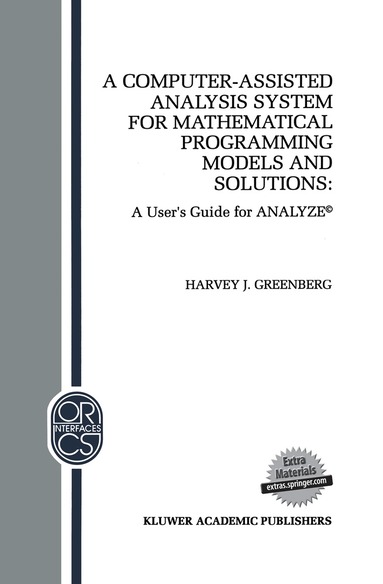



Du kanske också är intresserad av
Del 1
Computer-Assisted Analysis System for Mathematical Programming Models and Solutions
H.J. Greenberg
Häftad, 2013
2 159 kr
Del 2
Advances in Sensitivity Analysis and Parametric Programming
Tomas Gal, H.J. Greenberg
Häftad, 2012
3 589 kr
Del 6
Advances in Sensitivity Analysis and Parametric Programming
Tomas Gal, H.J. Greenberg
Inbunden, 1997
3 689 kr
- Nyhet
Del 7
- Nyhet
Del 11
- Nyhet
Del 4