
Del 14
Childhood and Schooling in (Post)Socialist Societies
Memories of Everyday Life
Inbunden, Engelska, 2017
1 809 kr
Beställningsvara. Skickas inom 10-15 vardagar. Fri frakt för medlemmar vid köp för minst 249 kr.
Finns i fler format (1)
This book explores childhood and schooling in late socialist societies by bringing into dialogue public narratives and personal memories that move beyond imaginaries of Cold War divisions between the East and West. Written by cultural insiders who were brought up and educated on the eastern side of the Iron Curtain - spanning from Central Europe to mainland Asia - the book offers insights into the diverse spaces of socialist childhoods interweaving with broader political, economic, and social life. These evocative memories explore the experiences of children in navigating state expectations to embody “model socialist citizens” and their mixed feelings of attachment, optimism, dullness, and alienation associated with participation in “building” socialist futures. Drawing on the research traditions of autobiography, autoethnography, and collective biography, the authors challenge what is often considered ‘normal’ and ‘natural’ in the historical accounts of socialist childhoods, and engage in (re)writing histories that open space for new knowledges and vast webs of interconnections to emerge. This book will be compelling reading for students and researchers working in education, sociology and history, particularly those within the interdisciplinary fields of childhood and area studies.‘The authors of this beautiful book are professional academics and intellectuals who grew up in different socialist countries. Exploring “socialist childhoods” in myriad ways, they draw on memories, and collective history, emotional insider knowledge and the measured perspective of an analyst. What emerges is life that was caught between real optimism and dullness, ethical commitments and ideological absurdities, selfless devotion to children and their treatment as a political resource. Such attention to detail and examination of the paradoxical nature of this time makes this collective effort not only timely but remarkably genuine.’—Alexei Yurchak, University of California, USA
Produktinformation
- Utgivningsdatum2017-12-28
- Mått148 x 210 x 22 mm
- Vikt518 g
- FormatInbunden
- SpråkEngelska
- Antal sidor297
- Upplaga17001
- FörlagSpringer International Publishing AG
- ISBN9783319627908
Tillhör följande kategorier
Hoppa över listan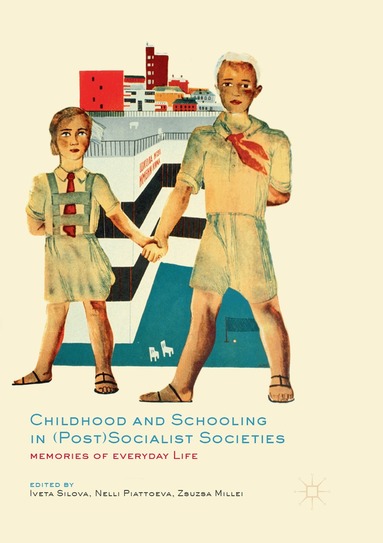
Du kanske också är intresserad av
Childhood and Schooling in (Post)Socialist Societies
Iveta Silova, Nelli Piattoeva, Zsuzsa Millei
Häftad, 2018
1 259 kr
Del 24
Keywords in Education Policy Research
Andrew Wilkins, Steven J. Courtney, Nelli Piattoeva
Häftad, 2024
449 kr
World Yearbook of Education 2022
Daniel Tröhler, Nelli Piattoeva, William F. Pinar
Inbunden, 2021
3 189 kr
Interrupting the Psy-Disciplines in Education
Eva Bendix Petersen, Zsuzsa Millei
Inbunden, 2016
1 389 kr
Del 24