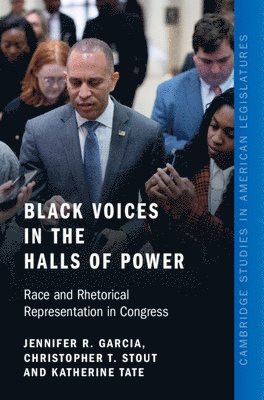
In Black Voices in the Halls of Power, authors Jennifer R. Garcia, Christopher T. Stout, and Katherine Tate explore how US lawmakers use racial rhetoric to elevate the voice of Black communities, influence policy, and shape voter trust. Through a combination of data-driven research and accessible storytelling, the book uncovers the strategic ways politicians speak about race, revealing how rhetoric impacts policymaking and representation and offering fresh insights into race and power in American politics. The book explores how politicians craft messages to appeal to diverse audiences and use political communication to advance legislative priorities. It also examines how legislators' engagement in racial outreach affects voter attitudes. Given the increasingly important role of race on the national political stage in the US, the book provides a critical yet engaging examination of race, rhetoric, and representation in Congress.
Jennifer R. Garcia is Assistant Professor in the Politics Department at Oberlin College. Her work has been published in several journals, including Political Communications, Legislative Studies Quarterly and Political Research Quarterly. Christopher T. Stout is Professor of Political Science at the University of California, San Diego. He researches how US voters respond to race-based political messages. His previous work has earned multiple awards, including Best Book in US Electoral Politics (APSA) and the W.E.B. DuBois Best Book Award (NCOBPS) along with appearing in dozens of peer-reviewed journals. Katherine Tate is Professor of Political Science at Brown University. She is the author of several books, including the award-winning Black Faces in the Mirror: African Americans and Their Representatives in the US Congress (2004).
1. Introduction – echo in the halls: racial rhetorical representation in the modern era; 2. Pushing the agenda or reacting to the moment: why communication directors engage in rhetorical outreach; 3. Who racializes? Exploring the demographic factors of Members of Congress who provide racial rhetorical representation through an intersectional perspective; 4. The highs and the lows: predicting racial rhetorical representation around high- and low-profile racial events; 5. Crystal clear: rhetorical representation and defining novel racial issues; 6. Depth and breadth: exploring the breadth of racial topics Members of Congress speak about when they engage in racial rhetorical representation; 7. Not all talk is cheap: the link between different forms of rhetorical representation and legislative activity in Congress; 8. Can racial rhetorical representation improve approval ratings?; 9. What if it fails? Is rhetorical representation without legislation valuable in the eyes of the Constituents; 10. Conclusion: is racial advocacy enough?
'Black Voices in the Hall of Power transcends typical accounts of descriptive, symbolic, and substantive representation with a commanding, multi-method analysis of interviews, survey experiments, legislative activity, and hundreds of thousands of press releases and tweets to demonstrate how Black legislators' rhetorical representation reshapes the legislative landscape for Black constituents.' LaGina Gause, University of California, San Diego
Jennifer R. Garcia, Christopher T. Stout, Katherine Tate, Ohio) Garcia, Jennifer R. (Oberlin College, San Diego) Stout, Christopher T. (University of California, Rhode Island) Tate, Katherine (Brown University