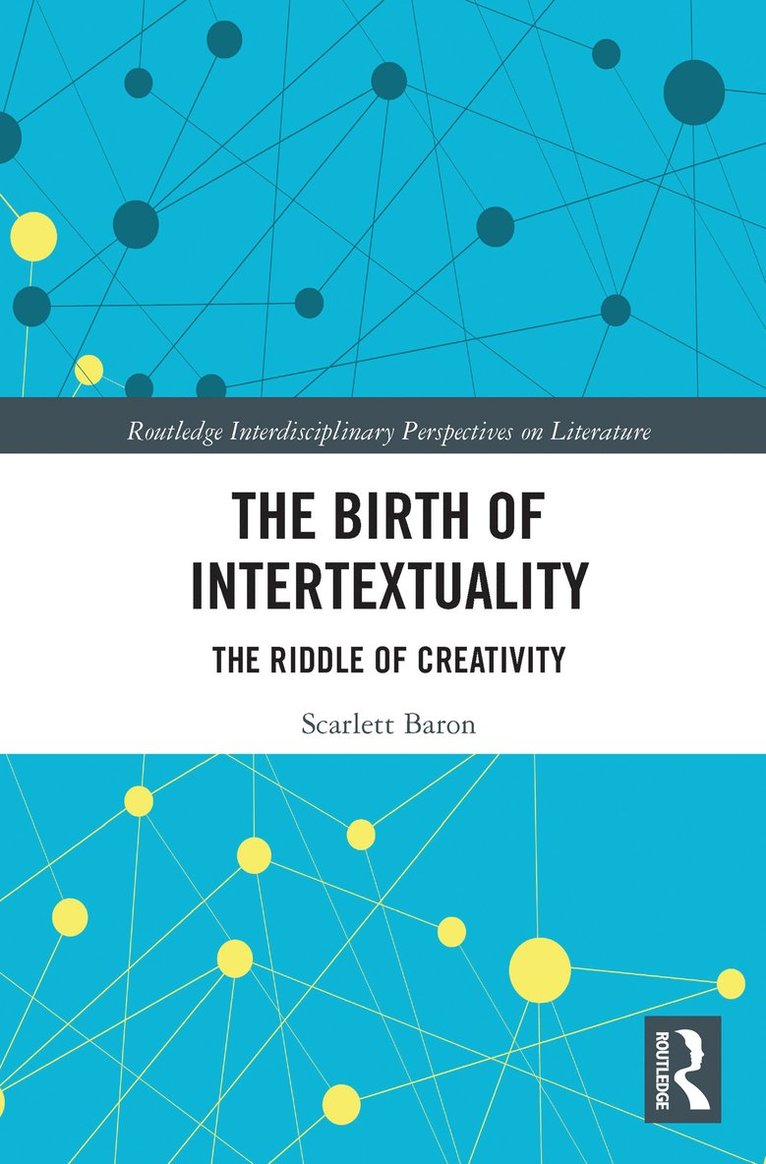
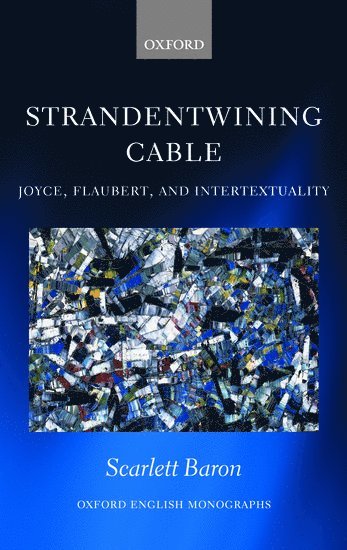
"The Birth of Intertextuality is such a welcome intervention in this unhappy context because it considers not only the genealogy of intertextuality, but how the wooliness of its deployment in literary studies and related disciplines can in part be attributed to the overdetermination attendant on the invention of the term. […] Baron’s patient demonstration of the validity of this valuable insight represents crucial intellectual historical work, illuminating this tricky enclave of twentieth-century theory." Niall Gildea, The Review of English Studies"Scarlett Baron’s second book is characteristically fluent and adept in its handling of a wide range of material and subjects. […] It is indeed a welcome addition to the library of theory-enthusiasts for its lucid and incisive unpacking of what is dense and far-reaching material. […] It is such dexterity in the synthesis of myriad materials and ideas that makes this book so successful." Emily Bell, James Joyce Broadsheet"The scope and ambition […] is impressive. There is a great deal here to admire. […] In dense, closely argued chapters, Baron shows the way that these ideas came together in the revolutionary politics of late 1960s Paris, where Kristeva arrived as a graduate student to work with Roland Barthes. […] Baron writes with great clarity on the long intellectual history that leads up to 1967. […] The relentless exposure of the contradictions in Kristeva’s prose that Baron offers is impressive." Bart Van Es, The Times Literary Supplement"Scarlett Baron’s The Birth of Intertextuality: The Riddle of Creativity is an impressively erudite analysis of the historical-cultural contexts conducive to the emergence of the concept of intertextuality. […] Baron’s study is also an object lesson in what the extended mind of the scholar looks like. […] Through her painstakingly disciplined, meticulous documentation of the sources […] Baron vividly demonstrates her point: she shows the working of her own mind, enmeshed in an intertextual network, making connections, drawing parallels, tracking down analogous metaphors among a vast array of authors. […] she weaves her threads into a novel pattern and demonstrates with brilliant erudition the combinatory interconnectedness fundamental to the conceptualization of intertextuality and creativity." – Katarzyna Bazarnik, James Joyce Quarterly, Volume 61, Number 3-4, Spring-Summer 2024, pp. 379-384. "This superb genealogy examines key author functions: Darwin, Nietzsche, Freud, Saussure, Bakhtin, and Kristeva, whose 1966 coinage, ‘intertextuality’, offers ‘a new term for [seemingly] age-old concerns’, envisaging ‘all texts as inextricably conditioned [. . .] by other texts’. This study’s originality lies in its identifying intertextuality’s values in ‘formative contexts of its genesis’ over a century, and in its insight that intertextuality is itself ‘the product of the “absorption and transformation of other texts”’. [….] Ultimately, this comprehensive survey convincingly demonstrates that intertextuality – through its radical ‘anti-foundationalis[m]’, eroding ‘belief in the subject, free will, originality, genius’—remains ‘more than the vacuous truism [of] humanistic sceptics’. It does so in situating it carefully in relation to key components of ‘its cargo of informing philosophies’." – Larry Duffy, Modern Language Review, Volume 117, Part 4, October 2022, pp. 694-696. "Baron’s history of intertextuality is useful to all those in the humanities who grapple with specific disciplinary tropes such as the function of the author. […] the strength of Baron’s book resides exactly in the detailed historicization of jargony or à-la-mode vulgarizations." – Mariaenrica Giannuzzi, Studies in 20th & 21st Century Literature, Volume 45 Issue 1, 2021. "The book’s achievement lies in demonstrating the affinity between a radical flowering in 1960s and 1970s France and key developments in nineteenth- and twentieth-century thought (Darwin; Nietzsche; Freud)." – ‘Critical Prehistory’ – Raphael Lyne, Cambridge Quarterly, 199-203. "a shrewd analysis of the problems of the notion of intertextuality […] Baron offers pertinent critiques of Kristeva’s transformation of Bakhtin’s conceptions […] Baron is rightly skeptical of Kristeva’s desire to mathematize the textual domain […] The Birth of Intertextuality offers a trenchant analysis of the problems inherent in Kristeva’s original definition." – Jonathan Culler, ‘Intertexts of Intertextuality’, Journal of Modern Literature, Volume 44, Number 3, Spring 2021, pp. 164-169.