Algebra Teacher's Activities Kit
150 Activities that Support Algebra in the Common Core Math Standards, Grades 6-12
Häftad, Engelska, 2016
Av Judith A. Muschla, Gary R. Muschla, Erin Muschla-Berry, Judith A Muschla, Gary R Muschla
449 kr
Produktinformation
- Utgivningsdatum2016-02-09
- Mått216 x 274 x 18 mm
- Vikt748 g
- FormatHäftad
- SpråkEngelska
- SerieJ-B Ed: Activities
- Antal sidor336
- Upplaga2
- FörlagJohn Wiley & Sons Inc
- ISBN9781119045748
Tillhör följande kategorier
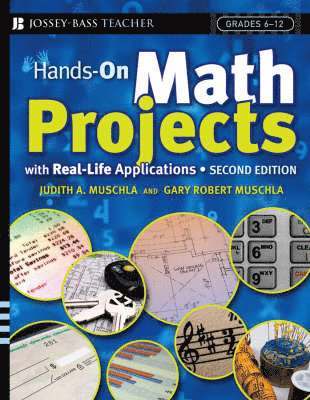
Judith A. Muschla has taught mathematics in South River, New Jersey, for over twenty-five years. Along with teaching and writing, she has been a member of the state Standards Review Panel for the Mathematics Core Curriculum Content Standards in New Jersey. Gary Robert Muschla taught at Appleby School in Spotswood, New Jersey, for more than twenty-five years; his specialties include mathematics at the middle school level, reading, and writing. Judith and Gary have coauthored several successful math activity books, including Teaching the Common Core Math Standards with Hands on Activities, Grades 9-12, Hands-On Math Projects with Real Life Applications, The Math Teacher's Book of Lists, and Math Starters. Erin Muschla-Berry teaches 8th grade math at Monroe Township Middle School in Monroe, New Jersey, and has collaborated with Judith and Gary on eight previous math books.
- About the Authors vii Acknowledgments ixPreface xviiSECTION 1: RATIOS AND PROPORTIONAL RELATIONSHIPS 1Teaching Notes for the Activities of Section 1 21–1: (6.RP.1) Understanding Ratios 21–2: (6.RP.2) Unit Rates and Ratios 21–3: (6.RP.3) Equivalent Ratios and the Coordinate Plane 31–4: (6.RP.3) Finding the Percent of a Number and Finding the Whole 31–5: (7.RP.1) Finding Unit Rates 41–6: (7.RP.2) Graphing Proportional Relationships 41–7: (7.RP.2) Representing Proportional Relationships 51–8: (7.RP.3) Solving Word Problems Involving Percents 5Reproducibles for Section 1 6SECTION 2: THE NUMBER SYSTEM AND NUMBER AND QUANTITY 19Teaching Notes for the Activities of Section 2 202–1: (6.NS.5) Representing Positive and Negative Numbers 202–2: (6.NS.6) Graphing Rational Numbers on a Number Line 202–3: (6.NS.6) Graphing Points in the Coordinate Plane 212–4: (6.NS.7) The Absolute Value and Order of Rational Numbers 222–5: (6.NS.8) Using the Coordinate Plane to Solve Problems 222–6: (7.NS.1) Using the Number Line to Add and Subtract Rational Numbers232–7: (7.NS.1) Using Properties to Add and Subtract Rational Numbers 242–8: (7.NS.2) Multiplying and Dividing Rational Numbers 252–9: (7.NS.2) Converting Rational Numbers to Decimals262–10: (7.NS.3) Solving Word Problems Involving Rational Numbers 272–11: (8.NS.1) Expressing Fractions as Repeating Decimals and Repeating Decimals as Fractions 272–12: (8.NS.2) Using Rational Approximations of Irrational Numbers 282–13: (N-RN.1) Using the Properties of Exponents292–14: (N-RN.2) Rewriting Expressions Involving Radicals and Rational Exponents 292–15: (N-RN.3) Sums and Products of Rational and Irrational Numbers 302–16: (N-Q.1) Interpreting and Using Units 312–17: (N-Q.2) Defining Appropriate Quantities 312–18: (N-Q.3) Choosing Appropriate Levels of Accuracy for Measurement 322–19: (N-CN.1) Writing Complex Numbers 332–20: (N-CN.2) Adding, Subtracting, and Multiplying Complex Numbers 342–21: (N-CN.7) Solving Quadratic Equations That Have Complex Solutions 34Reproducibles for Section 2 35SECTION 3: BASIC EXPRESSIONS, EQUATIONS, AND INEQUALITIES 60Teaching Notes for the Activities of Section 3 613–1: (6.EE.1) Writing and Evaluating Numerical Expressions with Whole-Number Exponents 613–2: (6.EE.2) Writing and Reading Algebraic Expressions 623–3: (6.EE.2) Evaluating Algebraic Expressions 623–4: (6.EE.3) Applying Properties of Operations to Generate Equivalent Expressions 633–5: (6.EE.4) Identifying Equivalent Expressions 633–6: (6.EE.5) Identifying Solutions of Equations and Inequalities 643–7: (6.EE.6) Writing Expressions in Which Variables Represent Numbers 643–8: (6.EE.7) Writing and Solving Equations 653–9: (6.EE.8) Using Inequalities 653–10: (6.EE.9) Using Variables to Represent Two Quantities 663–11: (7.EE.1) Adding, Subtracting, Factoring, and Expanding Linear Expressions 673–12: (7.EE.2) Rewriting Expressions in Different Forms 673–13: (7.EE.3) Solving Multi-Step Problems 683–14: (7.EE.4) Solving Equations and Inequalities 683–15: (8.EE.1) Applying Properties of Integer Exponents 693–16: (8.EE.2) Using Square Roots and Cube Roots 693–17: (8.EE.3) Using Numbers Expressed in Scientific Notation 703–18: (8.EE.4) Operations with Scientific Notation 713–19: (8.EE.5) Graphing Proportional Relationships 713–20: (8.EE.6) Deriving the Equation y = mx 723–21: (8.EE.7) Identifying Equations That Have One Solution, No Solutions, or Infinitely Many Solutions 733–22: (8.EE.7) Solving Equations with Variables on Both Sides 733–23: (8.EE.8) Solving Systems of Linear Equations Algebraically 743–24: (8.EE.8) Solving Systems of Equations by Graphing 75Reproducibles for Section 3 75SECTION 4: POLYNOMIAL, RATIONAL, EXPONENTIAL, AND RADICAL EXPRESSIONS, EQUATIONS, AND INEQUALITIES 103Teaching Notes for the Activities of Section 4 1044–1: (A-SSE.1) Interpreting Expressions 1044–2: (A-SSE.2) Using the Structure of an Expression to Identify Ways to Rewrite It 1044–3: (A-SSE.3) Factoring Quadratic Expressions to Reveal Zeroes 1054–4: (A-SSE.3) Completing the Square to Reveal Maximum or Minimum Values 1064–5: (A-SSE.4) Finding Sums of Finite Geometric Series 1064–6: (A-APR.1) Adding, Subtracting, and Multiplying Polynomials 1074–7: (A-APR.2) Applying the Remainder Theorem 1074–8: (A-APR.3) Using Zeroes to Construct a Rough Graph of a Polynomial Function 1084–9: (A-APR.4) Proving Polynomial Identities 1094–10: (A-APR.6) Rewriting Rational Expressions 1104–11: (A-CED.1) Writing and Solving Equations and Inequalities in One Variable 1114–12: (A-CED.2) Writing and Graphing Equations in Two Variables 1114–13: (A-CED.3) Representing Constraints and Interpreting Solutions 1124–14: (A-CED.4) Highlighting Quantities of Interest in Formulas 1134–15: (A-REI.1) Justifying Solutions to Equations 1134–16: (A-REI.2) Solving Rational and Radical Equations 1144–17: (A-REI.3) Solving Multi-Step Linear Equations in One Variable 1154–18: (A-REI.3) Solving Multi-Step Linear Inequalities in One Variable 1154–19: (A-REI.4) Solving a Quadratic Equation by Completing the Square 1164–20: (A-REI.4) Solving Quadratic Equations in a Variety of Ways 1164–21: (A-REI.5) Solving Systems of Equations 1174–22: (A-REI.6) Solving Systems of Linear Equations 1184–23: (A.REI.7) Solving a System of a Linear and a Quadratic Equation 1184–24: (A-REI.10) Relating Graphs to the Solutions of Equations 1194–25: (A-REI.11) Using Graphs and Tables to Find Solutions to Systems of Equations 1204–26: (A-REI.12) Solving Systems of Inequalities by Graphing 120Reproducibles for Section 4 121SECTION 5: FUNCTIONS 155Teaching Notes for the Activities of Section 5 1565–1: (8.F.1) Identifying Functions 1565–2: (8.F.2) Comparing Functions 1575–3: (8.F.3) Determining Whether Data Lies on a Line 1575–4: (8.F.4) Finding the Slope and Y-Intercept of a Line 1575–5: (8.F.5) Analyzing and Graphing Functions 1585–6: (F-IF.1) Understanding Functions 1595–7: (F-IF.2) Finding the Values of Functions 1595–8: (F-IF.3) Defining Sequences Recursively 1605–9: (F-IF.4) Identifying Key Features of Graphs 1605–10: (F-IF.5) Relating the Domain of a Function to Its Graph or Description 1615–11: (F-IF.6) Finding the Average Rate of Change over Specified Intervals 1625–12: (F-IF.7) Graphing Linear and Quadratic Functions 1625–13: (F-IF.7) Graphing Polynomial Functions 1635–14: (F-IF.8) Rewriting Quadratic Equations 1645–15: (F-IF.9) Comparing Properties of Functions 1655–16: (F-BF.1) Writing Functions 1655–17: (F-BF.2) Writing Arithmetic and Geometric Sequences 1665–18: (F-BF.3) Transforming a Function 1665–19: (F-BF.4) Finding the Inverses of Functions 1675–20: (F-LE.1) Proving Linear Functions Grow by Equal Differences over Equal Intervals 1685–21: (F-LE.1) Proving Exponential Functions Grow by Equal Factors over Equal Intervals 1685–22: (F-LE.2) Constructing Linear and Exponential Functions 1695–23: (F-LE.3) Observing the Behavior of Quantities That Increase Exponentially 1705–24: (F-LE.4) Writing and Solving Exponential Equations 1705–25: (F-LE.5) Interpreting Parameters in a Linear or Exponential Function 1715–26: (F-TF.1) Using Radian and Degree Measures 1725–27: (F-TF.2) Using the Unit Circle 1725–28: (F-TF.5) Modeling Periodic Phenomena 1735–29: (F-TF.8) Finding the Values of the Sine, Cosine, and Tangent Functions 174Reproducibles for Section 5 175SECTION 6: STATISTICS AND PROBABILITY 221Teaching Notes for the Activities of Section 6 2226–1: (6.SP.1) Identifying Statistical Questions 2226–2: (6.SP.2) Describing Data Distributions 2226–3: (6.SP.3) Finding the Mean, Median, Mode, and Range 2236–4: (6.SP.4) Using Dot Plots to Display Data 2246–5: (6.SP.4) Constructing a Box Plot 2246–6: (6.SP.5) Summarizing and Describing Data 2256–7: (7.SP.1) Drawing Inferences from Samples 2276–8: (7.SP.2) Drawing Inferences about a Population Using Random Samples 2276–9: (7.SP.3) Comparing Two Data Sets 2286–10: (7.SP.4) Drawing Inferences about Populations 2296–11: (7.SP.5) Understanding the Probability of Events 2296–12: (7.SP.6) Probabilities and Predictions 2306–13: (7.SP.7) Using Probability Models to Find Probabilities of Events 2306–14: (7.SP.8) Understanding the Probability of Compound Events 2316–15: (7.SP.8) Finding Probabilities of Compound Events Using Tables, Lists, and Tree Diagrams 2326–16: (8.SP.1) Constructing and Interpreting Scatter Plots 2336–17: (8.SP.2) Fitting Lines to Data 2346–18: (8.SP.3) Using Equations of Linear Models2346–19: (8.SP.4) Constructing and Interpreting Two-Way Tables 2356–20: (S-ID.1) Representing Data with Plots on the Real Number Line 2366–21: (S-ID.2) Comparing Two Data Sets 2366–22: (S-ID.3) Interpreting Differences in Shape, Center, and Spread of Data Distributions 2376–23: (S-ID.4) Recognizing Characteristics of Normal Distributions 2386–24: (S-ID.5) Summarizing Categorical Data in Two-Way Frequency Tables 2386–25: (S-ID.6) Finding the Equation of the Line of Best Fit 2396–26: (S-ID.6) Using Linear and Quadratic Models 2406–27: (S-ID.7) Interpreting the Slope and Y-Intercept of a Linear Model 2416–28: (S-ID.8) Computing and Interpreting the Correlation Coefficient 2416–29: (S-ID.9) Distinguishing between Correlation and Causation 2426–30: (S-IC.1) Understanding the Terminology of Statistical Experiments 2426–31: (S-IC.2) Evaluating Probability Models through Simulations 2436–32: (S-IC.3) Recognizing Surveys, Experiments, and Observational Studies 2446–33: (S-IC.4) Using Simulations with Random Sampling 2446–34: (S-IC.5) Comparing Two Treatments Using Simulations 2456–35: (S-IC.6) Evaluating Data in Reports 2466–36: (S-CP.1) Describing Events as Subsets of a Sample Space 2466–37: (S-CP.2) Identifying Independent Events 2476–38: (S-CP.3) Interpreting Conditional Probability 2476–39: (S-CP.4) Understanding Two-Way Frequency Tables 2486–40: (S-CP.5) Exploring Concepts of Conditional Probability 2496–41: (S-CP.6) Finding Conditional Probabilities as a Fraction of Outcomes 2496–42: (S-CP.7) Applying the Addition Rule 250Reproducibles for Section 6 250INDEX 305