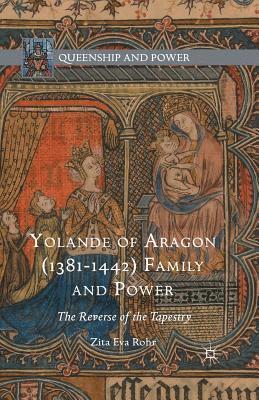
Rachel Gibbons, Professor of Early Modern History at The Open University The Reverse of the Tapestry: Yolande of Aragon, 1381-1442. A Case Study of Family and Power General This book is a much-needed scholarly assessment of an incredibly influential figure of fifteenth-century French history whom most of the reading public will probably only know (if they know her at all) as the somewhat Machiavellian Faye Dunaway portrait in 'The Messenger: the story of Joan of Arc'. Yolande of Aragon was a woman absolutely of her time and cultural milieu, who acted as lieutenant for her husband and sons, in a queen-dowager role to her inexperienced son-in-law Charles VII, and as a courtly patron to many. Project This book is rooted firmly within the growing body of queenship studies scholarship, and argues a convincing case that, over the last four or five years, is becoming more commonly accepted - that women's utilisation of power has to be seen as it was operated in the later Middle Ages, within the interwoven 'tapestry of threads' of their ties of kin and affinity. Conferences within monarchy studies over the last two or three years increasingly have stopped separating kingship from queenship, seeing them instead as co-dependent parts of the same monarchy. This book is an excellent example of this developing scholarship, and draws on a wide range of recent historiography to argue this point in the opening chapter. From the evidence of the text itself, I would judge that the author is absorbed within her/his subject matter and highly qualified to produce a book that will greatly enhance the broader field of royal studies as well as understanding and appreciation of the impact on familial, national and international politics of Yolande herself. The author's bibliography is extensive, drawing on the full range of sources and historiography of medieval Aragon, France and the Italian states. From the sample chapters offered, there are no obvious omissions and no re-working on which the overall success of the project is dependent. From preliminary reading, though, I have one or two small suggestions which I hope that the author may find useful. Chapter 1 perhaps is a little overwhelming in its coverage of complex family ties, back and forth across the generations. The inclusion of one or two good genealogical tables early on in the text would assist the reader greatly, especially those unfamiliar with the cognate dynasties of the French and Aragonese royal families. Of course, these may well exist as appendices or supplementary material in the complete manuscript - so apologies if I'm raising in ignorance of the content of the rest of the book an issue that doesn't actually exist. I found Chapter 3 to be a concise and highly-readable examination of the years of internecine conflict in France in the years following the madness of Charles VI. Regularly, focus is brought back onto the ramifications of wider events for Yolande's new Angevin family and the rule of her father-in-law and husband. If I'm being extremely picky, I'd like the excellent point made on page 76 - about the Angevins not being simply Armagnacs but motivated by 'Team Anjou' in all of their policy/alliance decisions - to be foregrounded right at the start of the chapter, and the history of these years in France presented through that prism all the way through. Again (as above), with no contents page and no clue as to how the rest of the book develops, the author may know (and I do not) that (e.g.) chapter 4 adequately makes connections on how viewing the mistakes of Isabeau's lieutenancy influenced decisions that Yolande made about her own. But a little more on why the context of the 1390s through 1410s is vital to understanding Angevin decision-making and Yolande's career in the 1420s and '30s would add to the impact of this chapter. The only other very small revisions are those within the brief of a publisher's copy editor: for example, a number of synonymous adjacent sentences (rewording across drafts but all retained, no doubt) and some linguistic internal inconsistencies (slipping between Pere and Peter, I noted, in the discussion of Pere/Peter IV in Chapter 2, for instance). Market and Competition This book occupies a rare space in the market as a genuine piece of European history. As already mentioned, the author is as equally well-read and confident with the sources and history of medieval Aragon and the Mediterranean world as with France. Previous works on Yolande of Aragon, or in which her life and career have featured, have been focused more narrowly either in the Iberian or in the French historiographical tradition. This work is the richer for its breadth of coverage and, through that, mirrors how Yolande would have regarded herself as a princess of all three traditions and cultures. Its international appeal is enhanced by this breadth and, also, as the only (to my knowledge) scholarly biography in English on Yolande. Therefore, its value to Anglophone medieval queenship scholars, gender historians and political historians will be large. In the United States particularly, there should be a market also amongst 'Joannistes' (adherents of everything Joan of Arc), given Yolande's prominent role in Joan's story. Recommendation I would without hesitation recommend that the book is accepted for publication. There are no major revisions needed; as mentioned above, there are one or two small factors that the author and/or Palgrave editors might consider in a final version of the manuscript. I would also be happy to provide a line or two of copy to endorse the final manuscript.