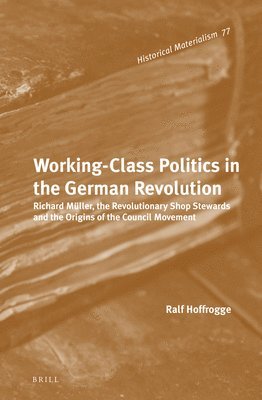
Del i serien Historical Materialism
Working Class Politics In The German Revolution (historical Materialsim, Volume 77)
Richard Muller, the Revolutionary Shop Stewards and the Origins of the Council Movement
459 kr
Beställningsvara. Skickas inom 5-8 vardagar. Fri frakt för medlemmar vid köp för minst 249 kr.
Produktinformation
- Utgivningsdatum2015-12-22
- Mått152 x 229 x 15 mm
- Vikt370 g
- FormatHäftad
- SpråkEngelska
- SerieHistorical Materialism
- Antal sidor356
- FörlagHaymarket Books
- ISBN9781608465507
Tillhör följande kategorier
Ralf Hoffrogge, Dr. phil. (2013), University of Potsdam, has published monographs and articles on German labour history, including Sozialismus und Arbeiterbewegung in Deutschland - Von den Anfängen bis 1914 (Schmetterling Verlag, 2011). He has just finished a biographical study on the German-Jewish Communist Werner Scholem: Werner Scholem eine politische Biographie (1895-1940) (Universitätsverlag Konstanz, 2014).
- List of IllustrationsList of AbbreviationsSisyphus of the Revolution: A Preface, Wolfgang WippermannAuthor’s Preface1 Introduction: A Forgotten RevolutionaryThe Politics of Historical InterpretationThe Makers of the German Revolution2 Background, Youth, and Early Union Activities: 1880-1913From Farm to FactoryMüller’s (Very) Private LifeFighting Taylorism with its Own WeaponsBureaucracy in the Service of Agitation3 Opposition to the Burgfrieden: 1914-1918‘The Great Betrayal’From Discipline to OppositionEarly Ambiguities and their Price4 The Revolutionary Shop Stewards and Political Mass Strikes: 1916-1918The Stewards’ First Political Strike: Protesting Liebknecht’s ArrestRepression and the New OppositionMüller’s Arrest and the April StrikeMarking Time under RepressionPreparing for the January Strike: Rising Discontent and the Bolshevik ExampleThe January 1918 Strike: Council Power EmergesThe Politics of the Action Committee and the End of the January StrikeBarth and Däumig lead in Müller’s AbsenceMüller’s Return5 The German Revolution in Berlin, 1918The Stewards and the Spartacists: A Tale of Two StylesArming the RevolutionOutbreakCouncil PowerThe State of the Revolution6 Chairman of the Berlin Executive Council: 1918–1919Conflict, Caution and Counter-revolutionLoss of National Power7 Richard Müller and the Council Movement: 1918–1919The Council Movement in War and RevolutionThe First Council Congress and the Triumph of ParliamentarianismThe Blocked Path to SocialismBerlin’s January UprisingPolitical Murder, Demoralisation, and the End of the Revolutionary Shop StewardsTheorising Council SocialismThe March Strikes of 1919After the Tumult8 From Council Movement to Works Councils: 1919-1920Council Ideal and Works Council RealityLeading the Left Opposition in the DMVDefeat at Nuremberg, Compromise in StuttgartThe Works Councils Act, Armed Conflict and Party SplitDMV Political Divisions and the Works Council CentreThe first Works Council Congress 1920The State of the Revolution in 19209 From Council Socialism to Party Communism and Beyond: 1920-1924The Leninist Model and the USPD SplitThe Communist Union CentreThe Red International of Labour UnionsCrisis in the Communist Party and the March Action of 1921Post-March Crises and `Made in Moscow´ ResolutionThe Revelation AffairMüller, the unwanted Communist10 Richard Müller as Historian of the German Revolution: 1923-1925Müller’s Historiographical ApproachMüller as Publisher11 Footnotes and Suppression - Richard Müller’s Impact on HistoriographyThe Millstones of Social Democracy and Marxism-LeninismMüller in East GermanyMüller in West Germany12 Break with Politics, Withdrawal into Private Life: 1925-1943The DIV, the ‘Construction Issue’ and Union FragmentationMüller as LandlordDrifting back to Social Democracy?Returning to Obscurity13 Conclusion: The Darkness of HistoryBibliography1. Printed Sources2. LiteratureAbout the AuthorIndex
"Hoffrogge has done historians of the German Revolution and the Weimar Republic a valuable service by reconstructing the trajectory of a key figure in the revolution (and one of its most important early historians), and by enabling us to see these events through the different focus afforded by a leading protagonist of the workers’ councils"—Andrew G. Bonnell, Labour History, Australia“In this study of Richard Müller’s role in the German Revolution, Ralf Hoffrogge sheds light on one of the most important, and yet understudied, aspects of the upheaval: the role of revolutionary shop stewards and workers’ councils in the overthrow of the old order and the establishment of the new one…[T]his work provides a much-needed perspective on the German upheaval from the bottom up. It places Richard Müller’s long neglected role in the revolution at center stage, and reminds us of the revolutionary promise that was the German Revolution."—William Smalldone, Against the Current“Hoffrogge’s biography differs from those written about revolutionary icons like Liebknecht or Luxemburg for very practical reasons. The latter were from middle-class backgrounds and used to writing letters and articles offering biographers insights into their political but also private lives. An ordinary worker like Müller did not leave comparable records…Hoffrogge’s book is a first-rate invitation to think about a link between Richard Müller and the Revolutionary Shop Stewards and today’s still unfocused struggles against imperialist wars and capitalist exploitation” —Ingo Schmidt, WorkingUSA"The merit of Hoffrogge’s contribution is a capacity to translate his extensive research into a wide-ranging historical analysis and narrative of the role of the Revolutionary Shop Stewards and Richard Müller. "—Dario Azzellini"Ralf Hoffrogge has authored an invaluable addition to the literature of German radicalism by detailing the life of one of the key leaders of the Revolutionary Shop Stewards."—William A. Pelz"Ralf Hoffrogge ... explores the complicated relationship between the Stewards and the various socialist political parties with great skill and discusses the emergence of a new kind of socialism amongst Müller and his colleagues, which did not focus on state power and centralization but rather on grassroots democracy and workers’ control, sometimes known as council communism."—Dick Geary"This study deserves special consideration because it addresses two of the main puzzles of modern German history: how did a supposedly strong state collapse in 1917 and 1918, and how did the SPD subsequently assume power? Already in the 1920s, Arthur Rosenberg pointed out that the Social Democrats followed a dual tactic of propagating but also preventing revolution. By clarifying the roles played in all this by Müller and the shop stewards, Hoffrogge has moved the discussion forward, showing the way in which revolutionary unrest spread and forced the Social Democrats into a much more active role than they had previously adopted."–Central European History“The important value of this book is to reveal a thing that is often overlooked in the socialist movement: Whether the theory of the working class political parties can be accepted by the masses. For a long time, in the history of the communist movement, writers stressed, on the one hand, the important role of revolutionary leaders, and on the other the important role of the working class. But who is the link between the two? Richard Muller's experience seems to give the answer to this question.”—Ma Jiahong, Contemporary World Socialism Issue No. 2016, No. 119-122.

Mer från samma serie
Dialectic Of The Ideal: Evald Ilyenkov And Creative Soviet Marxism
Alex Levant, Vesa Oittinen
449 kr
Toward a New World: Articles and Essays, 1901-1906
Alexander Bogdanov, David G. Rowley, David G Rowley
519 kr
Pavel V. Makasakovsky: The Capitalist Cycle. An Essay On The Marxist Theory Of The Cycle
Pavel V. Maksakovsky
369 kr
Clash Of Globalizations, The: Neo-liberalism, The Third Way And Anti-globalization
Ray Kiely
449 kr