
Del i serien World of the Roosevelts
Wizard of Washington
Emil Hurja, Franklin Roosevelt, and the Birth of Public Opinion Polling
Inbunden, Engelska, 2002
739 kr
Beställningsvara. Skickas inom 10-15 vardagar. Fri frakt för medlemmar vid köp för minst 249 kr.
Finns i fler format (1)
Historians have tended to point to John F. Kennedy's 1960 bid for the presidency as the first time a candidate relied extensively on public opinion polls to drive a campaign. Polling has come to define American politics, and is perhaps most clearly embodied in Bill Clinton, the post poll-driven president in history. Melvin G. Holli dismisses this notion, however, and reveals that presidential reliance on public opinion polls dates back to the New Deal Era, when Franklin Roosevelt employed a first-generation Finnish-American named Emil Hurja to conduct polls for this 1932 and 1936 presidential campaigns. Holli shows us how Hurja convinced the Democratic National Committee to allow him to apply the new science of polling FDR's presidential campaign of 1932. Roosevelt's triumph at the polls in that year and again in 1936, as well as the spectacular 1934 Democratic mid-term congressional victory was legendary. Holli restores Hurja to his rightful place in American history and politics, showing us that the Washington press corps were right on target when they dubbed Hurja the 'Wizard of Washington'.
Produktinformation
- Utgivningsdatum2002-03-28
- Mått140 x 216 x 18 mm
- Vikt322 g
- FormatInbunden
- SpråkEngelska
- SerieWorld of the Roosevelts
- Antal sidor164
- Upplaga2002
- FörlagSt Martin's Press
- ISBN9780312293956
Tillhör följande kategorier
Hoppa över listan
Mer från samma serie
Franklin D. Roosevelt, The Vatican, and the Roman Catholic Church in America, 1933-1945
David B. Woolner, R. Kurial
Häftad, 2010
719 kr
Hoppa över listan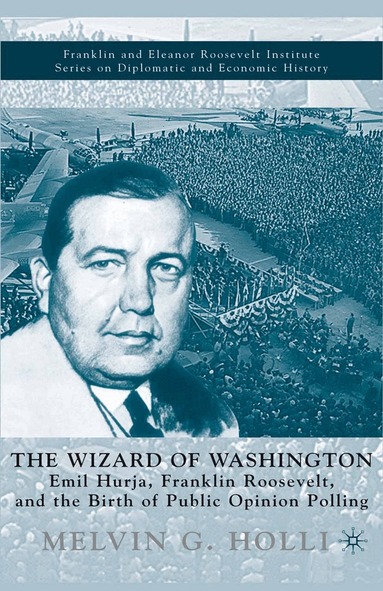
Du kanske också är intresserad av
Origins of U.S. Nuclear Strategy, 1945-1953
Samuel R. Williamson, Kenneth A. Loparo, Samuel R. Williamson Jr
Häftad, 1993
739 kr