
With or Against the World?
America's Role Among the Nations
Häftad, Engelska, 2005
779 kr
Beställningsvara. Skickas inom 10-15 vardagar. Fri frakt för medlemmar vid köp för minst 249 kr.
The events of 9/11, followed by the Bush administration's actions in Afghanistan and Iraq, have fueled a new debate about America's foreign and defense policies in the post-Cold War world. The debate has produced a torrent of books. This book argues that current policy making and reactions to terrorism cannot be understood properly without going back to the roots of America's civil-religious nationalism as well as to the Muslim roots of radical Islamism. After setting that stage in Chapters One and Two, the book goes on in the next three chapters to uncover the political and religious roots of the modern state, a western invention now dominant throughout the world. Chapters Six through Eight focus on the United States—at its founding, in the era of Woodrow Wilson and World War I, and today, post-9/11. The aim here, at the core of the book, is to show how a modest, constitutionally limited state became the carrier of a grandiose, civil-religious, nationalism (city on a hill; redeemer nation; American exceptionalism) that accounts for much of the ambivalence of America's approach to international relations to the present day. Chapter Nine focuses on contemporary questioning of just war doctrine, and Chapter Ten argues for a new priority of international institution building in America's approach to world affairs.
Produktinformation
- Utgivningsdatum2005-02-17
- Mått153 x 227 x 12 mm
- Vikt268 g
- FormatHäftad
- SpråkEngelska
- Antal sidor208
- FörlagBloomsbury Publishing Plc
- ISBN9780742535220
Tillhör följande kategorier
Hoppa över listan


Mer från samma författare
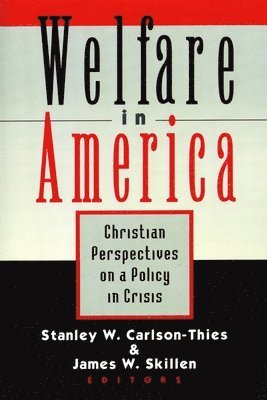
Welfare in America
Stanley Carlson-Thies, James W. Skillen, Stanley W.Carlson- Thies, James W. Skillen, Stanley W. Carlson-Thies
Häftad, 1995
729 kr
Hoppa över listan



Du kanske också är intresserad av
Welfare in America
Stanley Carlson-Thies, James W. Skillen, Stanley W.Carlson- Thies, James W. Skillen, Stanley W. Carlson-Thies
Häftad, 1995
729 kr
- Nyhet
Del 7
- Nyhet
Del 6
- Nyhet
Del 3
- Nyhet
Del 4