
Del i serien The IUCN Academy of Environmental Law series
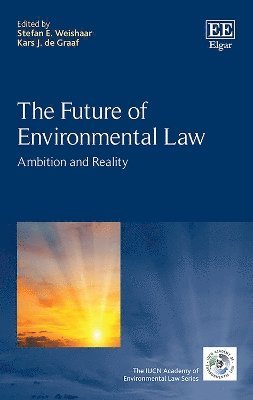
Water and the Law
Towards Sustainability
Inbunden, Engelska, 2014
3 009 kr
Beställningsvara. Skickas inom 5-8 vardagar. Fri frakt för medlemmar vid köp för minst 249 kr.
Finns i fler format (1)
Water and the Law examines the critical relationship between law and the management of water resources in the context of ensuring environmental sustainability. It highlights the central importance of integrated water resources management and cooperation in achieving sustainability.The book considers two broad themes that are critical for life on Earth: how law can contribute to the sustainability of water itself and how the law s regulation of water can contribute to the sustainability of life both human life as well as that of other species in their natural environment. The expert contributors highlight that current approaches to water governance embrace integrated water resources management and appreciation of the holistic nature of the hydrological cycle. In addition to the recognition of the nature of water, there is also an apparent need for addressing water concerns in a cooperative manner.Capturing the complexities and challenges of protecting water as a resource on the one hand and utilizing it as a service on the other, this thought-provoking book will prove a valuable resource for researchers and students of both water law, and the nexus of environmental law with human rights.Contributors include: H. Alebachew, A. Bodart, T. Daya-Winterbottom, C. Dutra, D.E. Fisher, A. Foerster, E.B. Kasimbazi, G. Keremane, N. Lugaresi, V.G. Magalhães, J. McKay, A.R. Paterson, R. Pejan, S. Pollard, M. van Rijswick, M.D. dos Santos, J.C.L. da Silva, N. Soininen, I.U. Tappeiner, D. du Toit, P. Wouters, Z. Wu
Produktinformation
- Utgivningsdatum2014-12-26
- Mått156 x 234 x undefined mm
- FormatInbunden
- SpråkEngelska
- SerieThe IUCN Academy of Environmental Law series
- FörlagEdward Elgar Publishing Ltd
- ISBN9781783479603
Tillhör följande kategorier
Hoppa över listan




Mer från samma serie
Environmental Law and Sustainability after Rio
Jamie Benidickson, Ben Boer, Antonio Herman Benjamin, Karen Morrow
Inbunden, 2011
3 049 kr
Environmental Law and Sustainability after Rio
Jamie Benidickson, Ben Boer, Antonio Herman Benjamin, Karen Morrow
Häftad, 2013
1 079 kr
Compliance and Enforcement in Environmental Law
Lee Paddock, Du Qun, Louis J. Kotzé, David L. Markell, Kenneth J. Markowitz, Durwood Zaelke
Häftad, 2012
1 209 kr
Teaching and Learning in Environmental Law
Amanda Kennedy, Anél du Plessis, Rob Fowler, Evan Hamman, Ceri Warnock
Häftad, 2023
739 kr
Transformation of Environmental Law and Governance
Francesco Sindico, Stephanie Switzer, Tianbao Qin
Häftad, 2023
689 kr
Re-imagining Environmental Law
Amanda Kennedy, Brian Preston, Rowena Maguire, Tiina Paloniitty
Inbunden, 2026
2 769 kr
Future-Proofing Law in a Time of Environmental Emergency
Harro van Asselt, Kaisa Huhta, Seita Vesa
Inbunden, 2025
2 459 kr
Hoppa över listan


Du kanske också är intresserad av
Del 61
Instant Insights: Developing Immunity in Poultry
Marie-Helene Pinard-van der Laan, J. Kaufman, A. Psifidi, Huaijun Zhou, Mark Fife, Michael H. Kogut, Michael Kidd, P. F. Surai, Rami A. Dalloul
Häftad, 2022
909 kr