Beställningsvara. Skickas inom 3-6 vardagar. Fri frakt för medlemmar vid köp för minst 249 kr.
Publisher's Note: Products purchased from Third Party sellers are not guaranteed by the publisher for quality, authenticity, or access to any online entitlements included with the product.
A fully updated guide to no-dig engineering and trenchless technology
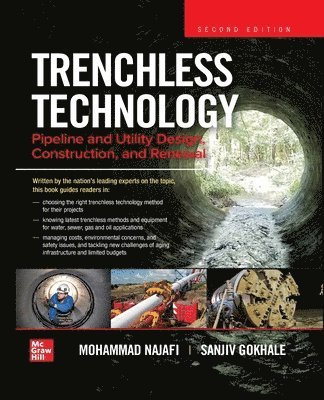
This thoroughly revised reference covers the latest techniques and materials for high-demand trenchless technology in underground projects. Written by recognized experts in the field, Trenchless Technology: Pipeline and Utility Design, Construction, and Renewal, Second Edition offers clear explanations of the full range of trenchless technologies and pertinent regulations. You will get complete details on new tools, techniques, and analysis methods and discover how to choose between them. The information contained in this guide can save you thousands of dollars in costs and weeks of surface disruptions.
Coverage includes:
Planning and design considerations for trenchless construction and renewal methods
Director, Center for Underground Infrastructure Research (CUIR) University of Texas at Arlington, Texas
ForewordForeword to First EditionPreface1 Overview and Comparison of Trenchless Technologies1.1 Introduction1.2 Two Main Divisions of Trenchless Technology Methods1.3 Trenchless Construction Methods (TCMs)1.4 Trenchless Renewal Methods (TRMs)1.5 Summary2 Social Costs of Utility Construction: A Life Cycle Cost Approach2.1 Cost of a Project2.2 Preconstruction Costs2.3 Construction Costs2.4 Postconstruction Costs2.5 Calculating Social Costs2.6 Estimating Cost of Traffic Disruptions2.7 Reducing Social Costs2.8 Summary3 Pipeline Asset Management, Condition Assessment, and Cleaning3.1 Background3.2 Asset Management3.3 Causes of Pipeline Deterioration3.4 Pipeline Inspection: Gravity Sewer Pipe3.5 Pipeline Inspection: Pressure Pipe3.6 Acoustic Emission Testing (AET)3.7 Tethered and Untethered Transmission Main Leak Location3.8 Pipeline Cleaning Methods3.9 Gas and Hazardous Liquid Asset Management3.10 External Corrosion3.11 Internal Corrosion3.12 Inline Inspection3.13 Third Party Damage Prevention3.14 Surveys and Patrols3.15 Advanced Leak Detection3.16 Emerging Technologies3.17 Acknowledgement4 Design Considerations for Trenchless Pipeline Construction Methods4.1 Introduction4.2 Surface Survey4.3 Subsurface Investigations4.4 Alignment Considerations4.5 Calculating Jacking Force in Pipe Jacking and Microtunneling4.6 Summary5 Design Considerations for Trenchless Renewal Methods5.1 Introduction5.2 TRM Selection Process5.3 Selection of a Renewal Method Based on Existing Pipe Conditions5.4 Selection of a Renewal Method Based on Site and Project Conditions5.5 Selection of a Renewal Method (a Six-Step Process)5.6 General Design Considerations5.7 Structural Design of CIPP6 Pipe Materials for Trenchless Technology6.1 Introduction6.2 Pipe-Soil Interaction6.3 Pipe Selection Considerations6.4 Cement-Based Pipes6.5 Vitrified Clay Pipe6.6 Plastics Pipes6.7 Metallic Pipes6.8 Corrosion Protection6.9 Acknowledgments7 Horizontal Auger Boring (Bore and Jack)7.1 Introduction7.2 Brief History7.3 Method Description7.4 Cradle-Type Horizontal Auger Boring7.5 Main Features and Application Range7.6 Guidance Systems7.7 Hybrid Methods8 Pipe Ramming8.1 Introduction8.2 Method Description8.3 Main Features and Application Range8.4 Effects of Pipe Ramming on Surrounding Environment9 Pipe/Box Jacking and Utility Tunneling9.1 Introduction to Pipe Jacking9.2 Method Description9.3 Main Features and Application Range9.4 Introduction to Utility Tunneling9.5 Method Description9.6 Main Features and Application Range10 Horizontal Directional Drilling10.1 Introduction and Background10.2 HDD Classifications10.3 Method Description10.4 Main HDD Features and Application Range10.5 Acknowledgment11 Microtunneling Methods11.1 Introduction11.2 Method Description11.3 Microtunneling Process11.4 Main Features and Application Range12 Pilot Tube12.1 Introduction12.2 Method Description12.3 Main Features and Application Range12.4 Advantages12.5 Limitations12.6 Acknowledgment13 Direct Pipe13.1 Introduction and Background13.2 Method Description13.3 Main Features and Application Range13.4 Hydraulic Fracture Analysis for Direct Pipe13.5 Case Study13.6 Review Questions13.7 Acknowledgments14 Cured-in-Place-Pipe14.1 Introduction14.2 Site Compatibility and Applications14.3 Main Characteristics14.4 Method Description14.5 Major Advantages14.6 Major Limitations14.7 Case Study15 Sliplining15.1 Introduction15.2 Site Compatibility and Applications15.3 Main Characteristics15.4 Sliplining Methods15.5 Installation15.6 Design Considerations15.7 Sliplining Gas Lines15.8 Advantages15.9 Limitations15.10 Case Study: Large Diameter Segmental Sliplining16 Close-fit Pipe16.1 Introduction16.2 Close-fit Pipe Applications16.3 Method Description16.4 Quality Documentation16.5 Advantages16.6 Limitations17 In-line Replacement17.1 Introduction17.2 Pipe Bursting Methods17.3 Pipe Removal Methods17.4 Method Applicability17.5 Construction Considerations17.6 Advantages17.7 Limitations18 Service Lateral Renewal18.1 Introduction18.2 Service Lateral Renewal Methods18.3 Advantages18.4 Limitations19 Localized Repair19.1 Introduction19.2 Primary Characteristics19.3 Robotic Repairs19.4 Grouting19.5 Internal Seal19.6 Point CIPP20 Modified Sliplining20.1 Introduction20.2 Spiral Wound Lining (SWL)20.3 Panel Lining (PL)20.4 Fiber Reinforced Polymer (FRP) Linings20.5 Acknowledgment21 Spray Applied Pipe Linings21.1 Introduction21.2 Material Type and Purpose21.3 Installation Process21.4 Inspection and Testing21.5 Acknowledgment22 Thermoformed Pipe22.1 Introduction22.2 Thermoformed Pipe Applications22.3 Construction Considerations22.4 Quality Assurance and Documentation22.5 Advantages22.6 Limitations23 Sewer Maintenance Hole Renewal23.1 Introduction23.2 Maintenance Hole Components and Typical Problems23.3 Maintenance Hole Inspection and Safety Issues23.4 Classification of Maintenance Hole Problems and Selection of Proper Method23.5 Decision Support Tool for Maintenance Hole Rehabilitation23.6 Summary of Maintenance Hole Renewal Methods23.7 Advantages and Limitations of Maintenance Hole Renewal MethodsGlossaryAcronyms and AbbreviationsOrganizations Related to Trenchless TechnologyConversion TableBibliographyReferencesIndex