
Trade Facilitation and Regional Cooperation in Asia
Inbunden, Engelska, 2010
2 339 kr
Beställningsvara. Skickas inom 5-8 vardagar. Fri frakt för medlemmar vid köp för minst 249 kr.
This insightful book collects empirical analyses and case studies to clarify issues and draw policy recommendations for facilitating greater regional trade through increased cooperation.Asia s rapid development has been heavily dependent on markets external to the region. However, given the unlikely timely recovery of the United States or Europe there is an urgent need to develop domestic and regional markets. While greater integration has long been a regional goal, its importance has never been more pressing. To facilitate trade and promote growth and regional integration, and to counteract declining markets in other regions, Asian countries have announced large expenditures for developing infrastructure. Thus, a look at how investment in regional infrastructure promotes and supports interregional trade growth has never been timelier. While the focus is on informing policy-making in Asia, the findings also have relevance for other regions. The detailed studies in this book will be of particular interest to academic economists, policy-makers, and the broader development community.Contributors: N. Banik, D.H. Brooks, J. Gilbert, L. Shantong, S. Stone, A. Strutt, T.S. Yean, H. Wang
Produktinformation
- Utgivningsdatum2010-06-30
- Mått156 x 234 x undefined mm
- FormatInbunden
- SpråkEngelska
- SerieADBI series on Asian Economic Integration and Cooperation
- FörlagEdward Elgar Publishing Ltd
- ISBN9781848449862
Tillhör följande kategorier
Hoppa över listan







Du kanske också är intresserad av
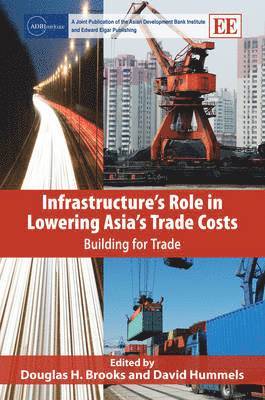
Infrastructure’s Role in Lowering Asia’s Trade Costs
Douglas H. Brooks, David Hummels
Inbunden, 2009
2 679 kr
Implications of the Global Financial Crisis for Financial Reform and Regulation in Asia
Masahiro Kawai, David G. Mayes, Peter Morgan
Inbunden, 2012
2 819 kr
New Global Economic Architecture
Masahiro Kawai, Peter J. Morgan, Pradumna B. Rana
Inbunden, 2014
2 659 kr
Infrastructure for Asian Connectivity
Biswa Nath Bhattacharyay, Masahiro Kawai, Rajat M. Nag
Inbunden, 2012
3 919 kr