
- Nyhet
Del i serien Historical Materialism
Time, Capitalism, And Alienation: A Socio-historical Inquiry Into The Making Of Modern Time
Historical Materialism, Volume 96
Häftad, Engelska, 2016
389 kr
Beställningsvara. Skickas inom 5-8 vardagar. Fri frakt för medlemmar vid köp för minst 249 kr.
Martineau challenges us to see time not as an objective reality, but as something structured by power and property relations. In Time, Capitalism And Alienation, the author offers and account of the histories of social time in Europe. Approaching time as a social phenomenon traversed by various power and property relations, this work provides a socio-theoretical and historical analysis of the relationship between clock-time and capitalist social relations, problematizing the rise to hegemony of a clock-time regime.
Produktinformation
- Utgivningsdatum2016-07-26
- Mått152 x 229 x 14 mm
- Vikt278 g
- FormatHäftad
- SpråkEngelska
- SerieHistorical Materialism
- Antal sidor179
- FörlagHaymarket Books
- ISBN9781608466405
Tillhör följande kategorier
Hoppa över listan





Mer från samma serie
Dialectic Of The Ideal: Evald Ilyenkov And Creative Soviet Marxism
Alex Levant, Vesa Oittinen
Häftad, 2015
459 kr
Toward a New World: Articles and Essays, 1901-1906
Alexander Bogdanov, David G. Rowley, David G Rowley
Häftad, 2022
529 kr
Hoppa över listan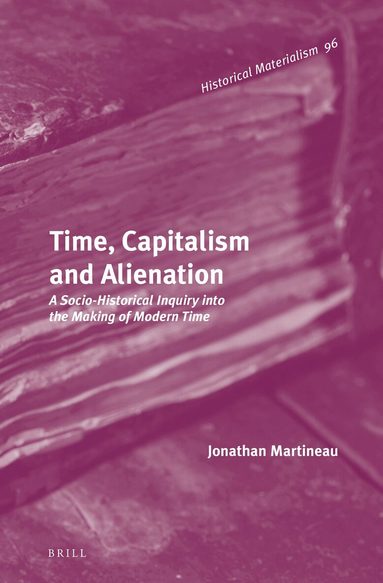








Du kanske också är intresserad av
Del 96
- Nyhet
- Nyhet
Del 7
- Nyhet
- Nyhet
Del 6
Del 3
- Nyhet
Del 4
- Nyhet
- Nyhet
Del 11