
Threats and Alliances in the Middle East
Saudi and Syrian Policies in a Turbulent Region
Häftad, Engelska, 2020
739 kr
Beställningsvara. Skickas inom 5-8 vardagar. Fri frakt för medlemmar vid köp för minst 249 kr.
Finns i fler format (1)
Examining differing perceptions of threats and the subsequent alliance choices of two Arab states, Saudi Arabia and Syria, during three pivotal wars in the region: the Iran-Iraq War (1980-1988), the Lebanon War (2006), and the Gaza War (2009), May Darwich analyses how ideational and material forces influence leaders' perceptions in the Middle East, and their broader international relationships. Using these comparative cases studies, Darwich advances our understanding of why, and the conditions under which, identity can play a predominant role in shaping the perception of threat in some cases, whilst material power is predominant in others. By engaging in significant debates about the role identity and material power in shaping state behaviour in the Middle East, this study has significant implications for international relations theory and beyond.
Produktinformation
- Utgivningsdatum2020-10-29
- Mått230 x 150 x 12 mm
- Vikt330 g
- FormatHäftad
- SpråkEngelska
- Antal sidor222
- FörlagCambridge University Press
- ISBN9781108737630
Tillhör följande kategorier
Hoppa över listan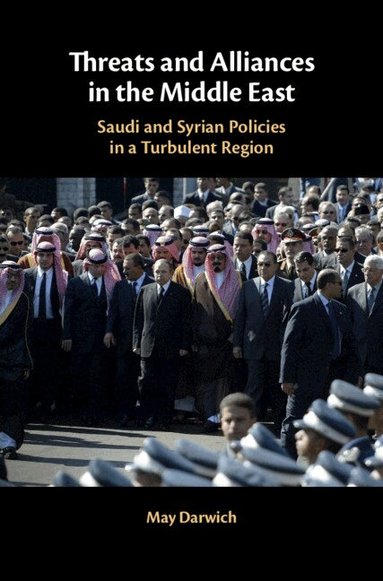






Du kanske också är intresserad av
- Nyhet
- Nyhet
Del 7
- Nyhet
Del 11
- Nyhet
Del 4
- Nyhet
Del 6
- Nyhet
Del 3