
Therapeutic Pluralism
Exploring the Experiences of Cancer Patients and Professionals
Häftad, Engelska, 2008
649 kr
Tillfälligt slut
Finns i fler format (1)
The profile of complementary and alternative medicine (CAM) has risen dramatically over the last decade and cancer patients represent its most prolific users. As a result, the NHS and UK cancer services are attempting to develop a wider range of therapeutic options for patients. Despite such developments, little is known about why cancer patients use CAM, its perceived benefits and the perspectives of the doctors and nurses involved. Drawing on extensive fieldwork in the UK, Therapeutic Pluralism includes over 120 interviews with cancer patients and professionals, plus innovative ‘diary’ data which, for the first time, detail the experiences of CAM users. It gives a systematic analysis of issues such as: The development of patient preferences and influences on decision making Expectations of CAM and interpretations of ‘success’ in cancer treatment The nature and importance of ‘evidence’ and ‘effectiveness’ for patients The organisational dynamics involved in integrating CAM into the NHS Pathways to CAM and the role of the Internet The role of oncology clinicians in patients’ experiences of cancer and their use of CAMs Therapeutic Pluralism is essential reading for students and researchers of medical sociology, complementary and alternative medicine and cancer. It will also be useful to medical and health professionals, and policy-makers with an interest in complementary and alternative medicine.
Produktinformation
- Utgivningsdatum2008-03-19
- Mått156 x 234 x undefined mm
- Vikt300 g
- FormatHäftad
- SpråkEngelska
- Antal sidor168
- FörlagTaylor & Francis Ltd
- ISBN9780415398534
Tillhör följande kategorier
Hoppa över listan

Mer från samma författare
Women's Health and Complementary and Integrative Medicine
Jon Adams, Amie Steel, Alex Broom, Jane Frawley
Häftad, 2019
849 kr
Traditional, Complementary and Alternative Medicine and Cancer Care
Philip Tovey, John Chatwin, Alex Broom
Inbunden, 2007
3 299 kr
Traditional, Complementary and Alternative Medicine and Cancer Care
Philip Tovey, John Chatwin, Alex Broom
Häftad, 2007
809 kr
Hoppa över listan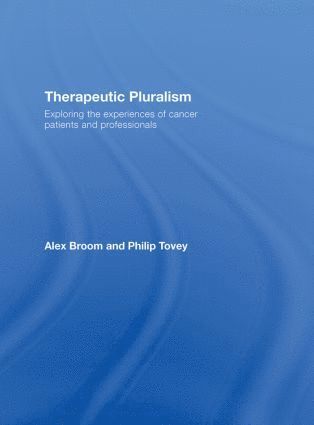

Du kanske också är intresserad av
Traditional, Complementary and Alternative Medicine and Cancer Care
Philip Tovey, John Chatwin, Alex Broom
Häftad, 2007
809 kr
Traditional, Complementary and Alternative Medicine and Cancer Care
Philip Tovey, John Chatwin, Alex Broom
Inbunden, 2007
3 299 kr
Mainstreaming Complementary and Alternative Medicine
Philip Tovey, Gary Easthope, Jon Adams
Häftad, 2003
1 059 kr
Mainstreaming Complementary and Alternative Medicine
Philip Tovey, Gary Easthope, Jon Adams
Inbunden, 2003
3 609 kr
Balance Sheets: How to Read and Understand Them; a Guide for Investors, Business Men, Commercial Students, Etc
Philip Tovey
Häftad, 2021
389 kr
Complementary and Alternative Medicine in Nursing and Midwifery
Jon Adams, Philip Tovey
Häftad, 2007
569 kr
Balance Sheets: How to Read and Understand Them; a Guide for Investors, Business Men, Commercial Students, Etc
Philip Tovey
Inbunden, 2021
599 kr
Complementary and Alternative Medicine in Nursing and Midwifery
Jon Adams, Philip Tovey
Inbunden, 2007
1 999 kr