
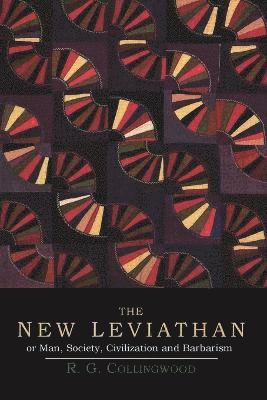
The New Leviathan
or Man, Society, Civilization, and Barbarism
Inbunden, Engelska, 1992
3 549 kr
Beställningsvara. Skickas inom 7-10 vardagar. Fri frakt för medlemmar vid köp för minst 249 kr.
Finns i fler format (1)
The New Leviathan, originally published in 1942, a few months before the author's death, is the book which R. G. Collingwood chose to write in preference to completing his life's work on the philosophy of history. It was a reaction to the Second World War and the threat which Nazism and Fascism constituted to civilization. The book draws upon many years of work in moral and political philosophy and attempts to establish the multiple and complex connections between the levels of consciousness, society, civilization, and barbarism. Collingwood argues that traditional social contract theory has failed to account for the continuing existence of the non-social community and its relation to the social community in the body politic. He is also critical of the tendency within ethics to confound right and duty.The publication of additional manuscript material in this revised edition demonstrates in more detail how Collingwood was determined to show that right and duty occupy different levels of rational practical consciousness. The additional material also contains Collingwood's unequivocal rejection of relativism.David Boucher's introduction shows that The New Leviathan and The Idea of History are integrally related and that neither can be properly understood independently of the other. He is also concerned to show how many of Collingwood's ideas have a contemporary relevance, and that his ideas on barbarism are not so unusual as they might at first appear.
Produktinformation
- Utgivningsdatum1992-12-17
- Mått145 x 223 x 34 mm
- Vikt732 g
- FormatInbunden
- SpråkEngelska
- Antal sidor586
- FörlagClarendon Press
- ISBN9780198239819
Tillhör följande kategorier
Hoppa över listan![R G Collingwood - Idea of History [1946 Edition], Häftad](https://bilder.akademibokhandeln.se/images_akb/9781614275619_766)






Mer från samma författare
Del 11
Del 31
The Philosophy of Enchantment
R. G. Collingwood, David Boucher, Wendy James, Philip Smallwood
Häftad, 2007
1 659 kr
Hoppa över listan


![R G Collingwood - Idea of History [1946 Edition], Häftad](https://bilder.akademibokhandeln.se/images_akb/9781684931972_766)


Du kanske också är intresserad av
The Philosophy of Enchantment
R. G. Collingwood, David Boucher, Wendy James, Philip Smallwood
Häftad, 2007
1 659 kr
Del 11