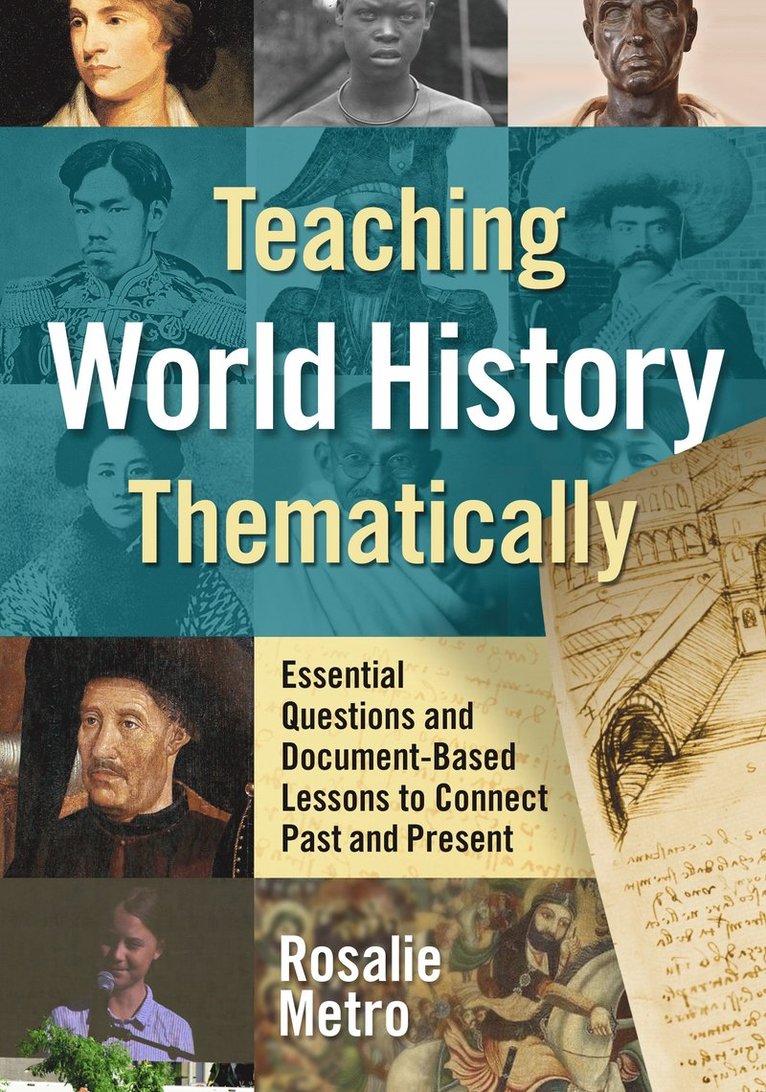
This book offers the tools teachers need to get started with a more thoughtful and compelling approach to teaching history, one that develops literacy and higher-order thinking skills, connects the past to students’ lives today, and meets social studies 3C standards and most state standards (grades 6–12). The author provides over 90 primary sources organized into seven thematic units, each structured around an essential question from world history. As students analyze carefully excerpted documents—including speeches by queens and rebels, ancient artifacts, and social media posts—they build an understanding of how diverse historical figures have approached key issues. At the same time, students learn to participate in civic debates and develop their own views on what it means to be a 21st-century citizen of the world. Each unit connects to current events with dynamic classroom activities that make history come alive. In addition to the documents themselves, this teaching manual provides strategies to assess student learning; mini-lectures designed to introduce documents; activities and reproducibles to help students process, display, and integrate their learning; guidance to help teachers create their own units; guidelines for respectful student debate and discussion; and more.Book Features:A timely aid for secondary school teachers tasked with meeting standards and other state-level quality requirements.An approach that promotes student engagement and critical thinking to replace or augment a traditional textbook.Challenges to the “master narrative” of world history from figures like Queen Nzinga and Huda Sha’arawi, as well as traditionally recognized historical figures such as Pericles and Napoleon.Essential questions to help students explore seven of the most important recurring themes in world history.Role-plays and debates to promote interaction among students.Printable copies of the documents included in the book can be downloaded at tcpress.com.
Rosalie Metro is an assistant teaching professor in the Department of Learning, Teaching, and Curriculum at the University of Missouri-Columbia and the author of Teaching U.S. History Thematically: Document-Based Lessons for the Secondary Classroom.
ContentsAcknowledgments xiiiIntroduction: Why Use a Thematic, Document-Based Approach for Teaching World History? 1Why Thematic? 2Why Document Based? 3Meeting Common Core and Other State and National Standards 7What Are the Long-Term Changes and Recurring Patterns in World History? 9Structure of a Unit 9Structure of a Lesson 13Assessment 17Accounting for Grade Level and Differentiating Instruction 18Classroom Climate 19Designing Your Own Thematic Units 221. Forms of Government: What Should Be the Rights and Responsibilities of the Rulers and the Ruled? 23Lesson 1.1: What Are Activists Asking the United Nations to Do About the Murder of Journalist Jamal Khashoggi? 24Lesson 1.2: What Kind of Laws Did King Hammurabi Make for His Subjects? 26Lesson 1.3: How Did Pericles Describe Direct Democracy in Athens? 29Lesson 1.4: How Did Sparta’s Oligarchy Work? 31Lesson 1.5: What Was the Role of the Imperial Monarch in Han Dynasty China? 33Lesson 1.6: How Did the Roman Republic Resemble a Monarchy, an Aristocracy, and a Democracy? 35Lesson 1.7: How Did Suryavarman II Rule as Devaraja? 38Lesson 1.8: How Did Muawiyah I Govern His Caliphate? 40Lesson 1.9: How Did Louis XIV Create an Absolute Monarchy in France? 42Lesson 1.10: How Did Igbo Women Command Respect in a Stateless Society? 45Lesson 1.11: How Is India’s Democracy Structured? 47Lesson 1.12: How Does Finland Guarantee Social Welfare to Its Citizens? 49Lesson 1.13: How Have Inuit People Practiced Egalitarianism? 522. Religion and Society: How Should Belief Systems Influence Our Lives? 55Lesson 2.1: What Were Albert Einstein’s Arguments for Agnosticism? 56Lesson 2.2: How Is Brahman Described in the Hindu Upanishads? 58Lesson 2.3: How Did Confucius Envision the Ideal Society? 60Lesson 2.4: What Did the Dao De Jing Advise People to Do? 63Lesson 2.5: What Did the Buddha Teach Was the Path to Enlightenment? 65Lesson 2.6: What Did God Command Jewish People to Do in the Torah? 67Lesson 2.7: What Did Jesus Command Christians to Do in the Holy Bible? 70Lesson 2.8: What Did Allah Command Muslims to Do in the Holy Quran? 723. Us vs. Them: Who Is Civilized, and Who Is a Barbarian? 75Lesson 3.1: How Did François Hollande React to ISIS’s Attack on France? 76Lesson 3.2: How Was Sumerian Civilization Different From What Came Before It? 78Lesson 3.3: How Did Alexander the Great Try to Civilize the World? 80Lesson 3.4: Why Did Ancient Romans Blame the Collapse of Their Empire on Barbarians? 83Lesson 3.5: Why Did Portuguese Colonists Portray Africans as Uncivilized? 85Lesson 3.6: How Did Ideas of Civilization Differ in the Ottoman and Austrian Empires? 87Lesson 3.7: Did Spanish Colonization of the Americas Bring Civilization or Barbarism? 89Lesson 3.8: Why Did Qing Dynasty Chinese See People From Europe as Barbarians? 91Lesson 3.9: How Did Enlightenment Philosophers Redefine Civilization? 94Lesson 3.10: Why Did French People Think They Needed to Civilize “Inferior Races”? 96Lesson 3.11: How Did Meiji Japanese Leaders Define Civilization? 99Lesson 3.12: What Kind of Civilization Did Hitler Envision for the World? 101Lesson 3.13: How Does the Universal Declaration of Human Rights Describe a Civilized Society? 1044. Conflict: What Is Worth Fighting For? 107Lesson 4.1: What Are the Effects of the War in Yemen on Civilians? 108Lesson 4.2: How Did the Greeks Try to Convince the Ionians to Join Their Fight Against the Persians? 110Lesson 4.3: Why Did King Aśoka Want to Stop Wars? 112Lesson 4.4: Why Did Hannibal Attack the Roman Empire? 115Lesson 4.5: Why Did the Normans Attack the Anglo-Saxons in the Battle of Hastings? 117Lesson 4.6: How Did Christians Justify the Crusades? 119Lesson 4.7: How Did Napoleon Motivate Soldiers to Fight for Him? 121Lesson 4.8: Why Did King Leopold II Fight for Control of the Congo? 123Lesson 4.9: Why Did Serbian Nationalists Ignite World War I? 126Lesson 4.10: Why Did Costa Rica Abolish Its Military? 128Lesson 4.11: Why Were Jewish People Willing to Fight for a Country of Their Own? 131Lesson 4.12: Why Have Palestinians Fought Against Israel? 133Lesson 4.13: Why Were Hutus Willing to Kill Tutsis in Rwanda? 1365. Equality vs. Hierarchy: What Should Be the Balance Between Social Equality and Social Hierarchy? 139Lesson 5.1: How Are Ordinary People in South Sudan Working Together for Justice? 140Lesson 5.2: How Did Athenian Democrats Justify Slavery? 142Lesson 5.3: What Social Classes Existed in the Maya Empire? 144Lesson 5.4: How Did Mongol Pastoralists Organize Their Nomadic Society? 146Lesson 5.5: How Did the Incan Allyu System Work? 149Lesson 5.6: How Did the Tokugawa Shogunate Practice Feudalism? 151Lesson 5.7: Why Did Karl Marx Envision a Classless Society? 153Lesson 5.8: How Did White South Africans Justify Apartheid Rule? 156Lesson 5.9: How Did Dalit People Seek Equality in India? 158Lesson 5.10: How Did the Khmer Rouge Justify Violence in the Name of Equality? 1616. Economics, Technology, and the Environment: How Should People Get the Resources They Need? 165Lesson 6.1: What Did Greta Thunberg Ask World Leaders to Do About Climate Change? 166Lesson 6.2: How Have Australian Aboriginal People Interacted With Their Environment? 168Lesson 6.3: What Were the Causes and Effects of the Neolithic Revolution? 170Lesson 6.4: How Did Ancient Egyptians Use the Nile River to Gain Resources? 172Lesson 6.5: How Did Trade Promote Cultural Diffusion Along the Silk Road? 174Lesson 6.6: How Did the Mali Empire Profit From Trade in Gold and Salt? 176Lesson 6.7: How Did Leonardo da Vinci Envision the Ideal City During the Renaissance? 178Lesson 6.8: How Did the Netherlands Profit From Colonization? 180Lesson 6.9: How Did Aztec Technology Aid Agriculture? 183Lesson 6.10: How Did Enslaved Africans Experience the Transatlantic Slave Trade? 185Lesson 6.11: How Was Free-Market Capitalism Supposed to Work? 187Lesson 6.12: What Were the Goals and Results of Mao Zedong’s Command Economy? 189Lesson 6.13: What Were the Effects of the Chernobyl Nuclear Disaster? 1927. Gender: What Should Be the Roles of Women and Men in Society? 195Lesson 7.1: How Are Transgender People Challenging Assumptions About Women and Men? 196Lesson 7.2: Why Did Roman Women Protest Being Taxed? 198Lesson 7.3: What Role Did Ibn Rushd Think Women Should Play in Islamic Society? 200Lesson 7.4: How Did Queen Elizabeth I Defend Her Leadership? 202Lesson 7.5: How Did Queen Nzinga Resist Portuguese Colonizers? 204Lesson 7.6: How Did Catherine the Great Present Herself as a Leader? 206Lesson 7.7: What Were Mary Wollstonecraft’s Arguments for Women’s Rights? 209Lesson 7.8: Why Did Qiu Jin Argue for Chinese Women’s Freedoms? 211Lesson 7.9: Why Did Some Women Oppose Getting the Right to Vote? 213Lesson 7.10: How Did Käthe Kollwitz Work for Peace Through Art? 216Lesson 7.11: How Did Huda Sha’arawi Argue for Feminist Nationalism in Egypt? 218Lesson 7.12: How Did Una Marson Participate in Worldwide Struggles Against Sexism and Racism? 2208. Resistance, Revolution, and Reform: How Should People Bring About Political and Social Change? 223Lesson 8.1: How Did Egyptians Use Social Media and Protest to Bring About Political Change? 224Lesson 8.2: How Did Julius Caesar Gain Control of Rome? 226Lesson 8.3: How Did the Safavid Empire Use Diplomacy to Accomplish Its Goals? 228Lesson 8.4: How Did Martin Luther Bring About the Protestant Reformation? 231Lesson 8.5: Why Did Maximilien Robespierre Believe Violence Was Necessary to Achieve the Goals of the French Revolution? 233Lesson 8.6: How Did Haitians End Slavery and Gain Independence From France? 236Lesson 8.7: How Did Southeast Asians Avoid Rulers Who Wanted to Control Them? 238Lesson 8.8: How Did Gandhi Use Nonviolent Resistance Against British Colonization? 241Lesson 8.9: Why Did Emiliano Zapata Think Land Reform Was Necessary for Mexico? 243Lesson 8.10: How Did Joseph Stalin Try to Revolutionize Soviet Society? 246Lesson 8.11: Why Did Algerians Believe That Violence Was Necessary to Decolonize Their Country? 249Lesson 8.12: How Did Rigoberta Menchú Resist the Human Rights Abuses of the Guatemalan Government? 251Lesson 8.13: How Did Václav Havel Spread Dissent Against the Totalitarian Regime in Czechoslovakia? 2539. Continuity and Change: What Are the Long-Term Changes and Recurring Patterns in World History? 257Lesson 9.1: How Did Human Societies Begin? 257Lesson 9.2: How Did Early Civilizations and Pastoral Peoples Emerge in the Fifth to the First Millennia BCE? 257Lesson 9.3: How Did Classical Traditions, Major Religions, and Giant Empires Emerge in the First Millennium BCE? 258Lesson 9.4: How Did Zones of Exchange and Encounter Expand in the First Millennium CE? 258Lesson 9.5: How Did Hemispheric Interactions Intensify in the Second Millennium CE? 258Lesson 9.6: Why Did the First Global Age Emerge in the 15th to 18th Centuries? 258Lesson 9.7: What Were the Causes and Effects of Revolutions in the 18th to 20th Centuries? 259Lesson 9.8: What Were the Crises and Achievements of the First Half of the 20th Century? 259Lesson 9.9: What Have Been the Promises and Paradoxes of the Second Half of the 20th Century? 259Appendixes 261Appendix A: Quick Reference Guide 261Appendix B: Course Entry Survey 272Appendix C: Course Exit Survey 272Appendix D: Unit Entry Survey 273Appendix E: Biographical Research Paper Instructions 273Appendix F: Summit Research Worksheet 273Appendix G: Unit Exit Survey 274Appendix H: 21st-Century Issue Letter Instructions 274Appendix I: Designing Your Own Thematic Units 275Appendix J: Online Content 275References 277Index 279About the Author 287
Azmil Tayeb, Rosalie Metro, Will Brehm, Azmil (University Sains Malaysia) Tayeb, USA) Metro, Rosalie (University of Missouri, CO, UK) Brehm, Will (University College London