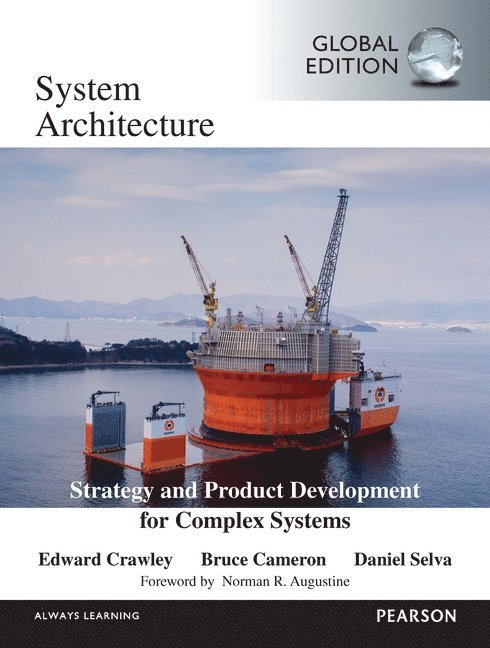
Systems Architecture
Strategy and Product Development for Complex Systems
Inbunden, Engelska, 2016
2 559 kr
Architecture and Function of Complex Systems
System architecture is the study of early decision making in complex systems. This text teaches how to capture experience and analysis about early system decisions, and how to choose architectures that meet stakeholder needs, integrate easily, and evolve flexibly. With case studies written by leading practitioners, from hybrid cars to communications networks to aircraft, this text showcases the science and art of system architecture.Produktinformation
- Utgivningsdatum2016-03-31
- Mått178 x 236 x 23 mm
- Vikt848 g
- FormatInbunden
- SpråkEngelska
- Antal sidor480
- Upplaga1
- FörlagPearson Education
- ISBN9780133975345
Tillhör följande kategorier
Edward F. Crawley is the President of the Skolkovo Institute of Science and Technology (Skoltech) in Moscow, Russia, and a Professor of Aeronautics and Astronautics and Engineering Systems at MIT. He is the founder of ACX, BioScale, DataXu, and Ekotrope, and a member four national academies of engineering. Bruce G. Cameron is the founder of Technology Strategy Partners (TSP), a consulting firm, and the Director of the System Architecture Lab at MIT. He has worked with 60 Fortune 500 firms across aerospace, high tech, and consumer goods, and has built hardware currently on orbit. Daniel Selva is a Professor of Mechanical and Aerospace Engineering at Cornell. He has pioneered the use of machine learning tools in system architecture analysis, and is the recipient of Best Paper and Hottest Article awards for his work with NASA.
- ForewordPrefaceAcknowledgmentsAbout the Authors PART 1: SYSTEM THINKING 1. Introduction to System ArchitectureArchitecture of Complex SystemsThe Advantages of Good ArchitectureLearning ObjectivesOrganization of the TextReferences 2. System Thinking2.1 Introduction2.2 Systems and Emergence2.3 Task 1: Identify the System, Its Form, and Its Function2.4 Task 2: Identify Entities of a System, Their Form, and Their Function2.5 Task 3: Identify the Relationships among the Entities2.6 Task 4: Emergence2.7 SummaryReferences 3. Thinking about Complex Systems3.1 Introduction3.2 Complexity in Systems3.3 Decomposition of Systems3.4 Special Logical Relationships3.5 Reasoning through Complex Systems3.6 Architecture Representation Tools: SysML and OPM3.7 SummaryReferences PART 2: ANALYSIS OF SYSTEM ARCHITECTURE 4. Form4.1 Introduction4.2 Form in Architecture4.3 Analysis of Form in Architecture4.4 Analysis of Formal Relationships in Architecture4.5 Formal Context4.6 Form in Software Systems4.7 SummaryReferences 5. Function5.1 Introduction5.2 Function in Architecture5.3 Analysis of External Function and Value5.4 Analysis of Internal Function5.5 Analysis of Functional Interactions and Functional Architecture5.6 Secondary Value-Related External and Internal Functions5.7 SummaryReferences 6. System Architecture6.1 Introduction6.2 System Architecture: Form and Function6.3 Non-idealities, Supporting Layers, and Interfaces in System Architecture6.4 Operational Behavior6.5 Reasoning about Architecture Using Representations6.6 SummaryReferences 7. Solution-Neutral Function and Concepts7.1 Introduction7.2 Identifying the Solution-Neutral Function7.3 Concept7.4 Integrated Concepts7.5 Concepts of Operations and Services7.6 SummaryReferences 8. From Concept to Architecture8.1 Introduction8.2 Developing the Level 1 Architecture8.3 Developing the Level 2 Architecture8.4 Home Data Network Architecture at Level8.5 Modularizing the System at Level8.6 SummaryReferences PART 3: CREATING SYSTEM ARCHITECTURE 9. The Role of the Architect9.1 Introduction9.2 Ambiguity and the Role of the Architect9.3 The Product Development Process9.4 SummaryReferences 10. Upstream and Downstream Influences on System Architecture10.1 Introduction10.2 Upstream Influence: Corporate Strategy10.3 Upstream Influence: Marketing10.4 U pstream Influence: Regulation and Pseudo-Regulatory Influences10.5 Upstream Influence: Technology Infusion10.6 Downstream Influence: Implementation—Coding, Manufacturing, and Supply Chain Management10.7 Downstream Influence: Operations10.8 Downstream Influence: Design for X10.9 Downstream Influence: Product and System Evolution, and Product Families10.10 The Product Case: Architecture Business Case Decision (ABCD)10.11 SummaryReferences 11. Translating Needs into Goals11.1 Introduction11.2 Identifying Beneficiaries and Stakeholders11.3 Characterizing Needs11.4 Interpreting Needs as Goals11.5 Prioritizing Goals11.6 SummaryReferences 12. Applying Creativity to Generating a Concept12.1 Introduction12.2 Applying Creativity to Concept12.3 Develop the Concepts12.4 Expand the Concepts and Develop the Concept Fragments12.5 Evolve and Refine the Integrated Concepts12.6 Select a Few Integrated Concepts for Further Development12.7 SummaryReferences 13. Decomposition as a Tool for Managing Complexity13.1 Introduction13.2 Understanding Complexity13.3 Managing Complexity13.4 SummaryReferences PART 4: ARCHITECTURE AS DECISIONS 14. System Architecture as a Decision-Making Process14.1 Introduction14.2 Formulating the Apollo Architecture Decision Problem14.3 Decisions and Decision Support14.4 Four Main Tasks of Decision Support Systems14.5 Basic Decision Support Tools14.6 Decision Support for System Architecture14.7 SummaryReferences 15. Reasoning about Architectural Tradespaces15.1 Introduction15.2 Tradespace Basics15.3 The Pareto Frontier15.4 Structure of the Tradespace15.5 Sensitivity Analysis15.6 Organizing Architectural Decisions15.7 SummaryReferences 16. Formulating and Solving System Architecture Optimization Problems16.1 Introduction16.2 Formulating a System Architecture Optimization Problem16.3 NEOSS Example: An Earth Observing Satellite System for NASA16.4 Patterns in System Architecting Decisions16.5 Formulating a Large-scale System Architecture Problem16.6 Solving System Architecture Optimization Problems16.7 SummaryReferences AppendicesChapter ProblemsIndex