
Strategic Multilateral Exchange
General Equilibrium with Imperfect Competition
Inbunden, Engelska, 2002
2 439 kr
Beställningsvara. Skickas inom 5-8 vardagar. Fri frakt för medlemmar vid köp för minst 249 kr.
Jean Gabszewicz's new book is devoted to the study of strategic multilateral exchange. Contrary to the classical competitive paradigm in which agents are assumed to behave as price takers, here traders are allowed to consciously behave as strategic agents who aim to influence trade to their own advantage. This is usually done in oligopoly theory using a partial equilibrium approach while in this case a system of interrelated markets is considered. Primarily, the book discusses the game-theoretic concept of core and the relationship between core and the set of price allocations in economies embodying significant traders is explored. The author goes on to adopt a non-cooperative approach building on the concept of Nash equilibrium.Strategic Multilateral Exchange will be welcomed by academics, advanced research scholars and doctoral students with an interest in economic theory, microeconomic theory and general equilibrium. It will also appeal to mathematical economists with an orientation in mathematical economics and game theory.
Produktinformation
- Utgivningsdatum2002-10-29
- Mått156 x 234 x undefined mm
- FormatInbunden
- SpråkEngelska
- FörlagEdward Elgar Publishing Ltd
- ISBN9781858980287
Tillhör följande kategorier
Hoppa över listan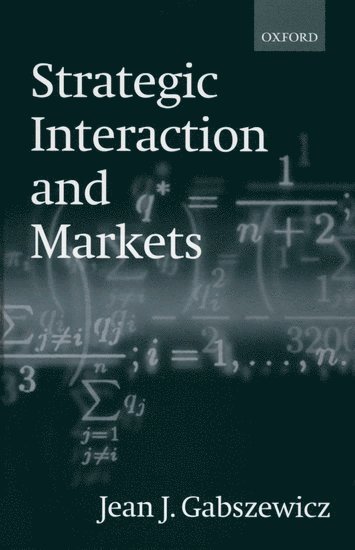

Mer från samma författare
Del 102
Microeconomic Theories of Imperfect Competition: Old Problems and New Perspectives
Jean J. Gabszewicz, Jacques-François Thisse
Inbunden, 1999
9 139 kr
Hoppa över listan






Du kanske också är intresserad av
Del 102
Microeconomic Theories of Imperfect Competition: Old Problems and New Perspectives
Jean J. Gabszewicz, Jacques-François Thisse
Inbunden, 1999
9 139 kr
- Nyhet
Del 11
- Nyhet
Del 3
Del 1
- Nyhet
Del 4
- Nyhet
- Nyhet
- Nyhet
Del 4