Beställningsvara. Skickas inom 10-15 vardagar. Fri frakt för medlemmar vid köp för minst 249 kr.
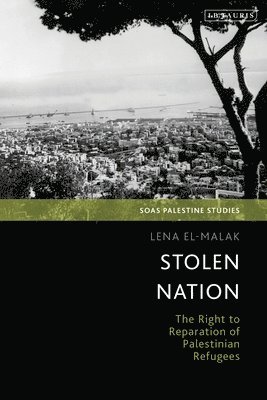
While Palestinians continue to face the threat of expulsion from their homes, identifying legal mechanisms that can be used to assert Palestinian’s property rights is needed more than ever. This book provides a legal analysis of the right to reparation of Palestinian refugees under international law for the destruction and expropriation of their property during the Nakba . Discussing the legal landscape related to property ownership prior to the creation of the State of Israel and the legal basis for the right to reparation under international law, Lena El-Malak advocates for a law-based approach to enforce this right and the form it should take.The book demonstrates how the legal rights of Palestinian refugees, specifically as related to their properties, have been marginalized and excluded from the political discourse of the “peace process”. Here, the legal rights of Palestinian refugees are demonstrated, challenges for invoking these rights in international and domestic courts are determined, and forms of restitution and compensation outlined. This study offers a timely contribution to provide a comprehensive legal, as opposed to a political, economic or historical analysis, of the right to reparation of Palestinian refugees for their property losses. Additionally, the book seeks to demonstrate the importance of adopting a legal framework in any future negotiation for a peaceful resolution to this long standing struggles for liberation.
Lena El-Malak is a technology and data privacy attorney, as well as an expert in public international law and refugee law. Prior to pivoting into a commercial legal career, she worked as a legal and development consultant and has published several reports and studies on issues related to the Middle East. She completed a doctoral thesis in public international law at the School of Oriental and African Studies (SOAS), University of London, UK.
Preface AcknowledgementsForeword Selected Abbreviations Introduction The Persistent Question of Palestinian Refugees Defining the Scope and Terminology The Refugee Issue under International Law Research Question and Outline of the Thesis Chapter One: Dispossession in Palestine 1.1 Introduction 1.2 Land Laws in Palestine during the Ottoman Period (1858-1917) 1.3 Land Laws in Palestine during the British Mandate (1920-1948) 1.4 Legalising Dispossession: Israeli Legislation And Its Impact On Palestinian Ownership of Land (1948-) 1.5 Conclusion Chapter Two: Palestinian Refugee Property Losses: The Grounds forReparation in International Law 2.1 Introduction 2.2 The Legal Concept of Reparation 2.2.1 Clarifying the Terminology 2.2.2 The Grounds for Reparation in International Law: Israel’s Expropriation of Refugee Property under the Law on State Responsibility 2.3 Israeli Expropriation of Palestinian Refugee Property: A Wrongful Act under International Law 2.3.1 Israeli Damage and Expropriation of Palestinian Refugee Propertyas a Violation of International Humanitarian Law 2.3.2 Israeli Property Expropriation and the Doctrine on Enemy Property 2.3.3 Palestinian Refugees’ Property Rights under United NationsResolution Right of Return and Restitution Right of Compensation Significance of Resolution 194 2.3.4 Palestinian Refugees’ Property Rights under Human Rights Law 2.4 Consequences of an Internationally Wrongful Act 2.5 Conclusion Chapter Three: Invoking the Right to Reparation: Is There a Forum forPalestinian Refugee Property Claims? 3.1 Introduction 3.2 Invoking a Right to Reparation before Domestic Courts 3.2.1 The Holocaust Restitution Movement: A Case Apart 3.2.2 Facing the Jurisdictional Barriers: Do the Property Claims of Palestinian Refugees Stand a Chance? 3.2.3 The Limited Advantages of the Litigation Model 3.2.4 Individual Claims before Regional Courts: the Loizidou Case 3.3 Palestinian Refugee Claims and the International Court of Justice 3.3.1 The ICJ’s Contentious Jurisdiction and Palestinian Refugees’Property Claims 3.5.2 The ICJ’s Advisory Jurisdiction and the Rights of PalestinianRefugees 3.4 Collective Settlement of Mass Claims 3.5 Conclusion Chapter Four: Forms of Reparation for Private Property Losses and Legal Obstacles to the Implementation of Palestinian Refugees’ Property Rights 4.1 Introduction 4.2 Forms of Reparation for Private Property Losses 4.2.1 The Right to Restitution 4.2.2 The Right to Compensation 4.3 Legal Obstacles to the Implementation of Palestinian Refugee PropertyRights 4.3.1 Repealing Laws 4.3.2 Dealing with Secondary Occupants 4.3.3 Rights of Descendants4.4 Conclusion Chapter Five: Palestinian Refugee Property Claims in Israeli-PalestinianNegotiations 5.1 Introduction 5.2 From the Nakba to Madrid: The Emergence of an International Consensus In Favour of a Law-Based Approach to the Resolution of theRefugee Issue 5.3 The Madrid Framework 5.3.1 The Madrid Peace Conference – A New Approach to PeaceNegotiations in the Middle East 5.3.2 The Refugee Working Group (RWG)5.3.3 The Ottawa Process 5.4 The Oslo Peace Process 5.4.1 The DOP and the Marginalisation of the Refugee Issue 5.4.2 The DOP: Abandoning a Law-Based Approach to the Resolutionof the Refugee Issue 5.5 Final Status Negotiations: From Camp David II to Taba 5.5.1 Camp David II 5.5.2 The Clinton Parameters 5.5.3 The Taba Negotiations 5.6 Peace Initiatives 5.7 ConclusionConclusion
This is a deeply researched and much-needed study of the international legal background surrounding to Palestinian refugee reparations. It makes a wonderful contribution to the growing literature not onlyl on reparations to Palestinian refugees from the 1948 Arab-Israeli War but reparations more broadly by approaching the topic from a law and rights-based perspective. Scholars and diplomats dealing with the Arab-Israeli Conflict and other conflicts as well will benefit from its insights.