
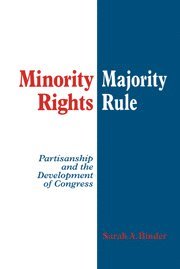
Stalemate
Causes and Consequences of Legislative Gridlock
Häftad, Engelska, 2003
339 kr
Beställningsvara. Skickas inom 10-15 vardagar. Fri frakt för medlemmar vid köp för minst 249 kr.
Gridlock is not a modern legislative condition. Although the term is said to have entered the American political lexicon after the 1980 elections, Alexander Hamilton complained about it more than two hundred years ago. In many ways, stalemate seems endemic to American politics. Constitutional skeptics even suggest that the framers intentionally designed the Constitution to guarantee gridlock. In Stalemate, Sarah Binder examines the causes and consequences of gridlock, focusing on the ability of Congress to broach and secure policy compromise on significant national issues. Reviewing more than fifty years of legislative history, Binder measures the frequency of deadlock during that time and offers concrete advice for policymakers interested in improving the institutional capacity of Congress. Binder begins by revisiting the notion of ""framers' intent,"" investigating whether gridlock was the preferred outcome of those who designed the American system of separated powers. Her research suggests that frequent policy gridlock might instead be an unintended consequence of constitutional design. Next, she explores the ways in which elections and institutions together shape the capacity of Congress and the president to make public law. She examines two facets of its institutional evolution: the emergence of the Senate as a coequal legislative partner of the House and the insertion of political parties into a legislative arena originally devoid of parties. Finally, she offers a new empirical approach for testing accounts of policy stalemate during the decades since World War II. These measurements reveal patterns in legislative performance during the second half of the twentieth century, showing the frequency of policy deadlock and the legislative stages at which it has most often emerged in the postwar period. Binder uses the new measure of stalemate to explain empirical patterns in the frequency of gridlock. The results weave together the effects of institu
Produktinformation
- Utgivningsdatum2003-02-25
- Mått151 x 229 x 11 mm
- Vikt358 g
- FormatHäftad
- SpråkEngelska
- Antal sidor222
- FörlagBloomsbury Publishing Plc
- ISBN9780815709114
Tillhör följande kategorier
Hoppa över listan
Mer från samma författare
The Oxford Handbook of Political Institutions
R. A. W. Rhodes, Sarah A. Binder, Bert A. Rockman
Häftad, 2008
819 kr
Hoppa över listan


Du kanske också är intresserad av
The Oxford Handbook of Political Institutions
R. A. W. Rhodes, Sarah A. Binder, Bert A. Rockman
Häftad, 2008
819 kr
- Nyhet
Del 3
- Nyhet
Del 11
Del 1