
Del i serien Studies in Critical Social Sciences
Sociogony
Social Facts and the Ontology of Objects, Things, and Monsters
Häftad, Engelska, 2020
459 kr
Beställningsvara. Skickas inom 5-8 vardagar. Fri frakt för medlemmar vid köp för minst 249 kr.
The Sociogony re-examines the social ontology of what Durkheim calls 'social facts' in the light of critical and progressive hostilities to the facticity of facts and the necessity of moral absolutes in the shift from bourgeois liberalism to a neoliberal global order. The introduction offers a wide-ranging rumination on the concept of the absolute after its apparent downfall; the chapter on facts turns the problem of external authority on its head and the chapter dealing with the sociogony situates facts in a process of generation, rule, and decay. Drawing heavily on the works of Hegel, Marx, Weber, and Durkheim, the resulting synthesis is what the author refers to as a Marxheimian Social Theory that offers a new map and a stable ontology for the homeless mind.
Produktinformation
- Utgivningsdatum2020-02-25
- Mått152 x 228 x 20 mm
- Vikt499 g
- FormatHäftad
- SpråkEngelska
- SerieStudies in Critical Social Sciences
- Antal sidor350
- FörlagHaymarket Books
- ISBN9781642590708
Tillhör följande kategorier
Hoppa över listan





Mer från samma författare
Disintegration: Bad Love, Collective Suicide, and the Idols of Imperial Twilight
Mark P. Worrell
Häftad, 2021
469 kr
Resignation and Ecstasy: The Moral Geometry of Collective Self-Destruction
Mark P. Worrell
Häftad, 2021
469 kr
Hoppa över listan





Mer från samma serie
Del 358
Del 364
Hybrid Identities: Theoretical And Empirical Examinations
Keri Smith, Keri E. Iyall Smith, Patricia Leavy, Keri E Iyall Smith
Häftad, 2009
539 kr
Dialectic Of Solidarity: Labor, Antisemitism, And The Frankfurt School
Mark Worrall
Häftad, 2009
459 kr
Liberal Modernity And Its Adversaries: Freedom, Liberalism And Anti-liberalism In The 21st Century
Milan Zafirovski
Häftad, 2009
659 kr
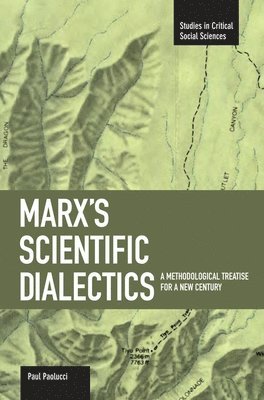
Marx's Scientific Dialectics: A Methodological Treatise For A New Century
Paul Paolucci, Paul Paolucci
Häftad, 2009
469 kr
Hoppa över listan
Du kanske också är intresserad av
Disintegration: Bad Love, Collective Suicide, and the Idols of Imperial Twilight
Mark P. Worrell
Häftad, 2021
469 kr
Resignation and Ecstasy: The Moral Geometry of Collective Self-Destruction
Mark P. Worrell
Häftad, 2021
469 kr
- Nyhet
Del 7