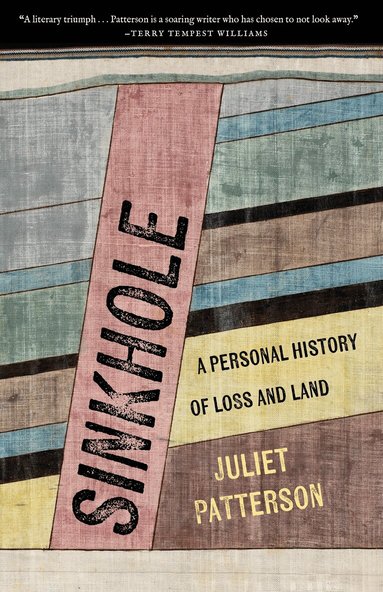
“Mixing autobiography, academic psychology, and an ecological history of Kansas, Patterson, a poet, examines the suicides in her family, beginning with her father’s.”—The New Yorker“A soulful odyssey . . . [Patterson’s] bewilderment and edge-of-the-sinkhole grief is palpable . . . Though the memoir doesn’t solve the riddle of suicide or offer a neat narrative arc, it does show the value of remembering and the importance of paying attention to, for example, a ‘rack of suits and ties,’ . . . or a Lite Brite message left glowing in the dark after her father left for a business trip that said: ‘Be good. I love you. See you soon.’”—Minneapolis Star Tribune“Patterson marvels at the pervasiveness of some of her family members’, on both her paternal and maternal sides, dying by suicide . . . Tying together environmental, political, and historical facts in her family tree, the author imagines what it means to take one’s life and shares what it’s like to be the one left behind. As fascinating as it is upsetting, Patterson has intersected the past and future, imagining the silent crisis happening among the men in her family, as well as the persistent fear of her own potential demise through self-harm, all while considering genetics, societal pressures, and prescribed antidepressants. The end result is an elegantly tragic work of research, history, and creative nonfiction that seeks answers, closure, and ultimate peace.”—Library Journal, starred review“A spare, sensitive evocation of Patterson’s experience of grief, paired with an insightful work of family and regional history . . . The poet’s sensibility is evident in these pages, as she excavates her own raw emotions alongside passages of clear-eyed journalism and creative nonfiction. Sinkhole is a painfully honest and sobering work that may provide insight and comfort to those facing a similar tragedy.’”—Shelf Awareness“After her father took his own life in 2009 at age 77, Patterson delved into her family’s legacy of suicide—the result is a stirring look at how history, environment, and cultural pressures all played a role . . . Patterson’s lyrical and discerning treatment of a global ‘psychological crisis’ will keep readers transfixed.”—Publishers Weekly“A pensive memoir about mental illness, suicide, and the quest to uncover often hidden family secrets . . . Apart from the personal, [Patterson] weaves in results from her research in thanatology and suicide, including the provocative thought from psychologist Edwin Shneidman that ‘the person who commits suicide puts his psychological skeleton in the survivor’s emotional closet.’ A searching, often elegant meditation on loneliness, pain, and redemption.”—Kirkus Reviews"Along with the environmental history braided throughout, Sinkhole offers a master class in how extensive research can add depth and breadth to personal writing."—The Washington Independent Review of Books“Patterson’s poetic sensibility informs her prose as she weaves together ideas about family and research about land in a lyrical way.”—Book Pages “Sinkhole is a literary triumph.Juliet Patterson brings us to a brave, smart, and compassionate understandingof suicide. Anyone who has lost someone to suicide knows the haunting thatfollows. You are buried beneath an avalanche of questions that can never beanswered. But in Patterson’s adept hands, we not only enter ‘thenatural history of suicide,’ offering insights to an erosional state of mind,we are taken into societal patterns that foster an atmosphere where suicidebecomes the end point of isolation and despair. The somber connectionsPatterson makes between her father’s death by suicide and the family legacythat precedes his death, tied to a history of coal mining, exposes the factthat our health and the health of the planet cannot be separated. Theviolence we inflict on ourselves is a mirror of the violence we inflict onland. Juliet Patterson is a soaring writer who has chosen to not lookaway. We are the beneficiaries of her gaze. There is poetry in thiselegiac book, with an uncommon beauty and stillness radiating between eachsentence. Sinkhole resurrects our dead from thesorrow and silences surrounding suicide and gives voice to the whys oftheir voiceless acts.”—Terry Tempest Williams, author of Erosion“In confronting her family’s dark legacy ofsuicide, Juliet Patterson does far more than plumb the depths of humandespair. Sinkhole is a master class in the way truth can pryopen the deepest cellar, how language can calm a raw, ragged soul. To read thisunflinching look at darkness is to find a way toward the light. After so muchdarkness, so much light!”—Margaret Renkl, author of Late Migrations“Juliet Patterson writes with a poet’s precision and a poet’s heart too about that most devastating moment, the loss of a parent. Devastating twice over by the terms and manner in which he died. Survivors are left to ask ‘Why?’ and normally one says there is no answer to this question. But Patterson keeps asking. In this text that has the feel of a police procedural but the emotional weight of a desperation to know, Patterson delves into familial and social history and brings us, the readers, along on a perilous journey. By the end we realize we each too might be—physically, socially, psychologically, spiritually, medically, environmentally—in the midst of life but on the lip of death. As a parent, a wife, a poet, a daughter, a human, Juliet Patterson makes the most courageous foray yet into answering that last unanswerable question: ‘Why?’”—Kazim Ali, author of Northern Light: Power, Land, and the Memory of Water“With deft fingers, Juliet Patterson digs below the surface of inherited illness, generational trauma, and societal notions of grief. Like its namesake, Sinkhole explores what lurks beneath seemingly stable ground. After the suicide of Patterson’s father, she is driven to investigate his death. What’s uncovered are multiple lifetimes of repressed emotion and internalized perceptions of failure. With two successive generations of patriarchs committing suicide Patterson reckons with what’s a coincidence, and what’s a pattern. In thoughtfully rendered passages she delves into creative nonfiction, imagining what those final hours were for her father and grandfather— what thoughts were on their minds, or weren’t. Sinkholes can be exacerbated by reckless natural resource mining, and Patterson ties a delicate net lulling the reader into a conversation between the two. If toxic lead levels can be discovered as a hidden byproduct of rampant capitalist practices— what other concealed ailments can be tied to a lack of respect for nature? What feelings of failure can epigenetically alter seemingly placid inner worlds generations later? Gracefully and languidly, Patterson illuminates what typically is seen as a void, and asks the reader to ponder: how do our outer landscapes reflect our inner worlds?”— Mathuson Anthony, Book Club Bookstore, New York, NY“When I started this lyrical exploration of suicide, inheritance, and place by lesbian poet Juliet Patterson, I had no idea that my home state would play such a central role. As it turns out, both of Patterson’s parents grew up in the former mining town of Pittsburg, KS, now ravaged by sinkholes. In an obsessive unearthing of family history spurred by grief for her father, Patterson investigates the lives and suicides of three family members: her father, and each of her parents’ fathers. As Patterson delicately processes her own experiences as a suicide survivor, she opens up a dialogue for readers—we can talk about suicide, and we should talk about suicide. Sinkhole is a beautiful, fascinating read.”—Mary Wahlmeier, Raven Book Store Lawrence, KS“The author takes us on her journey to learn the unknowable, to understand what is not understandable, in an effort to break the patterns of the past - escape a metaphorical sinkhole. Along the way you'll learn about the history of a region and the violence wreaked against its people and environment that persists today - literal sinkholes.”— Alana Haley, Schuler Books, Grand Rapids, MI“Great storytelling; Patterson has a soothing and inviting voice even while discussing the hardest parts of her father's suicide. A lovely blend of family history and grief.”— Lauren Nopenz Fairley, Curious Iguana, Frederick, MD“I had to wait to read to read this book, because in the last two years there has been so much loss both personally and collectively. I love Juliet's straight forward writing and research; I think it's something that we all want to be able to do. We're all on a journey and Juliet's book has helped me breath once more.”— Jayne Rowsam, Mystery to Me, Madison, WI Praise for JulietPatterson“Juliet Patterson’s poems are entirelythemselves; they use time and the eye and tongue—all the body, as thought andinsight, inside and outside history.”—Jean Valentine“Patterson’s work is rich with compression,power, and a precision I’d like to steal for myself.”—Joni Tevis, Orion“Spare, pastoral, intimate, and probing, [Patterson’s]musically exacting poems offer arresting insights. . . . They question, invent,refer, divert, take flying risks. They are fluid, considered, dignified. Theycelebrate the human eye, mind, and tongue.”—Olga Broumas“Thrilling . . . [Patterson’s] poetic realmhas been that of the precise image . . . placed in short and striking lines.Through these images, she has revealed the path of the mind, often playfully.”—DIAGRAM“[Patterson’s] poems are driven by a voicethat I think would define the world clearly and unequivocally if it werepossible. Instead, the poet is forced (like most of us) to offer up images, thecorrespondences that connect them, and the humanity behind what life leaves forus. . . . Creating a world where there are no easy answers, Patterson asksfor active reading.”—Painted Bride Quarterly“In Patterson’s vision, nature rarely giveswithout taking some small token in return. . . . She laments the loomingdestruction of nature even as that destruction portends the creation ofsomething new.”—Publishers Weekly“Direct and tough, lush and erect . . .[Patterson] will bring you tears, bend your branch, twist your mind.”—TwinCities Daily Planet“There is a kind of communion . . . betweenwhat is said and what is not said, that reminds the reader of walking throughthe very December fields that Patterson describes, noting the dry, brittlelandscape and yet—and also—the spry and determined life that persists withinit. . . . [Patterson’s] quiet poems . . . are more like finely chiseled icesculptures than gleaming, luxurious gems. But the truth they express is no lessradiant—in fact, it may be even more so, borne as it is out of a season of lessrather than plenty.”—Shannon Gibney“Patterson’s ear is at once impeccable andexciting. . . . We understand the poet’s vision and language as a form ofquerying, a kind of existential question conditioned by existence’s constantopposite, nonexistence.”—Ryo Yamaguchi