
Semiotic Grammar
Inbunden, Engelska, 1997
3 069 kr
Beställningsvara. Skickas inom 7-10 vardagar. Fri frakt för medlemmar vid köp för minst 249 kr.
The label `semiotic grammar' captures a fundamental property of the grammars of human languages: not only is language a semiotic system in the familiar Saussurean sense, but its organizing system, its grammar, is also a semiotic system. This proposition, explicated in detail by William McGregor in this book, constitutes a new theory of grammar. Semiotic Grammar is `functional' rather than `formal' in its intellectual origins, approaches, and methods. It demonstrates, however, that neither a purely functional nor a purely formal account of language is adequate, given the centrality of the sign as the fundamental unit of grammatical analysis. The author distinguishes four types of grammatical signs: experiential, logical, interpersonal, and textural. The signifiers of these signs are syntagmatic relationships of the following types, respectively: constituency, dependency, conjugational (scopal) and linking (indexical, connective).McGregor illustrates and exemplifies the theory with data from a variety of languages including English, Acehnese, Polish, Finnish, Japanese, Chinese, and Mohawk; and from his pioneering research on Gooniyandi and Nyulnyul, two languages of the Kimberleys region of Western Australia.
Produktinformation
- Utgivningsdatum1997-09-04
- Mått165 x 242 x 30 mm
- Vikt843 g
- FormatInbunden
- SpråkEngelska
- Antal sidor448
- FörlagOUP OXFORD
- ISBN9780198236887
Tillhör följande kategorier
Hoppa över listan
Mer från samma författare
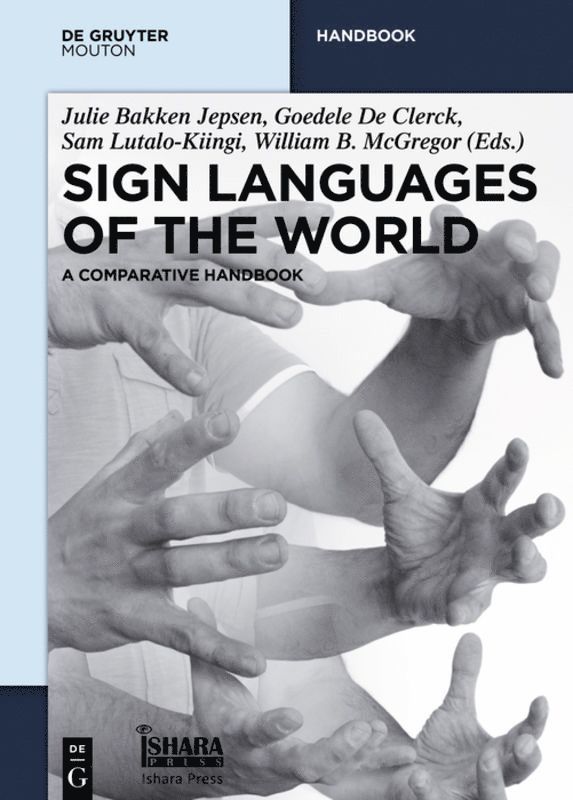
Sign Languages of the World
Julie Bakken Jepsen, Goedele De Clerck, Sam Lutalo-Kiingi, William B. McGregor
Inbunden, 2015
5 819 kr
Hoppa över listan
Du kanske också är intresserad av
Sign Languages of the World
Julie Bakken Jepsen, Goedele De Clerck, Sam Lutalo-Kiingi, William B. McGregor
Inbunden, 2015
5 819 kr