Beställningsvara. Skickas inom 3-6 vardagar. Fri frakt för medlemmar vid köp för minst 249 kr.
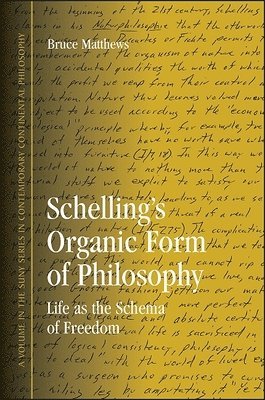
Locates in Schelling a new understanding of our relation to nature in philosophy.The life and ideas of F.W.J. Schelling are often overlooked in favor of the more familiar Kant, Fichte, or Hegel. What these three lack, however, is Schelling's evolving view of philosophy. Where others saw the possibility for a single, unflinching system of thought, Schelling was unafraid to question the foundations of his own ideas. In this book, Bruce Matthews argues that the organic view of philosophy is the fundamental idea behind Schelling's thought. Focusing in particular on Schelling's early writings, especially on Plato and Kant, Matthews explores Schelling's idea that any philosophical system must be perspectival and formed by each individual student of philosophy, providing a unique new understanding to an important and often overlooked figure in the history of philosophy.
Bruce Matthews is Associate Professor of Philosophy at Bard High School Early College. He is translator of Schelling's The Grounding of Positive Philosophy: The Berlin Lectures, also published by SUNY Press.
PrefaceAcknowledgmentsNotes on Sources and Abbreviations1. Life as the Schema of Freedom: Schelling’s Organic Form of PhilosophySubjectivism and the Annihilation of NatureImmanent ReconstructionKant and the Categorical Imperative of Unity in ReasonPlato’s o(do/j and the Eternal Form of PhilosophyOrganic Unity and Nature’s RedemptionIdeas in situ: Embedded Thought2. Beginnings: Theosophy and Nature DivineThe Acculturation of a Prophet of NatureThe Discipline of Language and Actuality of the PastThe Tradition of Pietism: Freedom as the Unmediated Experience of the DivineHalfway between Tradition and the Enlightenment: Theosophy and the Divinity of NatureOetinger’s Genetic Epistemology and the Unmediated Knowing of the ZentralerkenntnisDivinity as Freedom in Nature: The Priority of Freedom over WisdomSchelling’s Eulogy and the System of Philipp Matthäus Hahn(1739–1790)A Theology of LifeProcreative Logic: Hahn’s "ordo generativus"Systema Infl uxus: The Immanent Harmony of the Trichotomy of Body, Soul, and MindLife in the Anticipation of the Eschaton: The Prophet of Freedom and Nature DivineSchelling’s Eulogy of Hahn(1790)and the Passing of the Flame of Prophecy Prophet of the New Religion of Nature: Matter Spiritualized 3. The Question of Systematic Unity Systematic Unity and the Urform of Reason Life Is the Schema of Freedom: The Will of Desire and the Causality of FreedomThe Antinomy of Aesthetic Judgment The Unity of the Ideas of Reason and the Transcendental Ideal as the Form of FormsTranscendental Modality: Unity as Grundsatz of ReasonWeltbegriffe and Naturbegriffe: The Limits of a Mathematical World in the Face of the "Absolute Selbsttätigkeit" of NatureThe Urform of Reason: ai( suna/pasai e)pisth=maiThe Logical Visage: The Prinzipien of Unity, Manifoldness, and ContinuityThe Idea of the Maximum as the Analogon of the Schemafor the "Prinzipien der Vernunft"The Transcendental Ideas: The Figurative Guarantors of Reason’s ExtensionAesthetic Ideas, the Sublime, and the Internal Intuition of the Supersensible GroundGenius: Autoepistemic Organ of Nature?4. The Timaeus Commentary To Seek the Divine in NatureSchelling’s Commentary on the Timaeus The Divine Ideas of Reason to\ kalo/n as the Ideal of Unity and Completeness The World Soul as "The Ideal of the World": Organic Life as a Principle of Systematic UnityImmanent Preestablished Harmony: The Condition of Possibility of Einheit The Ideas: Existence Is Not a PredicateThe Threefold Form of All KnowingPlato’s Urform 5. On the Possibility of a Form of All Philosophy: The Form EssaySchelling’s Original Insight The Urform of All Forms Kant’s Progressive Method: The Removal of the Time Condition as the Condition of Comprehending an Absolute MagnitudeReciprocal Establishment of the Urform The Progressive Method of Disjunctive Identity The Urform of Relation Philological Justification Epistemic Positionality and the Removal of the Time-Condition Form of Being Unconditionally Posited: ‘I = I’Form of the Conditioned: NichtIch = Nicht Ich (Nichtich ≠ Ich)Form of Conditionality Determined by Unconditionality = Consciousness Disjunctive Identity 6. Freedom and the Construction of PhilosophyThe Dynamic Process: Producing the System of Identity The Self Versetzt: Freedom as the Postulate of Philosophy The Method of Construction: Einbildung as the In-Eins-Bildung of Duality Problematic: All Philosophy Is Construction An Aesthetic Philosophy The Construction of the Self: Theoretical Philosophy and Unconscious NatureFirst Epoch: Productive Intuition of Sensation through the Restriction of the PastSecond Epoch: Transition from Blind Intuition to Reflection through the Restriction of the PresentThird Epoch: From Reflection to the Absolute Act of the Will The Derivation of the Categories from Time Transition to Practical Philosophy: The Absolute Act of the Will Time and Historicity The Tense of the Absolute: Futurity The Endless Process Appendix "Eulogy Sung at Hahn’s Grave" NotesIndex