
Del 3
Del i serien Essays in Cognitive Psychology
Saying, Seeing and Acting
The Psychological Semantics of Spatial Prepositions
Häftad, Engelska, 2015
1 199 kr
Beställningsvara. Skickas inom 10-15 vardagar. Fri frakt för medlemmar vid köp för minst 249 kr.
Finns i fler format (1)
Our use of spatial prepositions carries an implicit understanding of the functional relationships both between objects themselves and human interaction with those objects.This is the thesis rigorously explicated in Saying, Seeing and Acting. It aims to account not only for our theoretical comprehension of spatial relations but our ability to intercede with efficacy in the world of spatially related objects. Only the phenomenon of functionality can adequately account for what even the simplest of everyday experiences show to be the technically problematic, but still meaningful status of expressions of spatial location in contentious cases.The terms of the debate are established and contextualised in Part One. In the Second Section, systematic experimental evidence is drawn upon to demonstrate specific covariances between spatial world and spatial language. The authors go on to give an original account of the functional and geometric constraints on which comprehension and human action among spatially related objects is based. Part Three looks at the interaction of these constraints to create a truly dynamic functional geometric framework for the meaningful use of spatial prepositions.Fascinating to anyone whose work touches on psycholinguistics, this book represents a thorough and incisive contribution to debates in the cognitive psychology of language.
Produktinformation
- Utgivningsdatum2015-06-25
- Mått156 x 234 x 12 mm
- Vikt317 g
- FormatHäftad
- SpråkEngelska
- SerieEssays in Cognitive Psychology
- Antal sidor216
- FörlagTaylor & Francis Ltd
- ISBN9781138877351
Tillhör följande kategorier
Hoppa över listan

Mer från samma författare
Modeling and Using Context
Michael Beigl, Henning Christiansen, Thomas R. Roth-Berghofer, Anders Kofod-Petersen, Kenny R. Coventry, Hedda R. Schmidtke
Häftad, 2011
729 kr
Hoppa över listan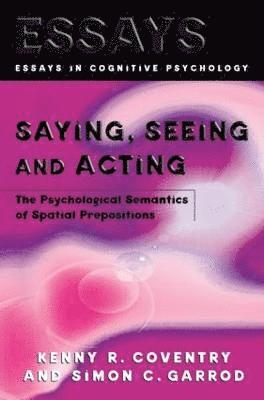





Du kanske också är intresserad av
Modeling and Using Context
Michael Beigl, Henning Christiansen, Thomas R. Roth-Berghofer, Anders Kofod-Petersen, Kenny R. Coventry, Hedda R. Schmidtke
Häftad, 2011
729 kr
Del 3
- Nyhet
Del 3
- Nyhet
Del 11
- Nyhet
Del 1
- Nyhet
Del 4