
Del i serien Routledge International Studies in Money and Banking
Safe Assets in the Global Economy
Supply, Demand and Financial Stability
Häftad, Engelska, 2026
929 kr
Beställningsvara. Skickas inom 10-15 vardagar. Fri frakt för medlemmar vid köp för minst 249 kr.
Finns i fler format (1)
Safe assets constitute an essential component of the contemporary, international financial system and are vital to its stability. As they are perceived as risk-free assets, they are a special type of financial instrument. Although the vast majority of safe assets are issued by governments, due to the increasing interdependence of economies, resulting from the liberalisation of capital flows, financial openness and the ineffectiveness of the international monetary system, issues relating to their significance, creation and allocation are global. This book combines theoretical threads by systematising the concept and characteristics of safe assets against the background of alternative financial instruments with empirical analyses that present trends in shaping demand, supply, price conditions and various interdependencies in the financial markets. It shows the position and role of safe assets in the global financial sector, in the context of ongoing challenges, such as the evolution of forms of money and the processes of currency competition, the outbreak of financial and economic crises, the accumulation of foreign exchange reserves, financial innovations, the scale of securitisation and monetary integration. Although safe assets are not a new category of financial assets, they are inherently connected with the evolution of money. Thus, this book examines the determinants of their creation, motives of holding and the consequences of a shortage – all within the changing nature of the international financial system. Historical, political and institutional backgrounds are taken into account. This book will appeal to researchers, scholars and advanced students of macroeconomics, international finance and economics, investment analysis, financial economics and econometrics.The Open Access version of this book, available at http://www.taylorfrancis.com, has been made available under a Creative Commons Attribution-Non Commercial-No Derivatives (CC BY-NC-ND) 4.0 license.
Produktinformation
- Utgivningsdatum2026-05-22
- Mått156 x 234 x 11 mm
- Vikt370 g
- FormatHäftad
- SpråkEngelska
- SerieRoutledge International Studies in Money and Banking
- Antal sidor190
- FörlagTaylor & Francis Ltd
- ISBN9781032453439
Tillhör följande kategorier
Hoppa över listan


Mer från samma serie
- Nyhet
Post-Crash Development in the Indian Banking Sector
Rachita Gulati, Sunil Kumar
Inbunden, 2026
3 309 kr
Banking and Economic Rent in Asia
Yasushi Suzuki, Mohammad Dulal Miah, Manjula K. Wanniarachchige, S.M. Sohrab Uddin
Häftad, 2019
909 kr
Complexities of Financial Globalisation
Tony Cavoli, Sasidaran Gopalan, Ramkishen S. Rajan
Inbunden, 2020
3 309 kr
Hoppa över listan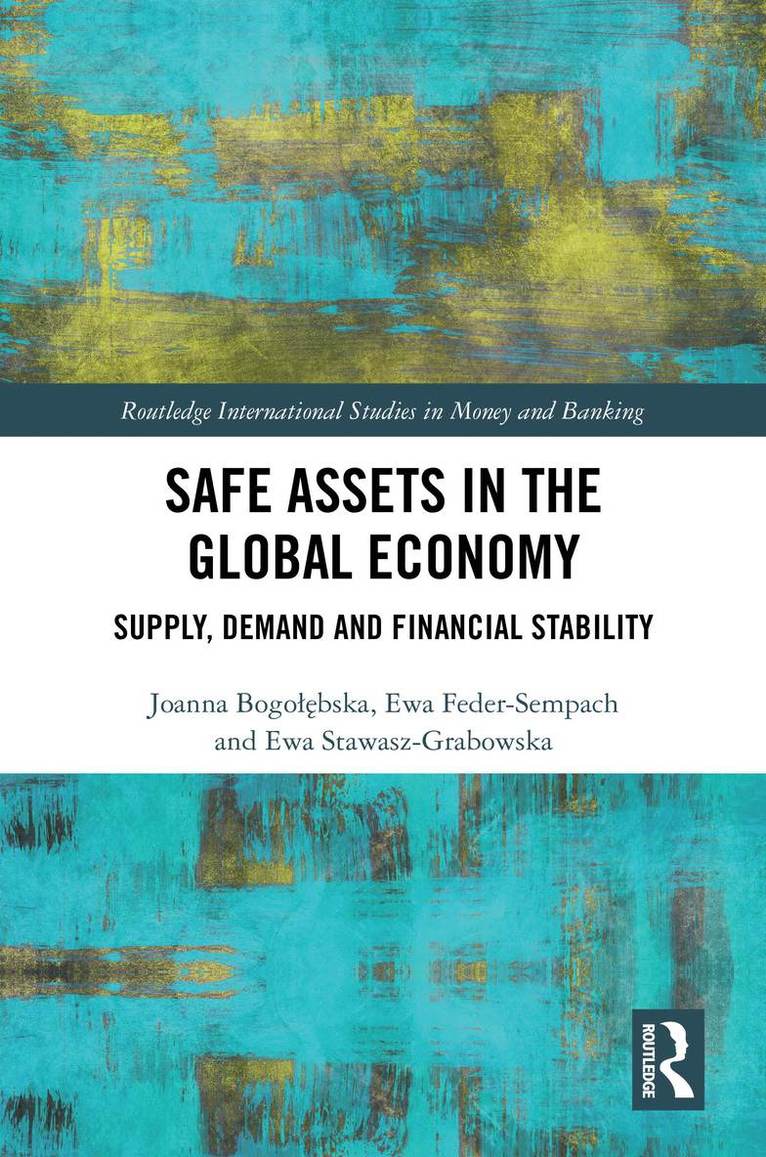







Du kanske också är intresserad av
Safe Assets in the Global Economy
Joanna Bogołębska, Ewa Feder-Sempach, Ewa Stawasz-Grabowska
Inbunden, 2024
3 309 kr
International Equity Exchange-Traded Funds
Tomasz Miziołek, Ewa Feder-Sempach, Adam Zaremba
Inbunden, 2020
1 259 kr
Del 48
Economic Populism in British and American Political Discourse
Ewa Feder-Sempach, Stanislaw Sulowski
Inbunden, 2022
579 kr
International Equity Exchange-Traded Funds
Tomasz Miziołek, Ewa Feder-Sempach, Adam Zaremba
Häftad, 2021
889 kr
- Nyhet
Del 3
- Nyhet
Del 11
- Nyhet
- Nyhet
- Nyhet
Del 4
Del 1