
Del 6
Del 28 i serien Law and Philosophy Library
Richness of Contract Law
An Analysis and Critique of Contemporary Theories of Contract Law
Inbunden, Engelska, 1996
1 969 kr
Beställningsvara. Skickas inom 10-15 vardagar. Fri frakt för medlemmar vid köp för minst 249 kr.
Finns i fler format (1)
Scholars have produced a wide variety of theoretical work on contract law. This is the first book to compile it, to present it coherently, to evaluate it, and to supply numerous references to additional sources. The author also offers his own practical perspective that emphasizes contract law's richness and complexity and questions the utility of abstract unitary theories. The author argues that, notwithstanding contract law's complexity, it successfully facilitates the formation and enforcement of private arrangements and ensures a degree of fairness in the process of exchange. Each chapter presents a pair of largely contrasting theories to clarify the central issue of contract law and theory, to set forth the range of views, and to help identify a practical middle ground. Among the contract theories discussed and analyzed are promise, contextual, feminist, formal, mainstream, critical, economic, empirical, and relational. The book should interest legal theorists, practising lawyers, law students, and general readers who want to learn more about contract law and theory.
Produktinformation
- Utgivningsdatum1996-12-31
- Mått155 x 235 x 19 mm
- Vikt614 g
- FormatInbunden
- SpråkEngelska
- SerieLaw and Philosophy Library
- Antal sidor279
- FörlagKluwer Academic Publishers
- ISBN9780792343363
Tillhör följande kategorier
Hoppa över listan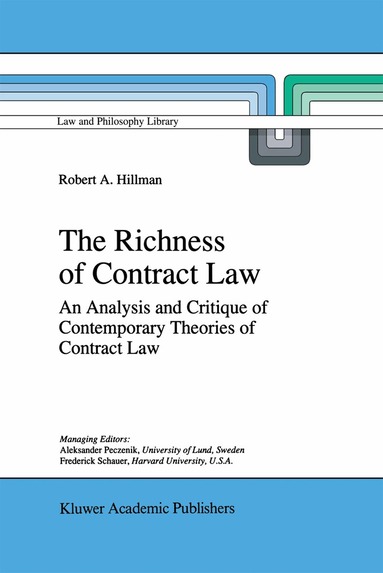








Du kanske också är intresserad av
Del 28
- Nyhet
Del 7
- Nyhet
Del 11
- Nyhet
Del 4
- Nyhet
Del 6
- Nyhet
Del 3
- Nyhet
- Nyhet
- Nyhet