
Del i serien NATO Science Series D:
Restorative Justice on Trial
Pitfalls and Potentials of Victim-Offender Mediation — International Research Perspectives —
Inbunden, Engelska, 1992
4 319 kr
Beställningsvara. Skickas inom 10-15 vardagar. Fri frakt för medlemmar vid köp för minst 249 kr.
Finns i fler format (1)
Victim-offender mediation schemes have experienced significant growth in the last decade. They are seen as an important and innovative alternative to the traditional sanctions of the criminal justice system. After a critical look at mediation schemes in the United States and Canada, most European countries have also increased their efforts to develop informal strategies to deal with deviant behavior. In terms of their legal and organizational base, it turns out that type, extent, and capacities for development are quite different in the individual countries -resulting in a remarkable diversity of programs with different outcomes. The contributions in this book are revised and edited versions of papers presented at the NATO Advanced Research Workshop Conflict, Crime and Reconciliation: The Organization of Welfare Intervention in the Field of Restitutive Justice in April 1991 at Il Ciocco, Italy. The chapters document the present stage of restorative justice in the individual countries, critically assess legal constraints and public needs, discuss the organizational requirements of implementation, and also evaluate outcomes in a broader context of crime and social policy. In the long run, this book should encourage further debates in the field of restorative justice and help build valid guidelines for an international evaluation research.
Produktinformation
- Utgivningsdatum1992-02-29
- Mått210 x 297 x 37 mm
- Vikt1 065 g
- FormatInbunden
- SpråkEngelska
- SerieNATO Science Series D:
- Antal sidor590
- Upplaga1992
- FörlagKluwer Academic Publishers
- ISBN9780792316206
Tillhör följande kategorier
Hoppa över listan

Mer från samma serie
Ethoexperimental Approaches to the Study of Behavior
NATO Advanced Study Institute on the Eth, North Atlantic Treaty Organization, Robert J. Blanchard, P.F. Brain, D. Caroline Blanchard, Stefano Parmigiani
Inbunden, 1989
6 979 kr
Social Competence in Developmental Perspective
B.H. Schneider, Grazia Attili, Jacqueline Nadel, Roger P. Weissberg
Inbunden, 1989
4 189 kr
Reading and Writing Disorders in Different Orthographic Systems
P. G. Aaron, R.M. Joshi
Inbunden, 1989
2 799 kr
Psychobiology of Stress
NATO Advanced Research Workshop on Psych, North Atlantic Treaty Organization, Stefano Puglisi-Allegra, A. Oliverio
Inbunden, 1990
2 969 kr
Sensory-Motor Organizations and Development in Infancy and Early Childhood
H. Bloch, B.I. Bertenthal
Inbunden, 1990
4 319 kr
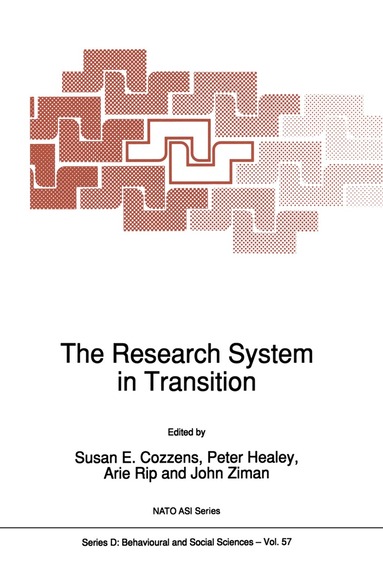
Research System in Transition
Susan E. Cozzens, Peter Healey, Arie Rip, John Ziman
Inbunden, 1990
2 879 kr
Hoppa över listan









Du kanske också är intresserad av
- Nyhet
Del 6
- Nyhet
Del 11
- Nyhet
Del 3
- Nyhet
- Nyhet
Del 7
- Nyhet
Del 4
- Nyhet
- Nyhet
Del 3
- Nyhet
Del 1