
Del 16
Del 1 i serien Combinatorial Optimization
Quadratic Assignment Problem
Theory and Algorithms
Häftad, Engelska, 2010
2 149 kr
Beställningsvara. Skickas inom 10-15 vardagar. Fri frakt för medlemmar vid köp för minst 249 kr.
Finns i fler format (1)
The quadratic assignment problem (QAP) was introduced in 1957 by Koopmans and Beckmann to model a plant location problem. Since then the QAP has been object of numerous investigations by mathematicians, computers scientists, ope- tions researchers and practitioners. Nowadays the QAP is widely considered as a classical combinatorial optimization problem which is (still) attractive from many points of view. In our opinion there are at last three main reasons which make the QAP a popular problem in combinatorial optimization. First, the number of re- life problems which are mathematically modeled by QAPs has been continuously increasing and the variety of the fields they belong to is astonishing. To recall just a restricted number among the applications of the QAP let us mention placement problems, scheduling, manufacturing, VLSI design, statistical data analysis, and parallel and distributed computing. Secondly, a number of other well known c- binatorial optimization problems can be formulated as QAPs. Typical examples are the traveling salesman problem and a large number of optimization problems in graphs such as the maximum clique problem, the graph partitioning problem and the minimum feedback arc set problem. Finally, from a computational point of view the QAP is a very difficult problem. The QAP is not only NP-hard and - hard to approximate, but it is also practically intractable: it is generally considered as impossible to solve (to optimality) QAP instances of size larger than 20 within reasonable time limits.
Produktinformation
- Utgivningsdatum2010-12-08
- Mått170 x 244 x 17 mm
- Vikt528 g
- FormatHäftad
- SpråkEngelska
- SerieCombinatorial Optimization
- Antal sidor287
- FörlagSpringer-Verlag New York Inc.
- ISBN9781441947864
Tillhör följande kategorier
Hoppa över listan


Mer från samma serie
Del 17
Combinatorial Optimization in Communication Networks
Maggie Xiaoyan Cheng, Yingshu Li, Ding-Zhu Du
Inbunden, 2006
2 149 kr
Del 12
Del 4
Geometric Methods and Optimization Problems
Vladimir Boltyanski, Horst Martini, V. Soltan
Inbunden, 1998
4 009 kr
Advances in Randomized Parallel Computing
M. Pardalos Pardalos, Panos M. Pardalos, Sanguthevar Rajasekaran
Inbunden, 1999
2 149 kr
Del 6
Del 7
Hoppa över listan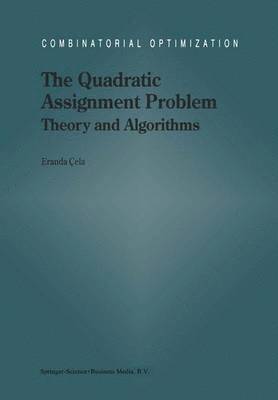




Du kanske också är intresserad av
Del 1
Del 6
Del 10
Del 1
Del 3
- Nyhet
Del 11
Del 15
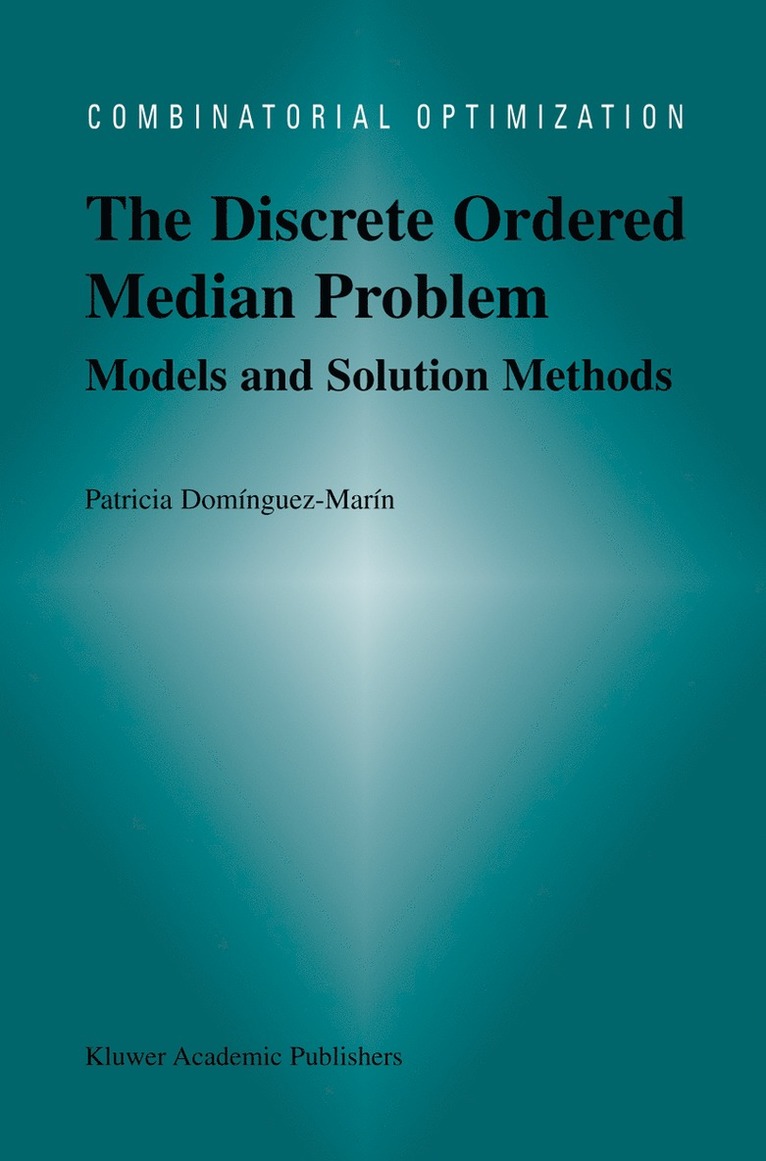
Discrete Ordered Median Problem: Models and Solution Methods
Patricia Dominguez-Marin
Inbunden, 2003
719 kr