
Del 9
Del i serien Studies in Theoretical Psycholinguistics
Processing of Tense
Psycholinguistic Studies on the Interpretation of Tense and Temporal Relations
Inbunden, Engelska, 2001
2 219 kr
Beställningsvara. Skickas inom 10-15 vardagar. Fri frakt för medlemmar vid köp för minst 249 kr.
Finns i fler format (1)
This work is a psycho linguistic investigation of the processing of tense (more specifically, the English past tense): When it is interpreted, how it is interpreted, and what it is interpreted with respect to. While there has been a great deal of attention paid to tense in the syntax and semantics literature, little work has been done on the details of the psychological processing of this category. The chief value and contribution of this book is to present a richly detailed in-depth study of the processing of tense in adult comprehension tasks, providing an excellent model of how to conceive of detailed experimental work against a background of sophisticated, deep, and broad linguistic theory. The discussion of the representational issues is deep and informative, and is directly brought to bear on experimental issues. The experiments aim to evaluate whether a hypothesis called "Parsimony," a highly plausible notion that has received tentative experimental support in other domains, is the chief controlling feature of the interpretation of tense. The experimental results presented quite consistently do not confirm the apparent predictions made by Parsimony, but rather tend to be more consistent with another view (which Parsimony is aimed at opposing) which holds that actual structural factors in the syntax of a sentence are a decisive factor. Along the way, the author considers a number of other plausible hypotheses as the experimental results are presented, but evaluating Parsimony remains the chief organizing principle of the line of research presented here.
Produktinformation
- Utgivningsdatum2001-12-31
- Mått152 x 223 x 23 mm
- Vikt664 g
- FormatInbunden
- SpråkEngelska
- SerieStudies in Theoretical Psycholinguistics
- Antal sidor310
- Upplaga2001
- FörlagKluwer Academic Publishers
- ISBN9781402001840
Tillhör följande kategorier
Hoppa över listan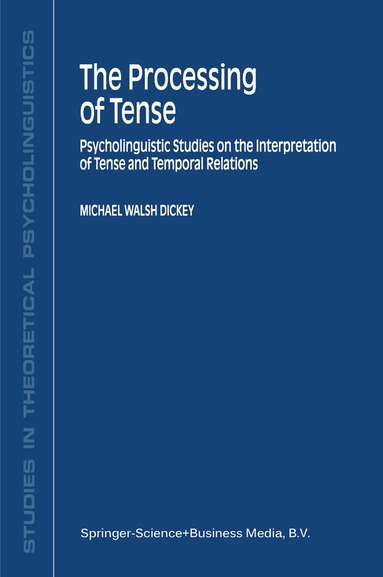







Du kanske också är intresserad av
Del 28
- Nyhet
Del 3
- Nyhet
- Nyhet
Del 6
- Nyhet
Del 7
- Nyhet
Del 11
- Nyhet
Del 4
- Nyhet
- Nyhet
Del 3