
Preference Organisation and Peer Disputes
How Young Children Resolve Conflict
Inbunden, Engelska, 2009
3 219 kr
Beställningsvara. Skickas inom 10-15 vardagar. Fri frakt för medlemmar vid köp för minst 249 kr.
Finns i fler format (1)
How do children get their own way in arguments? What is the most effective way of pursuing one's own goals in preschool? 'Use your words' is an instruction frequently heard in nurseries and pre-schools encouraging young children to resolve the situation through verbal rather than physical means. Discourse is seen as the solution, yet, what words are the children supposed to use, and how do they go about resolving disputes? This fascinating book offers a conversation analysis of children's arguments, revealing disputing as a highly ordered, rule-governed activity, even amongst very young children. The author provides a rich theoretical discussion of the work in speech acts and conversational analysis, whilst offering a sophisticated review in relation to children's culture. It will be of great interest to conversation analysts within sociology and linguistics, as well as to educationalists and scholars of childhood.
Produktinformation
- Utgivningsdatum2009-03-24
- Mått156 x 234 x 24 mm
- Vikt680 g
- FormatInbunden
- SpråkEngelska
- SerieDirections in Ethnomethodology and Conversation Analysis
- Antal sidor292
- FörlagTaylor & Francis Ltd
- ISBN9780754674412
Tillhör följande kategorier
Hoppa över listan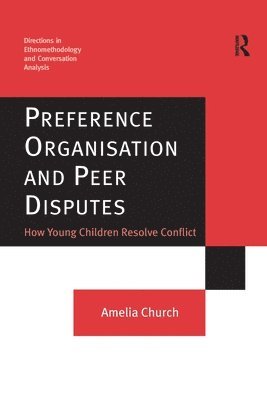

Du kanske också är intresserad av
- Nyhet
Ethnomethodological Studies of Music
Peter Tolmie, Dave Randall, Mark Rouncefield, Andy Crabtree
Inbunden, 2026
3 309 kr