
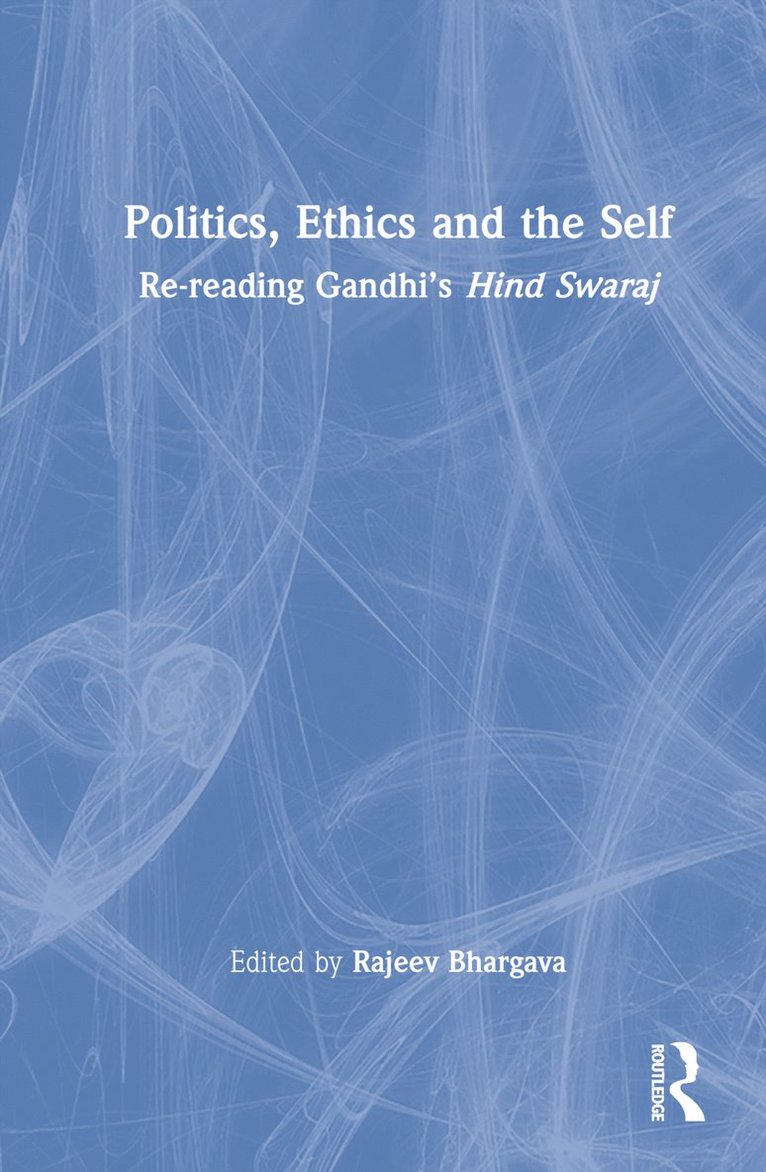
Politics, Ethics and the Self
Re-reading Gandhi’s Hind Swaraj
Häftad, Engelska, 2022
899 kr
Beställningsvara. Skickas inom 10-15 vardagar. Fri frakt för medlemmar vid köp för minst 249 kr.
Hind Swaraj by Mahatma Gandhi is arguably the greatest text to have emerged from the anti-colonial movement in India and the first to seriously challenge the cultural and civilizational premises of the colonizers’ mentality. It is also the first text in India that falls within the broad tradition of modern political philosophy, advancing a complex cluster of theses with conceptual sensitivity, analytical precision, and sustained argument.This book critically engages with Hind Swaraj and explores the fascinating and subtle dialogue set up by Gandhi between the characters of the reader and the editor. With essays from leading contemporary thinkers on Gandhi, the volume looks at themes such as Gandhi on epistemic servitude, decolonization, and intercultural translation; his complex critique of modern civilization; his views on the empire, democracy, citizenship, and violence; the normative structure of Gandhian thought; Gandhi and the political praxis of educational reconstruction; and how to read this text. An important intervention in Gandhian studies, this book will be useful for scholars and researchers of peace studies, political philosophy, Indian philosophy, Indian political thought, political sociology, and South Asian studies.
Produktinformation
- Utgivningsdatum2022-06-23
- Mått156 x 234 x 29 mm
- Vikt640 g
- FormatHäftad
- SpråkEngelska
- Antal sidor354
- FörlagTaylor & Francis Ltd
- ISBN9780367488598
Tillhör följande kategorier
Hoppa över listan




Du kanske också är intresserad av
Tianxia in Comparative Perspectives
Roger T. Ames, Peter D. Hershock, Rajeev Bhargava, Liam C. Kelley, Xinfeng Kong, Viren Murthy, Takahiro Nakajima, Mustapha Kamal Pasha, Qin Yaqing, Mogobe Bernard Ramose, Sor-hoon Tan, Christian Uhl, Ban Wang, Binfan Wang, Wang Qingxin, Jun-Hyeok Kwak, Roger T. Ames, Sor-hoon Tan, Steven Y. H. Yang
Inbunden, 2023
999 kr
Secular States and Religious Diversity
Bruce J. Berman, Rajeev Bhargava, André Laliberté
Häftad, 2014
529 kr
- Nyhet
Del 3
- Nyhet
Del 11