
Del i serien Nijhoff International Philosophy Series
Philosophy and Logic in Central Europe from Bolzano to Tarski
Selected Essays
Inbunden, Engelska, 1992
2 869 kr
Beställningsvara. Skickas inom 10-15 vardagar. Fri frakt för medlemmar vid köp för minst 249 kr.
Finns i fler format (1)
ways of doing it, but it is wrong to project it far into the past: it did not exist at the turn of the century and only became clearly apparent after the Second World War. I recently taught at an American university on the his tory of philosophy from Balzano to Husserl. The course title had to come from a fixed pool and gave trouble. Was it philosophical logic, the nine teenth century, or phenomenology? A logic title would connote over this period Frege, Russell, Carnap, perhaps a mention of Boole: not continental enough. The nineteenth century? The century of Kant's successors: Fichte, Hegel, Schopenhauer, Feuer bach, Marx, Nietzsche? What have they to do with Balzano, Lotze, Brentano, Meinong, Husserl and Twardowski? Even tually 'Phenomenology' was chosen, misdescribing more than half of the course. That illustrates the problems one faces in trying to work against the picture of the period which is ingrained in minds and syllabuses. This book arises from my efforts to combat that picture. I backed into writing about the history of recent philosophy rather than setting out to do so. The beginning was chance. In Manchester in the early seventies, at a time when most English philosophy departments breathed re cycled Oxford air, the intellectual atmosphere derived from Cambridge and Warsaw, spiced with a breath of Freiburg and Paris.
Produktinformation
- Utgivningsdatum1992-02-29
- Mått155 x 235 x 30 mm
- Vikt863 g
- FormatInbunden
- SpråkEngelska
- SerieNijhoff International Philosophy Series
- Antal sidor445
- Upplaga1992
- FörlagKluwer Academic Publishers
- ISBN9780792316213
Tillhör följande kategorier
Hoppa över listan

Mer från samma författare
Das Naturrechtsdenken Heute Und Morgen: Gedachtnisschrift Fur Rene Marcic
Dorothea Mayer-Maly, Peter M. Simons
Inbunden
2 459 kr
Del 73
Hoppa över listan
Mer från samma serie
Del 27
Del 31
Del 41
Stanislaw Lesniewski: Collected Works - Volumes I and II
S.J. Surma, Jan J.T. Srzednicki, D.I. Barnett, V.F. Rickey
Inbunden, 1991
11 439 kr
Hoppa över listan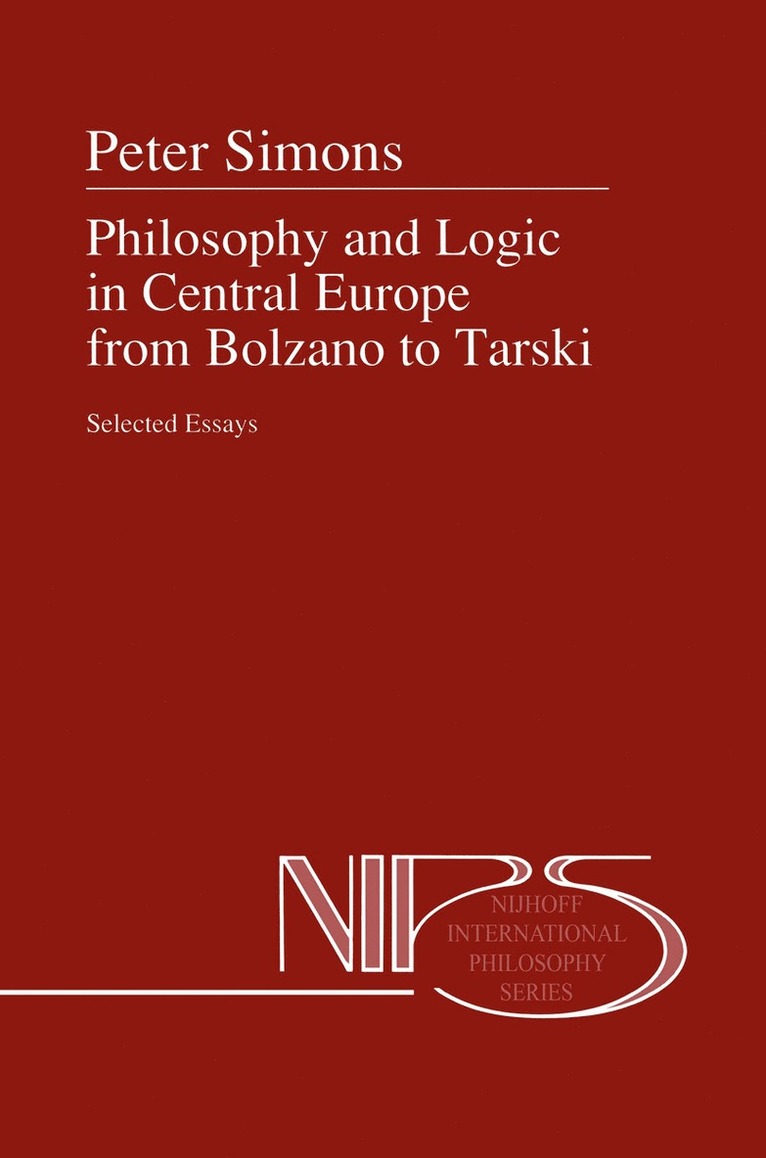




Du kanske också är intresserad av
Del 73
Das Naturrechtsdenken Heute Und Morgen: Gedachtnisschrift Fur Rene Marcic
Dorothea Mayer-Maly, Peter M. Simons
Inbunden
2 459 kr
- Nyhet
- Nyhet
- Nyhet
Del 6
- Nyhet
Del 11