
Del i serien Princeton Legacy Library
Philosopher in the City
The Moral Dimensions of Urban Politics
Inbunden, Engelska, 2016
4 209 kr
Beställningsvara. Skickas inom 3-6 vardagar. Fri frakt för medlemmar vid köp för minst 249 kr.
Finns i fler format (1)
After reestablishing the connection between morality and the law, the author develops a coherent position on many of the most controversial issues of urban life: the political uses of the streets; verbal assaults and the defamation of racial groups; the legitimate restriction of public speech; segregation, busing, and the use of racial quotas; education, housing, and the problem of the ghetto"; prostitution, gambling, and the "regulation of vices." Originally published in 1981. The Princeton Legacy Library uses the latest print-on-demand technology to again make available previously out-of-print books from the distinguished backlist of Princeton University Press. These editions preserve the original texts of these important books while presenting them in durable paperback and hardcover editions. The goal of the Princeton Legacy Library is to vastly increase access to the rich scholarly heritage found in the thousands of books published by Princeton University Press since its founding in 1905.
Produktinformation
- Utgivningsdatum2016-04-19
- Mått152 x 229 x 30 mm
- Vikt822 g
- FormatInbunden
- SpråkEngelska
- SeriePrinceton Legacy Library
- Antal sidor482
- FörlagPrinceton University Press
- ISBN9780691642765
Tillhör följande kategorier
Hoppa över listan


Mer från samma författare
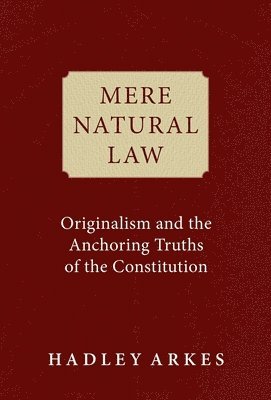
(Cancelled) Mere Natural Law: Originalism and the Anchoring Truths of the Constitution
Hadley Arkes
Häftad, 2026
449 kr
Hoppa över listan




Mer från samma serie
Princeton Encyclopedia of Classical Sites
Richard Stillwell, William L. MacDonald, Marian Holland McAllister
Häftad, 2017
2 309 kr