
Del i serien SUNY series in Chinese Philosophy and Culture
Neo-Confucian Ecological Humanism
An Interpretive Engagement with Wang Fuzhi (1619-1692)
Inbunden, Engelska, 2017
1 409 kr
Tillfälligt slut
Finns i fler format (1)
Addresses Ming Dynasty philosopher Wang Fuzhi's neo-Confucianism from the perspective of contemporary ecological humanism.In this novel engagement with Ming Dynasty philosopher Wang Fuzhi (1619–1692), Nicholas S. Brasovan presents Wang's neo-Confucianism as an important theoretical resource for engaging with contemporary ecological humanism. Brasovan coins the term "person-in-the-world" to capture ecological humanism's fundamental premise that humans and nature are inextricably bound together, and argues that Wang's cosmology of energy (qi) gives us a rich conceptual vocabulary for understanding the continuity that exists between persons and the natural world. The book makes a significant contribution to English-language scholarship on Wang Fuzhi and to Chinese intellectual history, with new English translations of classical Chinese, Mandarin, and French texts in Chinese philosophy and culture. This innovative work of comparative philosophy not only presents a systematic and comprehensive interpretation of Wang's thought but also shows its relevance to contemporary discussions in the philosophy of ecology.
Produktinformation
- Utgivningsdatum2017-05-01
- Mått152 x 229 x 12 mm
- Vikt445 g
- FormatInbunden
- SpråkEngelska
- SerieSUNY series in Chinese Philosophy and Culture
- Antal sidor216
- FörlagState University of New York Press
- ISBN9781438464534
Tillhör följande kategorier
Hoppa över listan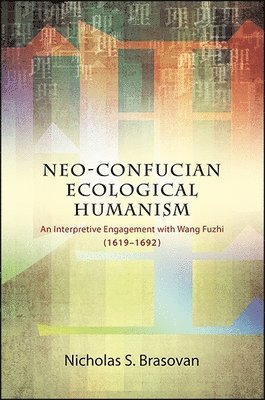




Du kanske också är intresserad av
- Nyhet
Del 7
- Nyhet
Del 4
- Nyhet
- Nyhet
Del 6
- Nyhet
Del 3
- Nyhet
Del 11
- Nyhet