
Del 64
Del i serien New Synthese Historical Library
Moment of Change
A Systematic History in the Philosophy of Space and Time
Inbunden, Engelska, 1998
3 289 kr
Beställningsvara. Skickas inom 10-15 vardagar. Fri frakt för medlemmar vid köp för minst 249 kr.
Finns i fler format (1)
This book is a systematic history of one of the oldest problems in the philosophy of space and time: How is the change from one state to its opposite to be described? To my knowledge it is the first comprehensive book providing information about and analysis of texts on this topic throughout the ages. The target audience I envisaged are advanced students and scholars of analytic philosophy and the history of philosophy who are interested in the philosophy of space and time. Authors treated in this book range from Plato, Aristotle, the logicians of the late Middle Ages, Kant, Brentano and Russell to contemporary authors such as Chisholm, Hamblin, Sorabji or Graham Priest, taking into account such theories as interval semantics or paraconsistent logic. For the first time, two main questions about the moment of change are explicitly kept apart: Which (if any) of the opposite states does the moment of change belong to? And does it contain an instantaneous event? The texts are discussed within a clear framework of the main systematic options for describing the moment of change, sometimes using predicate logic extended by newly introduced logical prefixes. The last part contains a new suggestion of how to solve the problem of the moment of change. It is centred around a theory of instantaneous states which provides a new solution to Zeno's Flying Arrow Paradox.
Produktinformation
- Utgivningsdatum1998-08-31
- Mått156 x 234 x 22 mm
- Vikt650 g
- FormatInbunden
- SpråkEngelska
- SerieNew Synthese Historical Library
- Antal sidor306
- Upplaga1998
- FörlagKluwer Academic Publishers
- ISBN9780792351207
Tillhör följande kategorier
Hoppa över listan

Mer från samma serie
Del 37
Del 39
Del 41
Del 42
Contingency and Freedom
Anthonie Vos Jaczn., Henri Veldhuis, Aline H. Looman-Graaskamp, E. Dekker, Nico W. den Bok
Inbunden, 1994
1 439 kr
Del 44
Del 46
Hoppa över listan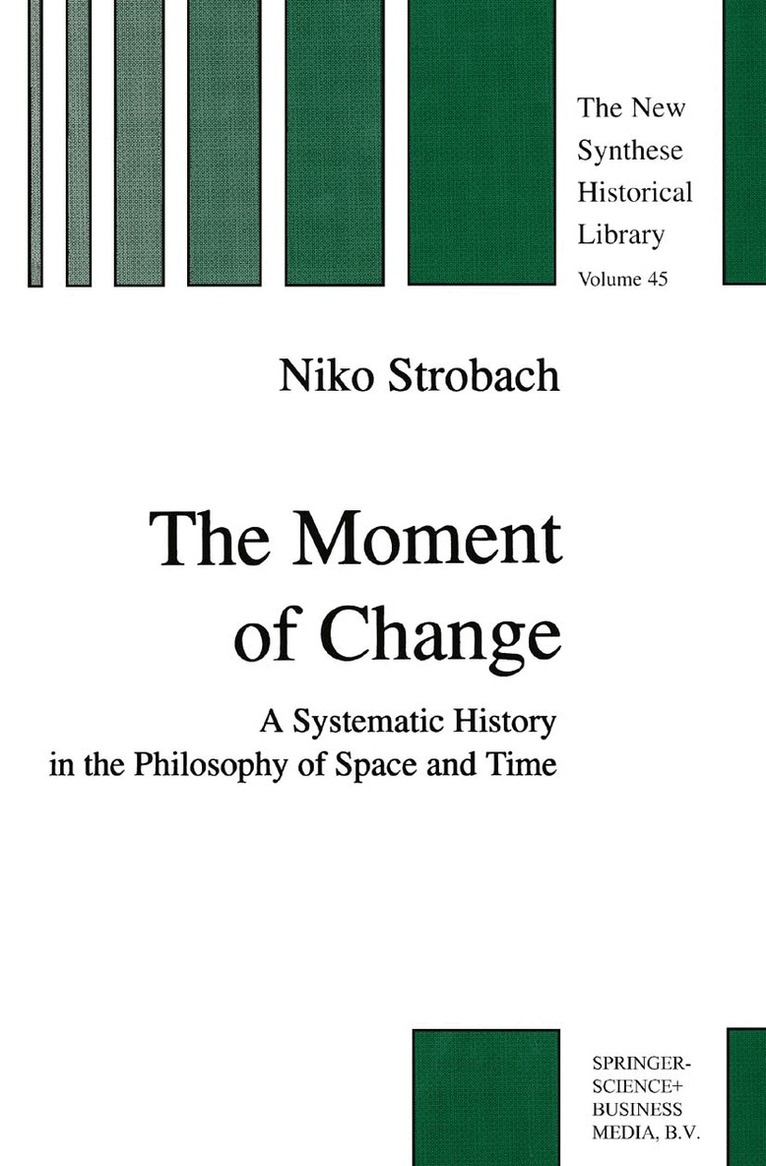








Du kanske också är intresserad av
Del 45
- Nyhet
Del 3
- Nyhet
Del 11
- Nyhet
- Nyhet
Del 6
- Nyhet
- Nyhet
Del 4
- Nyhet
- Nyhet
Del 3
- Nyhet
Del 4