
Del i serien Classics in Applied Mathematics
Methods of Mathematical Economics
Linear and Nonlinear Programming, Fixed-Point Theorems
Häftad, Engelska, 2002
1 089 kr
Beställningsvara. Skickas inom 5-8 vardagar. Fri frakt för medlemmar vid köp för minst 249 kr.
Finns i fler format (1)
Many advances have taken place in the field of combinatorial algorithms since this book first appeared two decades ago. Despite these advances and the development of new computing methods, several basic theories and methods remain important today for understanding mathematical programming and fixed-point theorems. In this easy-to-read classic, readers learn Wolfe's method, which remains useful for quadratic programming, and the Kuhn–Tucker theory, which underlies quadratic programming and most other nonlinear programming methods. In addition, the author presents multiobjective linear programming, which is being applied in environmental engineering and the social sciences.The book presents many useful applications to other branches of mathematics and to economics, and it contains many exercises and examples. The advanced mathematical results are proved clearly and completely. By providing the necessary proofs and presenting the material in a conversational style, Franklin made Methods of Mathematical Economics extremely popular among students. The addition of a list of errata, new to this edition, should add to the book's popularity as well as its usefulness both in the classroom and for individual study.
Produktinformation
- Utgivningsdatum2002-01-31
- Mått152 x 229 x 16 mm
- Vikt437 g
- FormatHäftad
- SpråkEngelska
- SerieClassics in Applied Mathematics
- Antal sidor315
- FörlagSociety for Industrial & Applied Mathematics,U.S.
- ISBN9780898715095
Tillhör följande kategorier
Hoppa över listan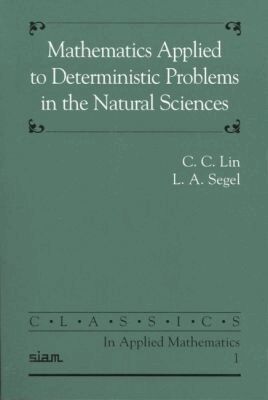
Mer från samma serie
Mathematics Applied to Deterministic Problems in the Natural Sciences
C.C. Lin, L.A. Segel
Häftad, 1988
1 289 kr
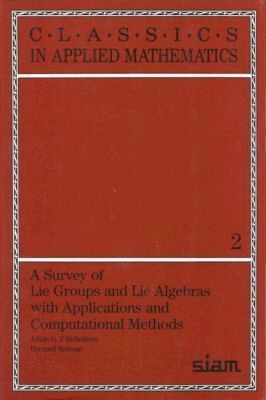
Survey of Lie Groups and Lie Algebras with Applications and Computational Methods
Johan G.F. Belinfante, Bernard Kolmon
Häftad, 1989
1 159 kr
Nonnegative Matrices in the Mathematical Sciences
Abraham Berman, Robert J. Plemmons
Häftad, 1994
1 029 kr
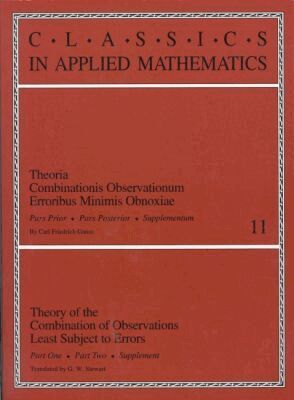
Theory of the Combination of Observations Least Subject to Errors
Carl Friedrich Gauss
Häftad, 1995
1 049 kr
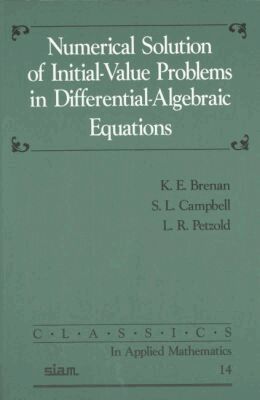
Numerical Solution of Initial-Value Problems in Differential-Algebraic Equations
K.E. Brenan, S.L. Campbell, L.R. Petzold
Häftad, 1996
1 069 kr
Hoppa över listan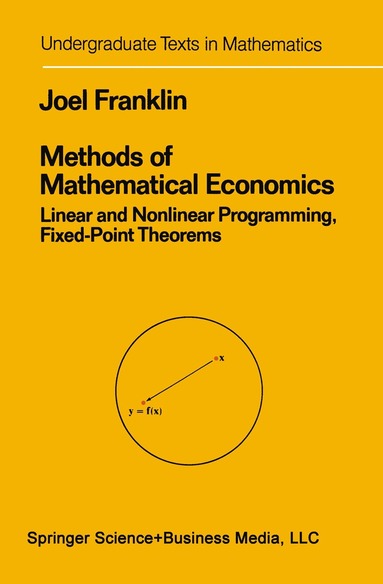








Du kanske också är intresserad av
- Nyhet
Del 6
- Nyhet
Del 3
- Nyhet
Del 7
- Nyhet
Del 4
- Nyhet
- Nyhet
Del 11
- Nyhet
- Nyhet
Del 3