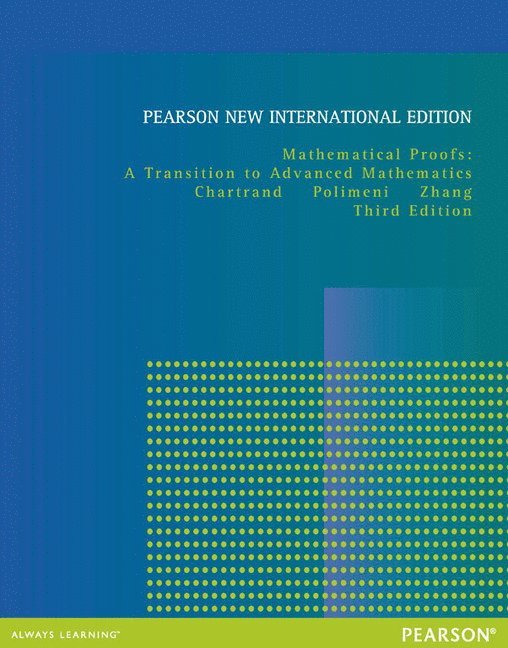
Mathematical Proofs
A Transition to Advanced Mathematics
Inbunden, Engelska, 2017
4 269 kr
Beställningsvara. Skickas inom 3-6 vardagar. Fri frakt för medlemmar vid köp för minst 249 kr.
For courses in Transition to Advanced Mathematics or Introduction to Proof.
Meticulously crafted, student-friendly text that helps build mathematical maturity
Mathematical Proofs: A Transition to Advanced Mathematics, 4th Edition introduces students to proof techniques, analyzing proofs, and writing proofs of their own that are not only mathematically correct but clearly written. Written in a student-friendly manner, it provides a solid introduction to such topics as relations, functions, and cardinalities of sets, as well as optional excursions into fields such as number theory, combinatorics, and calculus. The exercises receive consistent praise from users for their thoughtfulness and creativity. They help students progress from understanding and analyzing proofs and techniques to producing well-constructed proofs independently. This book is also an excellent reference for students to use in future courses when writing or reading proofs.
0134746759 / 9780134746753 Chartrand/Polimeni/Zhang, Mathematical Proofs: A Transition to Advanced Mathematics, 4/e
Produktinformation
- Utgivningsdatum2017-11-03
- Mått188 x 234 x 23 mm
- Vikt807 g
- FormatInbunden
- SpråkEngelska
- Antal sidor512
- Upplaga4
- FörlagPearson Education
- ISBN9780134746753
Tillhör följande kategorier
Gary Chartrand is Professor Emeritus of Mathematics at Western Michigan University. He received his Ph.D. in mathematics from Michigan State University. His research is in the area of graph theory. Professor Chartrand has authored or co-authored more than 275 research papers and a number of textbooks in discrete mathematics and graph theory as well as the textbook on mathematical proofs. He has given over 100 lectures at regional, national and international conferences and has been a co-director of many conferences. He has supervised 22 doctoral students and numerous undergraduate research projects and has taught a wide range of subjects in undergraduate and graduate mathematics. He is the recipient of the University Distinguished Faculty Scholar Award and the Alumni Association Teaching Award from Western Michigan University and the Distinguished Faculty Award from the State of Michigan. He was the first managing editor of the Journal of Graph Theory. He is a member of the Institute of Combinatorics and Its Applications, the American Mathematical Society, the Mathematical Association of America and the editorial boards of the Journal of Graph Theory and Discrete Mathematics. Albert D. Polimeni is an Emeritus Professor of Mathematics at the State University of New York at Fredonia. He received his Ph.D. degree in mathematics from Michigan State University. During his tenure at Fredonia he taught a full range of undergraduate courses in mathematics and graduate mathematics. In addition to the textbook on mathematical proofs, he co-authored a textbook in discrete mathematics. His research interests are in the area of finite group theory and graph theory, having published several papers in both areas. He has given addresses in mathematics to regional, national and international conferences. He served as chairperson of the Department of Mathematics for nine years. Ping Zhang is Professor of Mathematics at Western Michigan University. She received her Ph.D. in mathematics from Michigan State University. Her research is in the area of graph theory and algebraic combinatorics. Professor Zhang has authored or co-authored more than 200 research papers and four textbooks in discrete mathematics and graph theory as well as the textbook on mathematical proofs. She serves as an editor for a series of books on special topics in mathematics. She has supervised 7 doctoral students and has taught a wide variety of undergraduate and graduate mathematics courses including courses on introduction to research. She has given over 60 lectures at regional, national and international conferences. She is a council member of the Institute of Combinatorics and Its Applications and a member of the American Mathematical Society and the Association of Women in Mathematics.
- 0. Communicating Mathematics 0.1 Learning Mathematics0.2 What Others Have Said About Writing0.3 Mathematical Writing0.4 Using Symbols0.5 Writing Mathematical Expressions0.6 Common Words and Phrases in Mathematics0.7 Some Closing Comments About Writing1. Sets 1.1. Describing a Set1.2. Subsets1.3. Set Operations1.4. Indexed Collections of Sets1.5. Partitions of Sets1.6. Cartesian Products of SetsChapter 1 Supplemental Exercises2. Logic 2.1. Statements2.2. The Negation of a Statement2.3. The Disjunction and Conjunction of Statements2.4. The Implication2.5. More On Implications2.6. The Biconditional2.7. Tautologies and Contradictions2.8. Logical Equivalence2.9. Some Fundamental Properties of Logical Equivalence2.10. Quantified Statements2.11. Characterizations of StatementsChapter 2 Supplemental Exercises 3. Direct Proof and Proof by Contrapositive 3.1. Trivial and Vacuous Proofs3.2. Direct Proofs3.3. Proof by Contrapositive3.4. Proof by Cases3.5. Proof EvaluationsChapter 3 Supplemental Exercises 4. More on Direct Proof and Proof by Contrapositive 4.1. Proofs Involving Divisibility of Integers4.2. Proofs Involving Congruence of Integers4.3. Proofs Involving Real Numbers4.4. Proofs Involving Sets4.5. Fundamental Properties of Set Operations4.6. Proofs Involving Cartesian Products of SetsChapter 4 Supplemental Exercises 5. Existence and Proof by Contradiction 5.1. Counterexamples5.2. Proof by Contradiction5.3. A Review of Three Proof Techniques5.4. Existence Proofs5.5. Disproving Existence StatementsChapter 5 Supplemental Exercises6. Mathematical Induction 6.1 The Principle of Mathematical Induction6.2 A More General Principle of Mathematical Induction6.3 Proof By Minimum Counterexample6.4 The Strong Principle of Mathematical InductionChapter 6 Supplemental Exercises7. Reviewing Proof Techniques 7.1 Reviewing Direct Proof and Proof by Contrapositive7.2 Reviewing Proof by Contradiction and Existence Proofs7.3 Reviewing Induction Proofs7.4 Reviewing Evaluations of Proposed ProofsChapter 7 Supplemental Exercises8. Prove or Disprove 8.1 Conjectures in Mathematics8.2 Revisiting Quantified Statements8.3 Testing StatementsChapter 8 Supplemental Exercises9. Equivalence Relations 9.1 Relations9.2 Properties of Relations9.3 Equivalence Relations9.4 Properties of Equivalence Classes9.5 Congruence Modulo n9.6 The Integers Modulo nChapter 9 Supplemental Exercises10. Functions 10.1 The Definition of Function10.2 The Set of All Functions From A to B10.3 One-to-one and Onto Functions10.4 Bijective Functions10.5 Composition of Functions10.6 Inverse Functions10.7 PermutationsChapter 10 Supplemental Exercises11. Cardinalities of Sets 11.1 Numerically Equivalent Sets11.2 Denumerable Sets11.3 Uncountable Sets11.4 Comparing Cardinalities of Sets11.5 The Schröder - Bernstein TheoremChapter 11 Supplemental Exercises12. Proofs in Number Theory 12.1 Divisibility Properties of Integers12.2 The Division Algorithm12.3 Greatest Common Divisors12.4 The Euclidean Algorithm12.5 Relatively Prime Integers12.6 The Fundamental Theorem of Arithmetic12.7 Concepts Involving Sums of DivisorsChapter 12 Supplemental Exercises13. Proofs in Combinatorics 13.1 The Multiplication and Addition Principles13.2 The Principle of Inclusion-Exclusion13.3 The Pigeonhole Principle13.4 Permutations and Combinations13.5 The Pascal Triangle13.6 The Binomial Theorem13.7 Permutations and Combinations with RepetitionChapter 13 Supplemental Exercises14. Proofs in Calculus 14.1 Limits of Sequences14.2 Infinite Series14.3 Limits of Functions14.4 Fundamental Properties of Limits of Functions14.5 Continuity14.6 DifferentiabilityChapter 14 Supplemental Exercises15. Proofs in Group Theory 15.1 Binary Operations15.2 Groups15.3 Permutation Groups15.4 Fundamental Properties of Groups15.5 Subgroups15.6 Isomorphic GroupsChapter 15 Supplemental Exercises16. Proofs in Ring Theory (Online) 16.1 Rings16.2 Elementary Properties of Rings16.3 Subrings16.4 Integral Domains16.5 FieldsChapter 16 Supplemental Exercises17. Proofs in Linear Algebra (Online) 17.1 Properties of Vectors in 3-Space17.2 Vector Spaces17.3 Matrices17.4 Some Properties of Vector Spaces17.5 Subspaces17.6 Spans of Vectors17.7 Linear Dependence and Independence17.8 Linear Transformations17.9 Properties of Linear TransformationsChapter 17 Supplemental Exercises18. Proofs with Real and Complex Numbers (Online) 18.1 The Real Numbers as an Ordered Field18.2 The Real Numbers and the Completeness Axiom18.3 Open and Closed Sets of Real Numbers18.4 Compact Sets of Real Numbers18.5 Complex Numbers18.6 De Moivre's Theorem and Euler's FormulaChapter 18 Supplemental Exercises19. Proofs in Topology (Online) 19.1 Metric Spaces19.2 Open Sets in Metric Spaces19.3 Continuity in Metric Spaces19.4 Topological Spaces19.5 Continuity in Topological SpacesChapter 19 Supplemental Exercises Answers and Hints to Odd-Numbered Section ExercisesReferencesIndex of SymbolsIndex