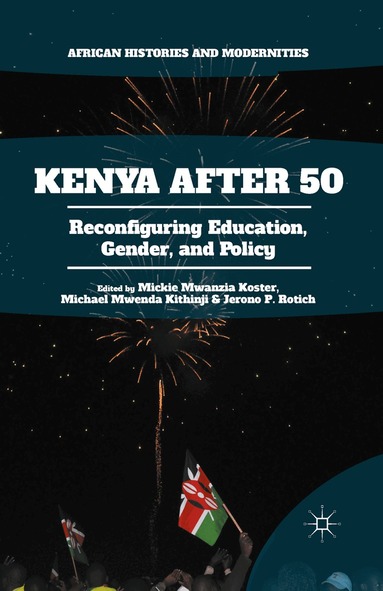
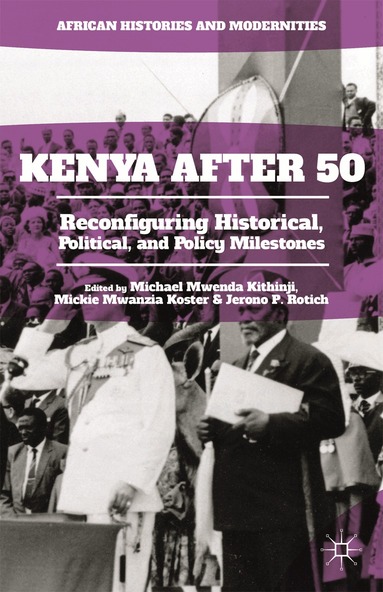
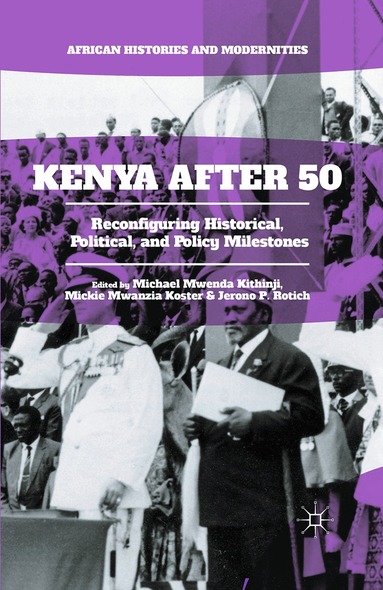
"The themes covered in the two volumes are critical in igniting a wider conversation and debate on the issues that have plagued postcolonial Kenya especially mediocre leadership, mismanagement of national resources, and corruption."Mary Njeri Kinyanjui PhD. Senior Research Fellow Institute for Development Studies, University of Nairobi, Nairobi "[These volumes] perhaps the most well documented evidence that Kenya Scholars and Studies Association (KESSA) has created a market place away from home where ideas regarding international research and development are exchanged."Faith Maina, Professor of Curriculum and Instruction, Texas Tech University, USA and KESSA regional representative, Southwest USA "By drawing on the expertise of a wide multidisciplinary team of contributors, the two volumes present us with a deeply informative examination of the country's history and memories, policies and politics, education, technology, and road safety policy, as well as contextualizing its sports and gender scene in the early twenty-first century."-Kefa M. Otiso, President, Kenya Scholars and Studies Association, USA Toyin Falola, University of Texas Austin I recommend that we offer an advance contract to Professors Kithinji, Mwanzia Koster, and Rotich for their manuscript. This manuscript critically examines Kenya's past achievements, present challenges, and future opportunities since a half a century of Independence. The manuscript is centered on this Kenya Golden Jubilee anniversary occurring on December 12, 2013 as a moment to reflect on the nation's postcolonial experience and also to evaluate its future prospects. The authors show that although Kenya's postcolonial experience is a mixed bag of momentous feats but also several missteps that on occasion have severely strained the national fabric. Significantly, the country has distinguished itself as the hub for commerce and industry in East and Central Africa, and has mostly avoided destructive civil strife. Further, the new constitution promulgated in 2010 has been a source of confidence and optimism for a better future. Nevertheless, Kenya is confronted with many challenges the most significant being the inability to generate enough jobs for its youth, severe ethnic differences largely nurtured by the political class, and widespread corruption. This recommended manuscript builds and expands this study by uniquely looking at the Golden Jubilee moment through an interdisciplinary view that provides a much bigger picture of the complexity of Kenya while making it appealing to a variety of different audiences. Drawing from different disciplines and perspectives, the manuscript addresses three important questions: 1) What precisely has Kenya achieved in half a century of independence? 2) What challenges has the nation faced in the last 50 years, and what lessons can be learned from these experiences going forward? 3) What will the next 50 years look like? The last book that attempted to explore the dynamics of Kenya since Independence was published in 2011. In this book, Kenya: Between Hope and Despair, 1963-2011, Daniel Branch treats the political history of Kenya from independence to 2011. Unlike Branch's study of a Kenya between hope and despair, the authors and contributors conceptualize Kenya in terms of its milestones, challenges, and prospects, arguing for a Kenya well positioned to prosper despite many obstacles. Overall, this work promises to offer a scholarly and fruitful conversation on postcolonial Kenya. This edited collection of chapters will also illuminate the lessons learned from the challenges and hopes to give an overview of what Kenya will look like in the next 50 years. This interdisciplinary book project promises to be a handy reference source for scholars and researchers in institutions of higher learning. The perspectives and issues raised in the manuscript are relevant and central to issues of Kenya and postcolonial Africa in general. Through the different historical and cultural dimensions, the chapters reveal the tensions of a country that is still in a state of flux based on their colonial past.