
Del i serien Josef Frank Writings
Josef Frank Writings
Volumes 1-2
Inbunden, Engelska, 2026
1 619 kr
Kommande
A two-volume compendium of Josef Frank’s culturally critical, often witty and biting texts on modernism and architecture, offered for the first time in a complete bilingual edition alongside many of the original illustrations.For more than five decades, from the 1910s to the early 1960s, Josef Frank was one of the leading figures of Modernism and, at the same time, one of its sharpest critics. In his many essays and articles, as well as in his book Architecture as Symbol, Frank sought to expose the layers of meaning—and the flaws—of Modernism, its underlying assumptions, and what he viewed as its often misguided implementations. Above all, this internationally renowned architect strove to reclaim for modern design some of the freedom it had lost through its dogmatization.Editors Tano Bojankin, Christopher Long, and Iris Meder, along with award-winning Austrian designer Peter Duniecki, have compiled all available published texts by Josef Frank on these subjects into a beautiful, highly readable, collectible German/English two-volume set. Introduced by one of America's leading architects, Denise Scott Brown, the extensive written oeuvre of Josef Frank is made accessible to both bibliophiles and a wider public interested in modernism, architecture, and one of its most influential critics.
Produktinformation
- Utgivningsdatum2026-10-22
- Mått177 x 254 x 76 mm
- Vikt2 422 g
- FormatInbunden
- SpråkEngelska
- SerieJosef Frank Writings
- Antal sidor900
- FörlagDoppelHouse Press
- MedarbetarePeter Duniecki
- ISBN9781954600492
- ÖversättareBrian Dorsey
Tillhör följande kategorier
Hoppa över listan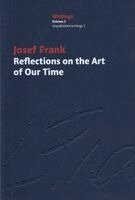
Mer från samma författare
Nichtstationäre Vorgänge in den Zuleitungs- und Ableitungskanälen von Wasserkraftwerken
Josef Frank
Häftad, 2013
809 kr
Schwingungen in den Zuleitungs- und Ableitungskanälen von Wasserkraftanlagen
Josef Frank, Josef Schüller
Häftad, 1938
939 kr