Beställningsvara. Skickas inom 5-8 vardagar. Fri frakt för medlemmar vid köp för minst 249 kr.
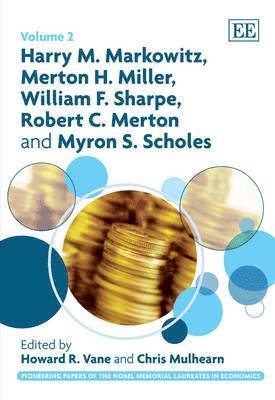
This groundbreaking series brings together a critical selection of key papers by the Nobel Memorial Laureates in Economics that have helped shape the development and present state of economics. The editors have organised this comprehensive series by theme and each volume focuses on those Laureates working in the same broad area of study. The careful selection of papers within each volume is set in context by an insightful introduction to the Laureates’ careers and main published works. This landmark series will be an essential reference for scholars throughout the world.
Edited by Howard R. Vane, Emeritus Professor of Economics, Liverpool Business School, Liverpool John Moores University, UK and Chris Mulhearn, formerly Reader in Economics, Liverpool Business School, Liverpool John Moores University, UK
Contents:AcknowledgementsGeneral IntroductionHoward R. Vane and Chris MulhearnPART IJAMES A. MIRRLEES Introduction to Part I: James A. Mirrlees (b. 1936)1. J.A. Mirrlees (1971), ‘An Exploration in the Theory of Optimum Income Taxation’2. Peter A. Diamond and James A. Mirrlees (1971a), ‘Optimal Taxation and Public Production I: Production Efficiency’3. Peter A. Diamond and James A. Mirrlees (1971b), ‘Optimal Taxation and Public Production II: Tax Rules’4. J.A. Mirrlees (1974), ‘Notes on Welfare Economics, Information and Uncertainty’5. James A. Mirrlees (1976), ‘The Optimal Structure of Incentives and Authority within an Organization’6. James A. Mirrlees (1997), ‘Information and Incentives: The Economics of Carrots and Sticks’PART II WILLIAM S. VICKREY Introduction to Part II: William S. Vickrey (1914-96)7. William Vickrey (1939), ‘Averaging of Income for Income-Tax Purposes’8. William Vickrey (1945), ‘Measuring Marginal Utility by Reactions to Risk’9. William S. Vickrey (1955), ‘A Proposal for Revising New York’s Subway Fare Structure’10. William Vickrey (1961), ‘Counterspeculation, Auctions, and Competitive Sealed Tenders’11. William S. Vickrey (1962), ‘Auction and Bidding Games’12. William Vickrey (1992), ‘Federal Tax Policy for the 1990’s: An Updated Agenda for Progressive Taxation’PART IIIGEORGE A. AKERLOF Introduction to Part III: George A. Akerlof (b. 1940)13. George A. Akerlof (1970), ‘The Market for “Lemons”: Quality Uncertainty and the Market Mechanism’14. George Akerlof (1976), ‘The Economics of Caste and of the Rat Race and Other Woeful Tales’15. George A. Akerlof (1980), ‘A Theory of Social Custom, of Which Unemployment May Be One Consequence’16. George A. Akerlof (1982), ‘Labor Contracts as Partial Gift Exchange’17. George A. Akerlof and Janet L. Yellen (1985), ‘A Near-Rational Model of the Business Cycle, with Wage and Price Inertia’18. George A. Akerlof and Janet L. Yellen (1990), ‘The Fair Wage-Effort Hypothesis and Unemployment’PART IVA. MICHAEL SPENCE Introduction to Part IV: A. Michael Spence (b.1943)19. Michael Spence (1973), ‘Job Market Signaling’20. Michael Spence (1974), ‘Competitive and Optimal Responses to Signals: An Analysis of Efficiency and Distribution’21. Michael Spence (1976), ‘Product Selection, Fixed Costs, and Monopolistic Competition’22. A. Michael Spence (1977), ‘Entry, Capacity, Investment and Oligopolistic Pricing’23. Michael Spence (1984), ‘Cost Reduction, Competition, and Industry Performance’24. Michael Spence (2002), ‘Signaling in Retrospect and the Informational Structure of Markets’PART VJOSEPH E. STIGLITZ Introduction to Part V: Joseph E. Stiglitz (b. 1943)25. Joseph E. Stiglitz (1974), ‘Incentives and Risk Sharing in Sharecropping’26. Michael Rothschild and Joseph Stiglitz (1976), ‘Equilibrium in Competitive Insurance Markets: An Essay on the Economics of Imperfect Information’27. Sanford J. Grossman and Joseph E. Stiglitz (1980), ‘On the Impossibility of Informationally Efficient Markets’28. Joseph E. Stiglitz and Andrew Weiss (1981), ‘Credit Rationing in Markets with Imperfect Information’29. Carl Shapiro and Joseph E. Stiglitz (1984), ‘Equilibrium Unemployment as a Worker Discipline Device’30. Bruce C. Greenwald and Joseph E. Stiglitz (1986), ‘Externalities in Economies with Imperfect Information and Incomplete Markets’
’What a brilliant idea! To provide readers with both information on the Nobel Laureates in Economics and, to the degree possible, the original papers for which they were honored. The names of the "contributing" Laureates speak for themselves. Howard Vane and Chris Mulhearn, the editors, and Edward Elgar, the publisher, are to be congratulated for putting the idea into effect.'